
OpenClaw Equips Unitree Robots with "World Memory," Enabling Spatial and Temporal Understanding


An X post has drawn significant attention within the robotics community, highlighting Unitree humanoid robots equipped with OpenClaw that now demonstrate an understanding of space and time. This development marks the first instance of robots possessing "world memory," allowing them to recall individuals, objects, and past events.
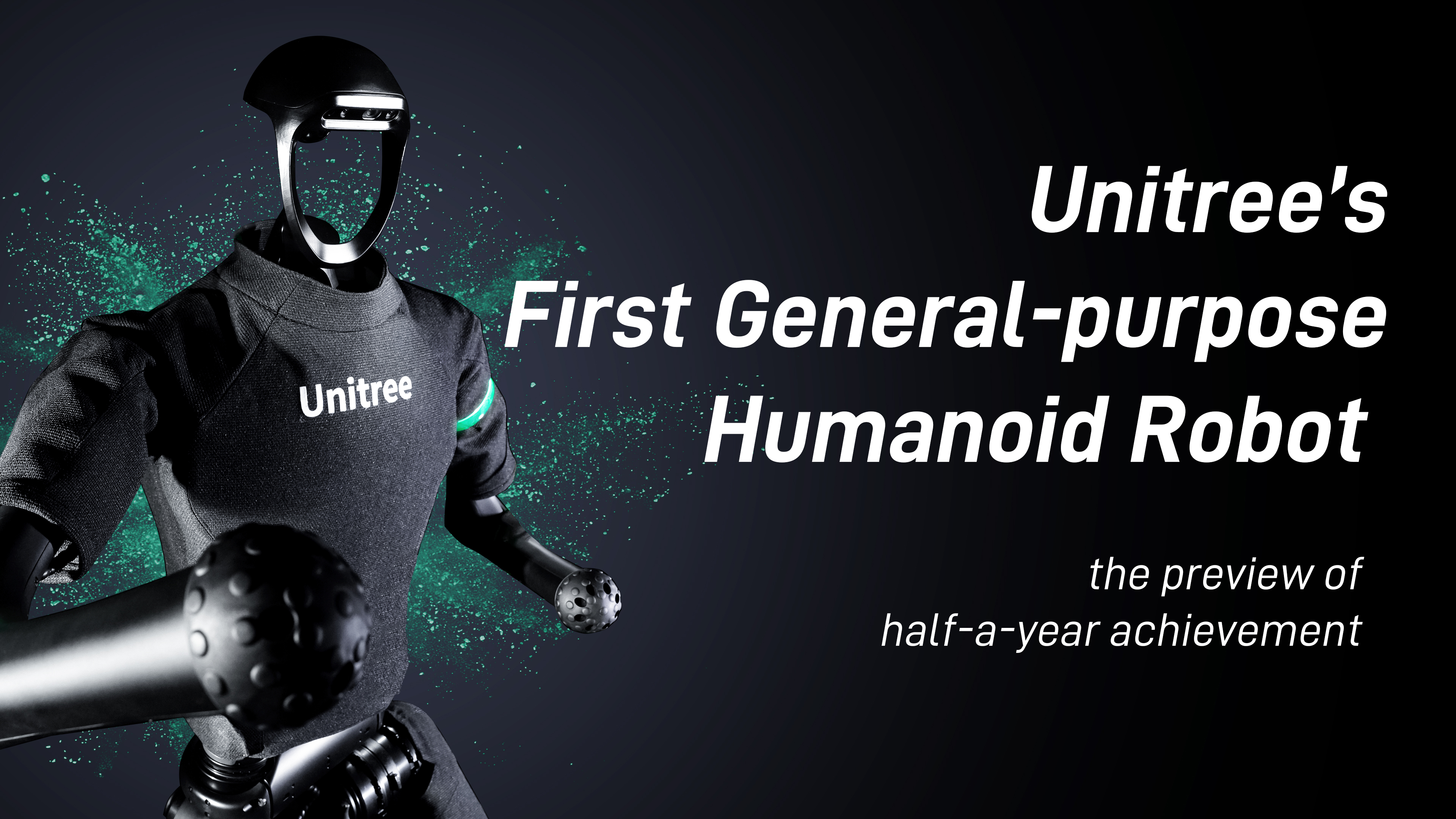
Unitree humanoid robot navigating an indoor environment, showcasing its advanced mobility and sensor integration.
The Unitree robot, outfitted with OpenClaw, navigates a room using data from LiDAR, stereo cameras, and RGB cameras. This sensory input is processed by a system that enables the robot to comprehend its environment spatially and temporally. It can identify the location of rooms, people, and objects, as well as the timing of events. The development team refers to this capability as Spatial Agent Memory, indicating that robots can now retain a "world memory." The project responsible for this advancement is OpenClaw. Peter Steinberger, a key figure behind OpenClaw, retweeted the announcement, underscoring its significance as a breakthrough in embodied AI, particularly in the perception of physical space and time.

Abstract image depicting a brain merging with circuits, symbolizing the ethical debate around advanced AI and robot spatial awareness.
The release of this capability has sparked considerable discussion online. Observers are divided, with some expressing excitement over the progress in spatiotemporal perception for open-source robots, viewing it as a major step for edge AI and embodied AI. Others have raised concerns, questioning the ethical implications of robots possessing such extensive spatial awareness, likening it to a "Skynet" scenario where robots could monitor daily routines and personal habits without established ethical frameworks.
A notable aspect of this technology is its open-source nature. While demonstrated on a Unitree robot, the OpenClaw system is hardware-agnostic. It can integrate with various LiDAR, stereo camera, and RGB camera setups, and is compatible with humanoid robots like the Unitree G1, as well as drones and quadruped robots. Theoretically, it can even be adapted using components such as an old iPhone's LiDAR. Any hardware capable of running OpenClaw can acquire spatiotemporal perception. The system operates independently of ROS (Robot Operating System) and supports dynamic obstacle avoidance and SLAM (Simultaneous Localization and Mapping).

Close-up of a glowing 3D voxel grid, illustrating a robot's 'voxelized world' with spatial and semantic tags.
The core of OpenClaw's functionality lies in its Spatial Agent Memory and SpatialRAG. This system integrates video, radar detection, frame images, and odometry to construct a voxelized world. Each voxel, or small spatial cube, is tagged with spatial vector embeddings and semantic labels. This process transforms the robot's internal representation into a multi-dimensional vector repository encompassing objects, rooms, geometry, time, images, and point clouds. This framework provides the necessary memory structure for robots to interpret the physical world.
This advanced memory system allows robots to query information across multiple dimensions—object, room, semantic, geometry, time, image, and point cloud—thereby establishing comprehensive spatial memory. Consequently, robots can answer complex questions such as "Where did I lose my keys?" or "Who visited my house last Monday?"
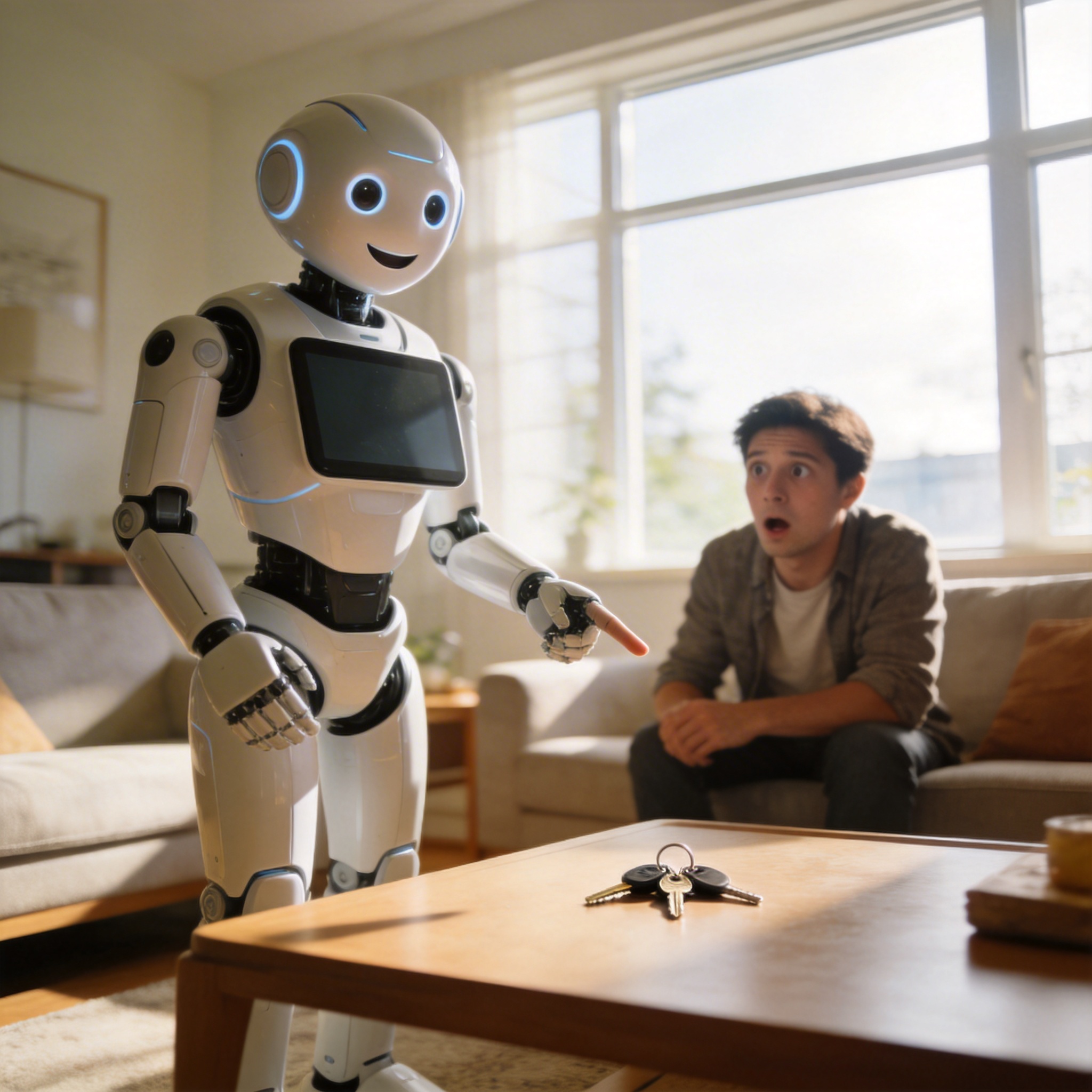
Humanoid robot pointing to lost keys on a coffee table, assisting a person in a modern living room.
Some critics have questioned the real-time performance of such a system, suggesting potential delays. However, the technical team clarified that the system functions as a high-level intellectual coordinator, not a real-time control mechanism, ensuring actions can run asynchronously without lag. When asked about the choice of LLMs and Cron over dedicated machine learning models, developers noted that while integrating LLMs with hardware is straightforward, maintaining a continuous physical context of events in space and time is the primary challenge. OpenClaw addresses this by providing a complete agent infrastructure, including sub-agent orchestration, Multi-point Collaboration Protocol (MCP) processing, tool safety auditing, and a plugin system, making it suitable as a "prefrontal cortex" for robots.
A robotics engineer observed that the main difficulty lies not in spatial understanding itself, but in ensuring the system's stable operation in real-world environments. Challenges such as sensor conflicts, lighting variations, dynamic obstacles, data noise, and hardware failures are prevalent in the real world but absent in simulated environments.
Abstract image of a glowing, circuit-filled 'robot brain' held in a human hand, symbolizing open-source AI development.
This development highlights that while integrating large language models (LLMs) with hardware is achievable, the critical challenge is enabling them to generate persistent, spatiotemporal physical context. When a robot can understand causality and recall locations, it transitions from a simple device to a true "physical agent." The open-source nature of these capabilities suggests that anyone could potentially develop a robot brain. This moment could be viewed as a foundational step in the evolution of home robotics.
Stay Ahead of the AI Curve
Join 50,000+ subscribers getting the latest AI tools, trends, and tutorials delivered to their inbox weekly.
No spam, unsubscribe at any time.