
OpenAI Unveils GPT-5.4 Mini and Nano Models, Offering Enhanced Performance at Reduced Costs


OpenAI has released two new language models, GPT-5.4 mini and GPT-5.4 nano, designed to offer high performance, speed, and cost-efficiency. The models were launched without prior announcement, with OpenAI emphasizing their suitability for real-world production environments where rapid, accurate, and economical AI solutions are critical.
These new models incorporate core features from the GPT-5.4 series, focusing on speed and cost reduction. GPT-5.4 mini and nano aim to provide advanced capabilities in a lightweight format.

Server rack with glowing lights, one unit highlighted, symbolizing efficient AI models.
Performance and Cost Efficiency
In coding tasks, GPT-5.4 mini achieved a 54.4% score on the SWE-Bench Pro benchmark, closely approaching the full GPT-5.4 model's 57.7%. For computer usage, measured by OSWorld-Verified, GPT-5.4 mini scored 72.1%, compared to GPT-5.4's 75%. The mini model also shows capabilities in reasoning and tool calling that are comparable to the full GPT-5.4. Furthermore, GPT-5.4 mini operates at twice the speed of its predecessor, GPT-5 mini.
The GPT-5.4 mini model features a 400k context window, with input priced at $0.75 per million tokens and output at $4.50 per million tokens. The GPT-5.4 nano model is priced at $0.20 per million tokens for input and $1.25 per million tokens for output. Compared to GPT-5.4, the mini model's output price is one-third, and the nano model's price is one-twelfth.

Digital interface showing code and performance graphs, symbolizing coding task efficiency.
Advancements in Coding and Reasoning
The SWE-Bench Pro benchmark, which evaluates models on their ability to fix real software bugs from GitHub, demonstrated GPT-5.4 mini's strong coding performance. Its 54.4% score was only 3.3 percentage points below the flagship GPT-5.4. This marks a significant improvement over the previous generation GPT-5 mini, which scored 45.7%. On the Terminal-Bench 2.0, GPT-5.4 mini scored 60.0%, a substantial increase from GPT-5 mini's 38.2%. Even the GPT-5.4 nano model achieved 52.4% on SWE-Bench Pro, surpassing the previous generation's mini model.
In reasoning tasks, GPT-5.4 mini scored 88% on the GPQA Diamond benchmark, a doctoral-level scientific reasoning test, trailing GPT-5.4 by 5 percentage points. Its tool-calling capabilities were also highlighted, with a 42.9% score on Toolathlon, which assesses performance in complex multi-step toolchains. This compares to GPT-5 mini's 26.9%. On the telecom industry-specific τ2-bench, mini achieved 93.4%, close to GPT-5.4's 98.9%, and significantly higher than GPT-5 mini's 74.1%.

Hands interacting with a holographic interface showing a complex network, symbolizing reasoning and tool-calling.
Computer Usage and Agent Paradigms
GPT-5.4 mini achieved 72.1% on OSWorld-Verified, a benchmark for visual understanding, reasoning, and operation in computer usage, with GPT-5.4 scoring 75.0%. This represents a near doubling of capability compared to GPT-5 mini's 42.0%. However, GPT-5.4 nano scored 39.0% on this test, indicating a capability gap in visual reasoning for smaller models. On MMMUPro, which includes Python tools, mini scored 78.0%, close to the flagship's 81.5%. These results suggest potential for AI Agents that can parse UI screenshots and make operational decisions with low latency.
OpenAI's architectural concept proposes using the flagship GPT-5.4 for planning and decision-making, while GPT-5.4 mini sub-agents handle specific execution tasks such as code repository searches, file reviews, and document processing. This "layered scheduling" approach, already implemented in Codex, allows developers to run more tasks with the same budget, as mini models consume less quota.
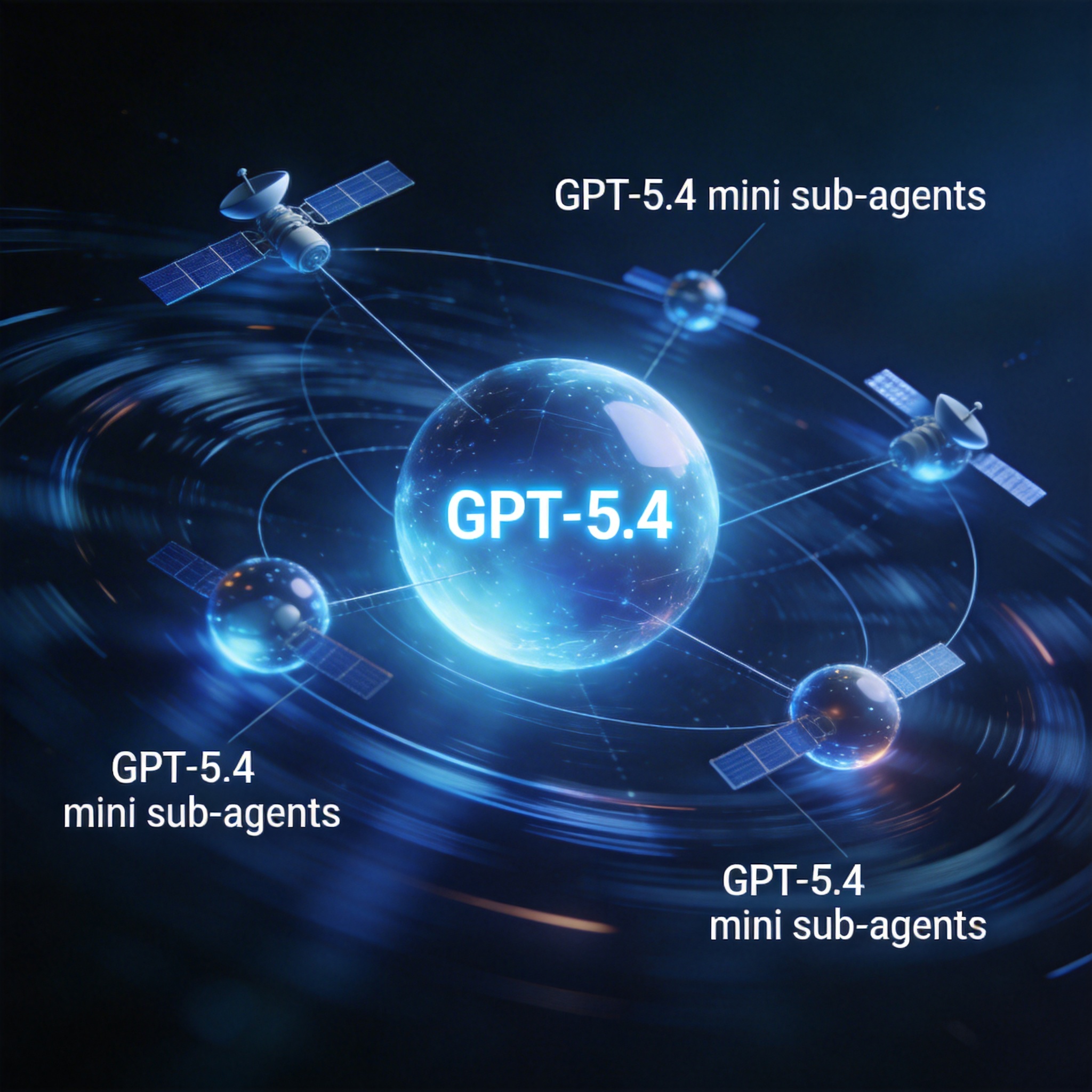
Abstract layered architecture with a central orb and smaller orbiting orbs, symbolizing AI agent paradigms.
Availability and Limitations
GPT-5.4 mini is now available via API, Codex, and ChatGPT. Its API pricing is $0.75/million tokens for input and $4.50/million tokens for output, with a 400K context window. It supports text and image input, tool use, function calling, web search, file search, and computer usage. GPT-5.4 nano is available only through the API, priced at $0.20/million tokens for input and $1.25/million tokens for output, offering cost-effectiveness for high-frequency, low-complexity tasks.
Free and Go ChatGPT users can access GPT-5.4 mini through the "Thinking" feature. Paid users will have mini as a fallback option when their GPT-5.4 Thinking quota is depleted.
Despite its strengths, GPT-5.4 mini shows limitations in long context processing. OpenAI MRCR v2 tests revealed a significant performance gap between mini and the flagship version in tasks requiring information retrieval and logical tracking over ultra-long texts. For example, in an 8-pin search task within a 128K-256K window, GPT-5.4 scored 79.3%, while mini scored 33.6%. This indicates that for large-scale document analysis or long conversation memory, GPT-5.4 remains the preferred choice.

Digital representation of an information gap, with dense data on one side and sparse data on the other.
The introduction of these models reflects an industry trend toward specialized models for different tasks, with flagship models defining intelligence ceilings and smaller models facilitating broader AI application.
Stay Ahead of the AI Curve
Join 50,000+ subscribers getting the latest AI tools, trends, and tutorials delivered to their inbox weekly.
No spam, unsubscribe at any time.