
OpenAI Shifts Focus to ChatGPT, Prompting Veteran Departures and Research Cuts

OpenAI is undergoing a significant strategic shift, moving its core resources from long-term exploratory research to the engineering enhancement of its flagship product, ChatGPT. This pivot has led to the departure of several key veterans, including former Vice President of Research Jerry Tworek, and has marginalized non-core large model projects like Sora.
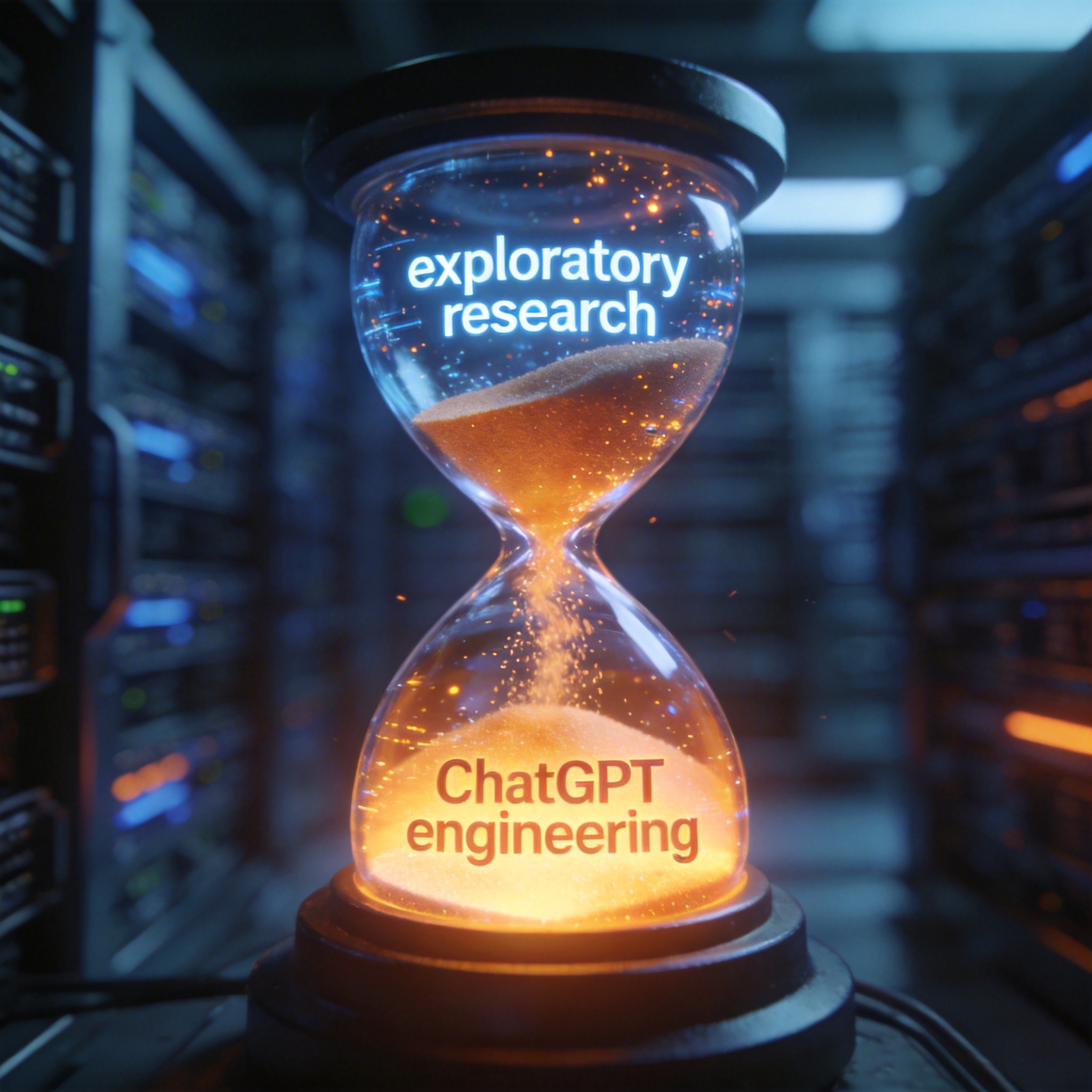
Digital hourglass with data flowing from 'exploratory research' to 'ChatGPT engineering'.
The company's reorientation comes as it faces a valuation of $500 billion and increased competition from rivals such as Anthropic and Google. This strategic adjustment marks a retreat from OpenAI's founding idealism, which once emphasized "benefiting all humanity" through Artificial General Intelligence (AGI).
Internal Resource Reallocation and Research Prioritization
The internal reallocation of resources has concentrated computing power, data, and algorithmic engineering talent on ChatGPT. According to internal sources, this move is intended to compete in a "cutthroat" arms race. An insider stated that OpenAI now treats language models purely as an engineering problem, focusing on continuous expansion of computing power, algorithm stacking, and data feeding to extract performance improvements.

Intensely lit section of a server rack, symbolizing concentrated computing power.
This shift has sidelined basic research and exploratory projects that do not directly generate revenue. Teams working on projects like Sora (video generation) and DALL-E (image generation) are reportedly experiencing neglect and resource depletion, as they are deemed "not closely related" to ChatGPT's core strategy. An employee noted that pursuing cutting-edge, exploratory research has become challenging within the current OpenAI structure, with non-ChatGPT projects often treated as "second-class citizens."
Veteran Departures Amid Ideological Differences
The strategic changes have prompted the departure of several long-serving researchers. Jerry Tworek, who served as OpenAI's Vice President of Research for seven years and was a core figure in ChatGPT's "reasoning" research, left the company in January. His departure was reportedly driven by a collapse of his belief in "basic research." Tworek advocated for "Continuous Learning"—a method for models to retain existing knowledge while absorbing new data, considered a path to AGI—but found it did not align with OpenAI's current revenue-generating pace.

A thoughtful man in a professional setting, symbolizing a researcher contemplating his beliefs.
Insiders indicated that Tworek's requests for computing power and personnel support were repeatedly denied. His conflict with Chief Scientist Jakub Pachocki, who favored existing large language model architectures for quicker results, highlighted a divergence in values: one focused on scientific unknowns and the other on commercial viability.
Other departures include Andrea Vallone, who researched model policy and user psychological dependence on ChatGPT, and economist Tom Cunningham, who suggested OpenAI was deviating from neutral research in favor of public relations. A former senior employee expressed that while the company theoretically supports various research, resource allocation is heavily biased towards core projects.
Developer Paradigm Shift and Market Dynamics
The evolving landscape of AI tools is also impacting software development. Marcelo De Santis, former Chief Digital Officer at ThoughtWorks, observed a "hockey stick" growth curve for Anthropic's Claude in AI programming tools. He noted that engineers prioritize usability and effectiveness, often switching tools based on performance rather than brand loyalty.

Developer's hands orchestrating AI agents on a holographic interface, symbolizing 'Agent Engineering'.
This shift suggests that the core competency for developers is moving from writing code line-by-line to orchestrating AI agents. Andrej Karpathy, for example, reported that his programming workflow has shifted from 80% manual coding and 20% AI-generated code to the reverse. Peter Steinberger, developer of OpenClaw, described current development as "Agent Engineering," where he uses multiple AI agents in parallel to complete tasks.
While OpenAI's Codex remains a favored tool for some, including Steinberger and OpenAI CEO Sam Altman, the broader trend indicates that developers will increasingly rely on AI to automate coding, requiring them to master systemic thinking and command AI tools effectively. This evolving dynamic presents both a challenge and an opportunity for OpenAI to regain market share amidst intense competition.
Stay Ahead of the AI Curve
Join 50,000+ subscribers getting the latest AI tools, trends, and tutorials delivered to their inbox weekly.
No spam, unsubscribe at any time.