
OpenAI's GPT-5.4 Achieves Native Computer Control, Surpassing Human Baseline in Desktop Operations

OpenAI has released GPT-5.4, introducing native computer control capabilities that enable the model to operate a wide range of applications on a computer. This development is anticipated to significantly influence the AI Agent landscape.
The new model is integrated into OpenAI's web version and Codex. Initial tests indicate GPT-5.4 can manage files, programs, archives, and terminals, performing tasks typically handled by human users. For instance, it can interact with a MacBook's calendar to set reminders or open and operate applications like Xiaoyuzhou and Calculator directly. It can also modify computer wallpapers and execute commands within the terminal.

MacBook keyboard with calendar and calculator apps open, showing AI interaction.
Peter, the creator of OpenClaw, noted significant improvements in GPT-5.4's programming capabilities and overall intelligence. Matt Shumer, CEO of HyperWriteAI and OthersideAI, described GPT-5.4 as "incredible, beyond imagination," asserting its performance surpasses previous professional models even in standard mode. Sebastien Bubeck, a distinguished scientist at OpenAI, used a meme to illustrate the model's enhanced programming abilities. Brenda, CEO of Mercor AI, suggested GPT-5.4 could soon exceed the professional capacities of top consulting firms, investment banks, and law firms.
Native Computer Control Capabilities
GPT-5.4 is the first general model from OpenAI to feature native computer usage. It identifies screen content via screenshots and issues mouse clicks and keyboard inputs to operate software in a desktop environment without requiring external frameworks or adaptation layers.
In the OSWorld-Verified benchmark, which assesses AI navigation in a desktop environment, GPT-5.4 achieved a 75.0% success rate. This compares to GPT-5.2's 47.3% and a human baseline of 72.4%, indicating GPT-5.4's ability to control a computer now exceeds that of an average human user.
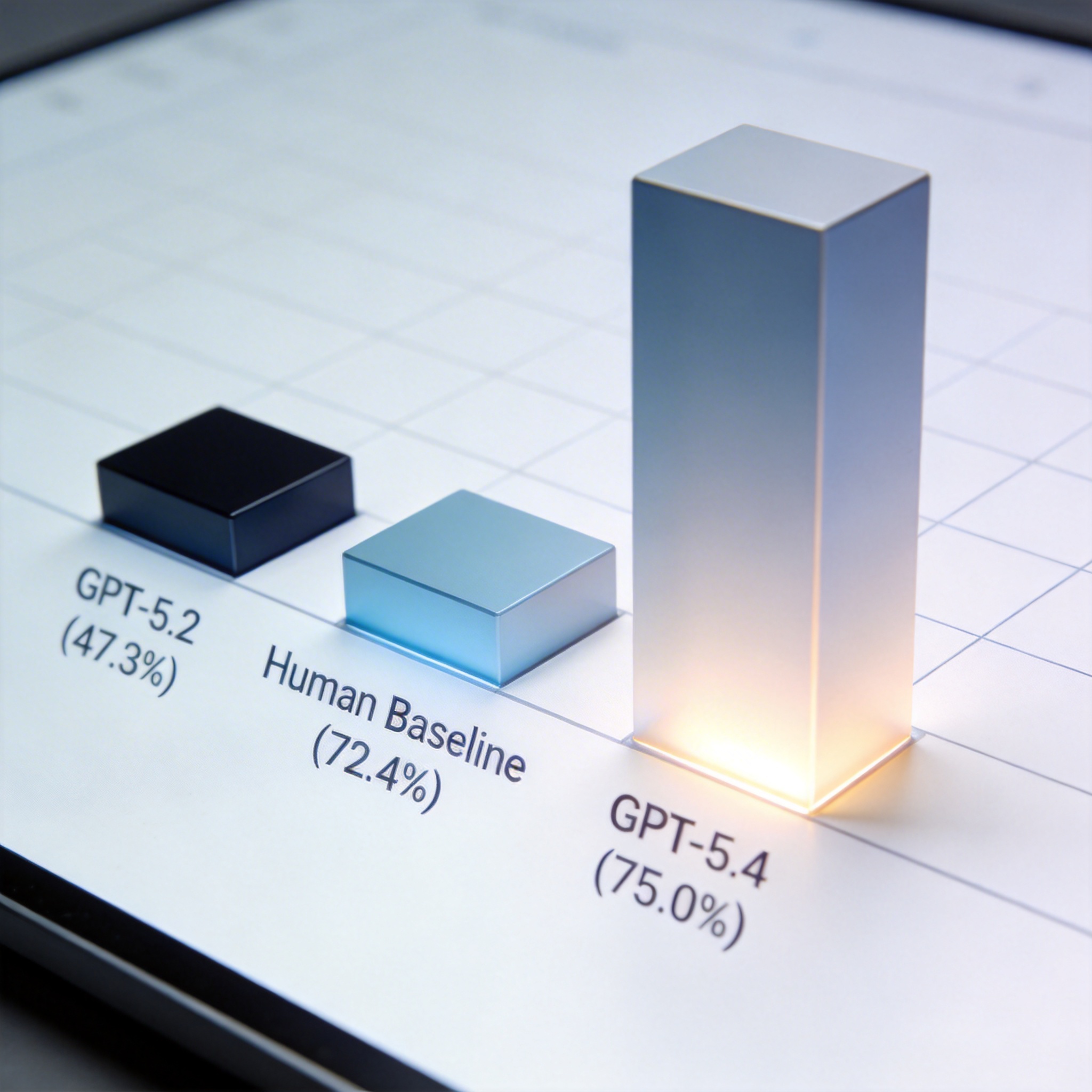
Bar chart showing GPT-5.4 surpassing human baseline in desktop navigation success rate.
Integration with OpenClaw
GPT-5.4 is considered particularly well-suited for OpenClaw, an open-source personal AI assistant project. OpenClaw, developed by PSPDFKit founder Peter Steinberger, gained rapid popularity in January 2026 for its ability to perform tasks on a user's computer, including executing terminal commands, writing scripts, and managing emails.
Peter Steinberger has previously stated that OpenClaw's effectiveness is highly dependent on the underlying AI model, recommending the use of the "strongest, latest-generation model." Community feedback suggests a substantial performance difference when OpenClaw is run with advanced models compared to lower-end alternatives. Peter recommends upgrading OpenClaw to version 5.4 and pairing it with GPT-5.4.
GPT-5.4's native computer control aligns with OpenClaw's core function of enabling AI to operate computers. Its 1 million token context window allows OpenClaw to maintain long conversations and manage complex tasks, addressing previous limitations where the system would forget past instructions.
The model's Tool Search mechanism optimizes efficiency for Agents by allowing on-demand tool usage, which can reduce token consumption and API costs. Furthermore, GPT-5.4's enhanced reasoning ability, which surpasses 83% of human experts in professional tasks, enables OpenClaw to handle more complex and high-value work scenarios. OpenClaw's official documentation already provides configuration solutions for GPT-5.4 integration, and OpenAI's Responses API supports it.
Interconnected digital network symbolizing OpenClaw and GPT-5.4 integration.
The Shift to Intelligent Agent AI
The introduction of GPT-5.4 represents a shift in the AI industry from conversational AI to intelligent agent AI. The model's capacity to independently control a computer more proficiently than an average person and to rival industry experts in a significant percentage of professional scenarios marks a qualitative change in AI capabilities.
Open-source Agent frameworks like OpenClaw are positioned to translate these capabilities into practical productivity. The combination of GPT-5.4 and OpenClaw illustrates a pathway from the concept of a personal AI employee to a tangible reality.
Stay Ahead of the AI Curve
Join 50,000+ subscribers getting the latest AI tools, trends, and tutorials delivered to their inbox weekly.
No spam, unsubscribe at any time.