
OpenAI Introduces GPT-5.4 with Native Computer Control and Enhanced Reasoning

OpenAI has released its next-generation flagship model, GPT-5.4, which introduces native computer usage capabilities and demonstrates significant advancements in reasoning, programming, and visual perception. The launch follows a period of competition with models like Gemini 3.1 Pro and Claude Opus 4.6.
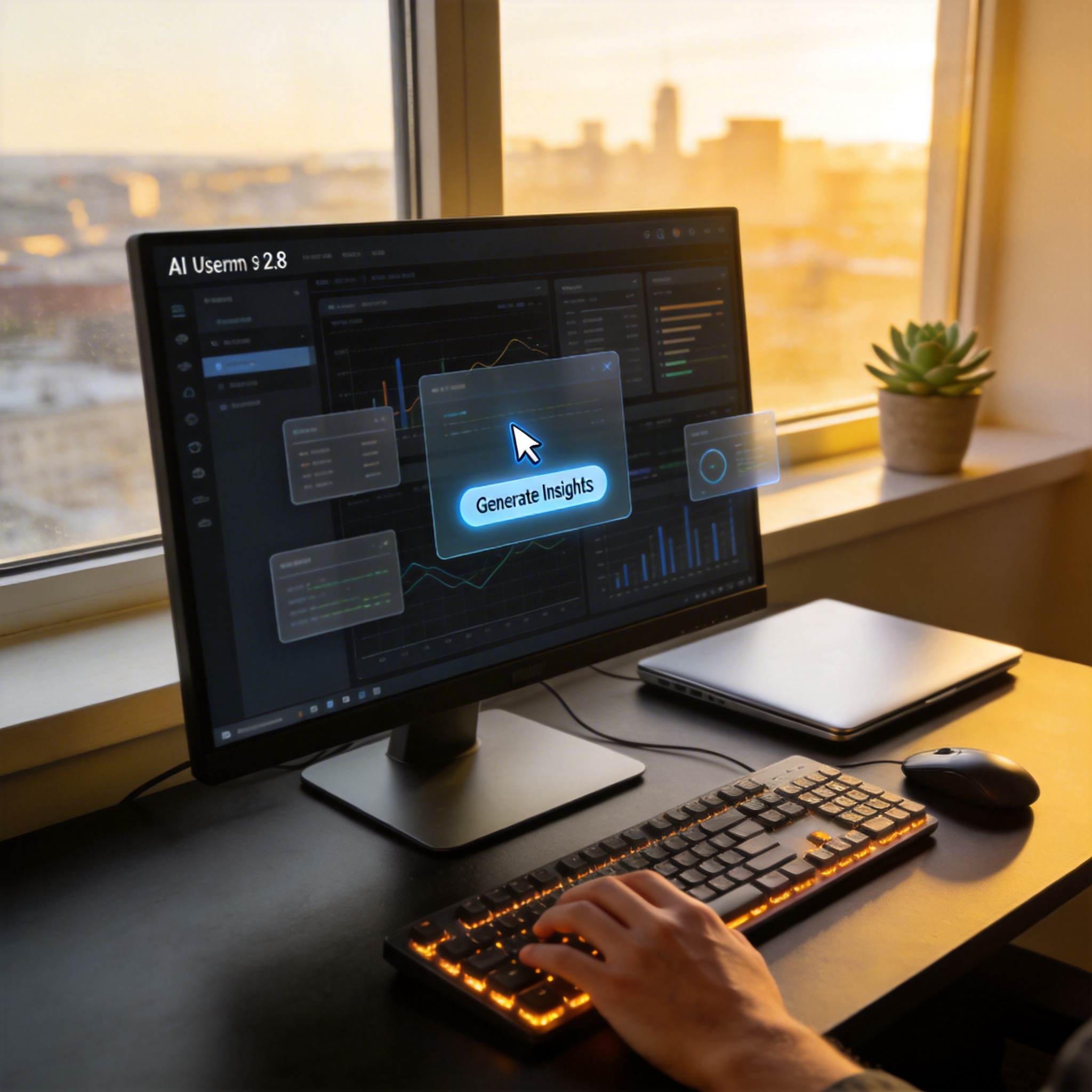
Modern desktop computer with AI-driven interface, mouse cursor, and human hand on keyboard.
GPT-5.4 is being rolled out in two main versions: GPT-5.4 Thinking and GPT-5.4 Pro for end-users, and GPT-5.4 integrated into API and Codex for developers, alongside a high-speed variant, GPT-5.4 fast.
The model achieves an 83% win rate on the GDPval benchmark, which measures performance across various knowledge work tasks. It also leads in programming on SWE-Bench Pro and mathematics on FrontierMath. In abstract reasoning, GPT-5.4 scored 83.3% on ARC-AGI-2, surpassing Gemini 3.1 Pro's 77.1% and Opus 4.6's 68.8%.
Native Computer Interaction

Human hand interacting with a holographic digital interface, symbolizing computer control.
A key feature of GPT-5.4 is its ability to interact directly with computers, recognizing user interfaces, controlling mouse and keyboard inputs, and navigating between software and web pages. This capability is reflected in its 75% success rate on the OSWorld-Verified benchmark, exceeding the 72.7% achieved by Claude Opus 4.6 and the 72.4% for human performance.
GPT-5.4 can automate tasks such as sending emails, scheduling, filling forms, and running processes. On WebArena-Verified, it reached a 67.3% success rate using both DOM and screenshot-driven interaction. In the Online-Mind2Web test, the model achieved 92.8% by relying solely on screenshot observation.
The model’s enhanced capabilities are supported by improved general visual perception. On MMMU-Pro, GPT-5.4 (without tools) achieved an 81.2% success rate, an improvement over GPT-5.2's 79.5%. Its document parsing capabilities also saw an upgrade, with an average error of 0.109 on OmniDocBench compared to GPT-5.2's 0.140.
GPT-5.4 also introduces "original" and "high" image input detail levels. The "original" setting supports full-fidelity perception up to 10.24 million total pixels, or a maximum single side of 6000 pixels. The "high" setting supports up to 2.56 million total pixels or a maximum single side of 2048 pixels.
Knowledge Work and Programming

Abstract network of light and data streams symbolizing knowledge work and programming.
In knowledge work, GPT-5.4 scored 83.0% on the GDPval benchmark, which evaluates performance across 9 industries and 44 occupations. This represents a 12 percentage point increase over GPT-5.2's 70.9%. The model demonstrated proficiency in tasks like creating presentations, spreadsheets, and schedules.
An internal test simulating a junior investment banking analyst showed GPT-5.4 achieving an average score of 87.3%, compared to GPT-5.2's 68.4%. Human evaluators preferred GPT-5.4's generated presentations in 68% of cases due to their visual quality and efficiency.
OpenAI reports a 33% reduction in the probability of GPT-5.4 independently stating factual errors compared to GPT-5.2, and an 18% reduction in the probability of an entire response containing errors.
GPT-5.4 integrates the programming capabilities of GPT-5.3-Codex, achieving 57.7% accuracy on the SWE-Bench Pro test, slightly surpassing GPT-5.3-Codex's 56.8%. The model is designed for token efficiency, reducing the tokens required for problem-solving, which translates to lower costs and faster speeds. Its token generation speed can be up to 1.5 times faster in Codex's /fast mode.
OpenAI’s internal tests indicate GPT-5.4's proficiency in complex front-end tasks, generating aesthetically pleasing and functionally complete interfaces. The experimental "Playwright Interactive" skill allows Codex to build web applications with visual debugging and in-browser testing.

Software developer working on a multi-monitor setup, building a web application.
Tool Integration and Search
GPT-5.4 introduces a "Tool Search" feature that automatically finds and loads tool definitions when needed. In the Scale's MCP Atlas benchmark, this configuration reduced total token usage by 47% while maintaining accuracy.
The model also shows improved precision in tool usage. On Toolathlon, GPT-5.4 achieved 54.6% accuracy, leading GPT-5.3-Codex (51.9%) and GPT-5.2 (45.7%), and completed tasks in fewer turns. This enables multi-step processes such as reading emails, extracting attachments, grading assignments, and recording results.
For latency-sensitive scenarios, GPT-5.4 demonstrated strong performance in τ²-bench telecom customer service tasks. With reasoning intensity enabled, it reached 98.9% on τ²-bench.
The agent network search capabilities of GPT-5.4 have also been upgraded. GPT-5.4 Pro achieved 89.3% on the BrowseComp test, surpassing Claude Opus 4.6's 84.0%. The standard GPT-5.4 version scored 82.7%. This allows GPT-5.4 Thinking to integrate information from multiple online sources and conduct multi-round searches.

Human hand interacting with a glowing sphere projecting a complex thought process.
Interactive Reasoning
GPT-5.4 Thinking allows users to intervene and adjust the direction of its thought process without interruption. This feature is available on web and Android applications, with an iOS version planned. For complex queries, the model outlines its work plan, and users can provide real-time adjustments.
The model is designed to handle difficult tasks with deeper thought and maintain stronger memory of conversation history.
GPT-5.4's comprehensive advancements across reasoning, programming, vision, tool usage, computer operation, web search, and knowledge work mark a significant development in OpenAI's pursuit of artificial general intelligence.
Stay Ahead of the AI Curve
Join 50,000+ subscribers getting the latest AI tools, trends, and tutorials delivered to their inbox weekly.
No spam, unsubscribe at any time.