
OpenAI Researcher Predicts AI Will Surpass Human Judgment by 2026
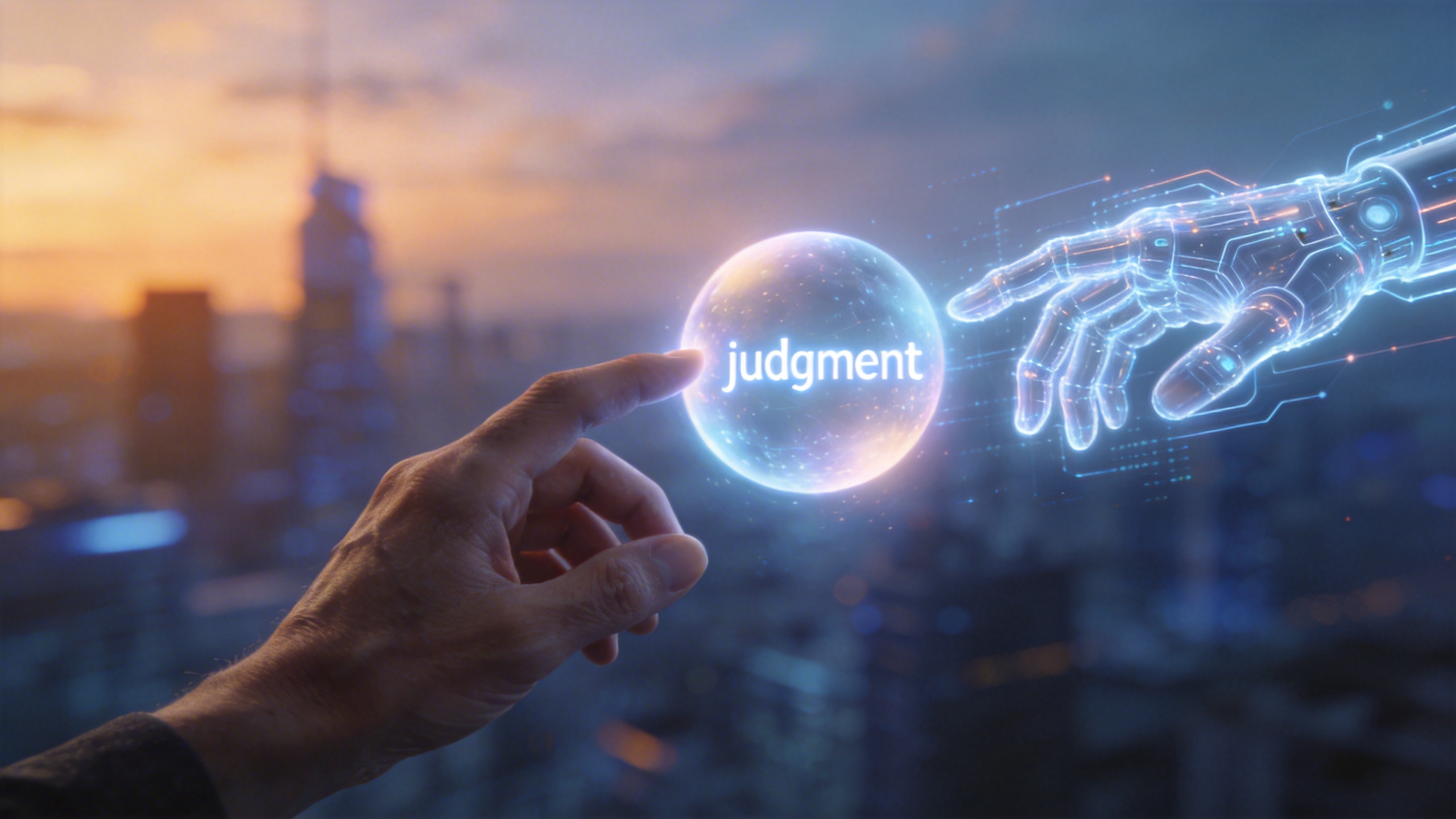
Noam Brown, a researcher at OpenAI, has issued a timeline suggesting that artificial intelligence will achieve superior judgment capabilities to humans by 2026, a prediction that has generated significant discussion in Silicon Valley and on social media platforms. Brown's timeline posits a future where AI transitions from being a tool to a decision-making entity, potentially rendering human roles in judgment obsolete.

Chessboard partially overlaid with a Go board, representing historical AI milestones.
This projection follows a historical pattern where human predictions about AI limitations have been consistently overturned. In 1997, The New York Times quoted Princeton astrophysicist Piet Hut, who estimated it would take a century or more for computers to defeat human Go players. However, just 19 years later, AlphaGo defeated Lee Sedol.
Evolving AI Capabilities and Human Redefinitions
Historically, as AI has conquered various domains, human observers have often redefined the criteria for "intelligence" to maintain a perceived advantage.
In 1987, critics argued AI lacked "planning" capabilities, believing chess required strategic foresight beyond mere calculation. This perspective shifted after Deep Blue defeated Garry Kasparov in 1997, leading to the assertion that chess was arithmetic, while Go was art.
By 1997, the argument shifted to AI's supposed lack of "intuition," particularly in games like Go, where "board feel" was considered an ineffable human quality. AlphaGo's victory and its novel moves demonstrated that what humans perceived as intuition could be modeled as a high-dimensional probability distribution by AI.
In 2016, the focus moved to AI's inability to "bluff" in incomplete information games such as Texas Hold'em. Brown's own work with Pluribus, an AI that successfully bluffed and outmaneuvered top human players in six-player Texas Hold'em, disproved this notion.

AI interfaces interacting with poker cards and chips, symbolizing AI's ability to bluff.
The Erosion of Human Exclusivity in Creativity and Logic
More recently, the domains of creativity and logical reasoning, once considered exclusively human, have also seen AI advancements. Brown's timeline highlights the collapse of these perceived human strongholds:
Artistic Creation: The emergence of tools like Midjourney and Sora has challenged the notion that AI cannot create art, impacting professions such as illustration and film direction.
Mathematical Reasoning: While debates continued about the capabilities of large language models (LLMs), DeepMind's AlphaProof won a silver medal at the International Mathematical Olympiad (IMO) in 2024. This achievement demonstrated AI's capacity for creative auxiliary line constructions and rigorous logical deduction, capabilities previously thought to be beyond machines.

Split image of AI-generated art and mathematical proof, showing AI's creative and logical prowess.
The Future of Human Judgment
Brown's 2026 milestone for AI surpassing human judgment suggests a shift from AI as a "super intern" that assists with tasks to an "Agentic AI" that makes final decisions. Nikolai Yakovenko, an AI researcher, noted that if judgment and taste can be quantified, AI will redefine what constitutes "good taste" and optimal solutions through reinforcement learning, even in areas like business intuition or aesthetics.
A common human counter-argument, often cited as a last refuge, is that AI cannot replicate human emotions like "love." However, this perspective is viewed by some as a retreat from intellectual competition, implying a surrender in the cognitive domain and a reduction of human uniqueness to biological functions.
The historical trend, as observed by toolmesh.ai, indicates that human attempts to define unique cognitive territories have consistently been challenged by AI's progress. What was once termed "planning" in 1987, "intuition" in 1997, may become "decision-making" in 2026, as AI continues to demystify human cognitive processes. The question remains how humans will define their role and agency in a world increasingly governed by AI's advanced decision-making capabilities.
Stay Ahead of the AI Curve
Join 50,000+ subscribers getting the latest AI tools, trends, and tutorials delivered to their inbox weekly.
No spam, unsubscribe at any time.