
OpenAI Spent Billions on AI Programming Acquisition Before Microsoft Intervention
OpenAI reportedly spent $3 billion in an attempt to acquire AI programming startup Windsurf, a deal that ultimately failed due to intervention from its primary investor, Microsoft. The unsuccessful acquisition prompted OpenAI to intensify its internal development of Codex, its AI programming tool.

Exterior view of OpenAI's modern headquarters building, reflecting innovation and corporate presence.
This development follows a period where OpenAI, an early innovator in AI programming, found itself trailing Anthropic's Claude Code in market adoption and revenue. While OpenAI's ChatGPT achieved rapid market penetration, its focus on general intelligence may have diverted resources from specialized applications like programming.

Two abstract digital entities racing, one leading, one catching up, symbolizing market competition in AI.
OpenAI's Early Lead and Subsequent Lag
In 2021, OpenAI introduced Codex, a system capable of translating natural language into computer code. Greg Brockman, OpenAI co-founder and president, stated at the time that such a system would be "key to building 'super assistants'." However, by 2025, Claude Code had emerged as a dominant force in the AI programming market.
Claude Code's annualized revenue surpassed $2.5 billion, while OpenAI's Codex reached just over $1 billion in annualized revenue by January of the current year. This disparity highlights a challenge for companies pursuing Artificial General Intelligence (AGI): a focus on broad intelligence can sometimes lead to missed opportunities in commercially viable, vertical applications such as programming.
Human hand interacting with a holographic interface showing complex code and data, representing AI programming.
OpenAI’s internal reports indicate a significant resurgence in Codex usage, with a 20-fold increase over the past five months. The company is now prioritizing AI programming to regain its competitive position.
Strategic Shifts and Missed Opportunities
OpenAI's initial foray into AI programming saw the development of GitHub Copilot, an auto-completion tool powered by Codex. This product was subsequently managed by Microsoft, OpenAI's largest investor. Following this, OpenAI’s original Codex team was reportedly disbanded, with engineers reassigned to projects like DALL-E2 and GPT-4, which were considered more direct paths to AGI.
The explosive growth of ChatGPT in late 2022, attracting over 100 million users in two months, further shifted OpenAI's internal focus. For an extended period, the company lacked a dedicated team for AI programming products, as the area was perceived to be adequately covered by GitHub Copilot. This strategic decision meant that ChatGPT's success came at the expense of progress in Codex.

Two glowing light paths diverging in a cosmic void, symbolizing strategic shifts and missed opportunities.
During 2023 and 2024, OpenAI heavily invested in multimodal AI, believing that AI needed to process visual and auditory information for true intelligence. Meanwhile, Anthropic pursued a different strategy, emphasizing programming as a critical pathway to AGI. Brockman later acknowledged that Anthropic's early and intense focus on programming, including training models on complex, real-world codebases, provided a valuable lesson for OpenAI.
The Rise of "Vibe Coding" and Anthropic's Innovation
In June 2024, Anthropic released Claude Sonnet 3.5. Concurrently, AI programming software like Cursor, developed by Anysphere, gained traction by enabling engineers to use AI models from various providers to write and debug code. Anysphere, founded in 2022 by MIT alumni, reportedly declined an acquisition offer from OpenAI in its early stages.
Anthropic launched an internal beta of Claude Code in February 2025, with a general release in May. Unlike earlier "vibe coding" tools that assisted with code completion, Claude Code directly integrated with terminals and command lines, taking over entire project workflows. This approach, characterized as replacement rather than assistance, fueled Claude Code's rapid market adoption.
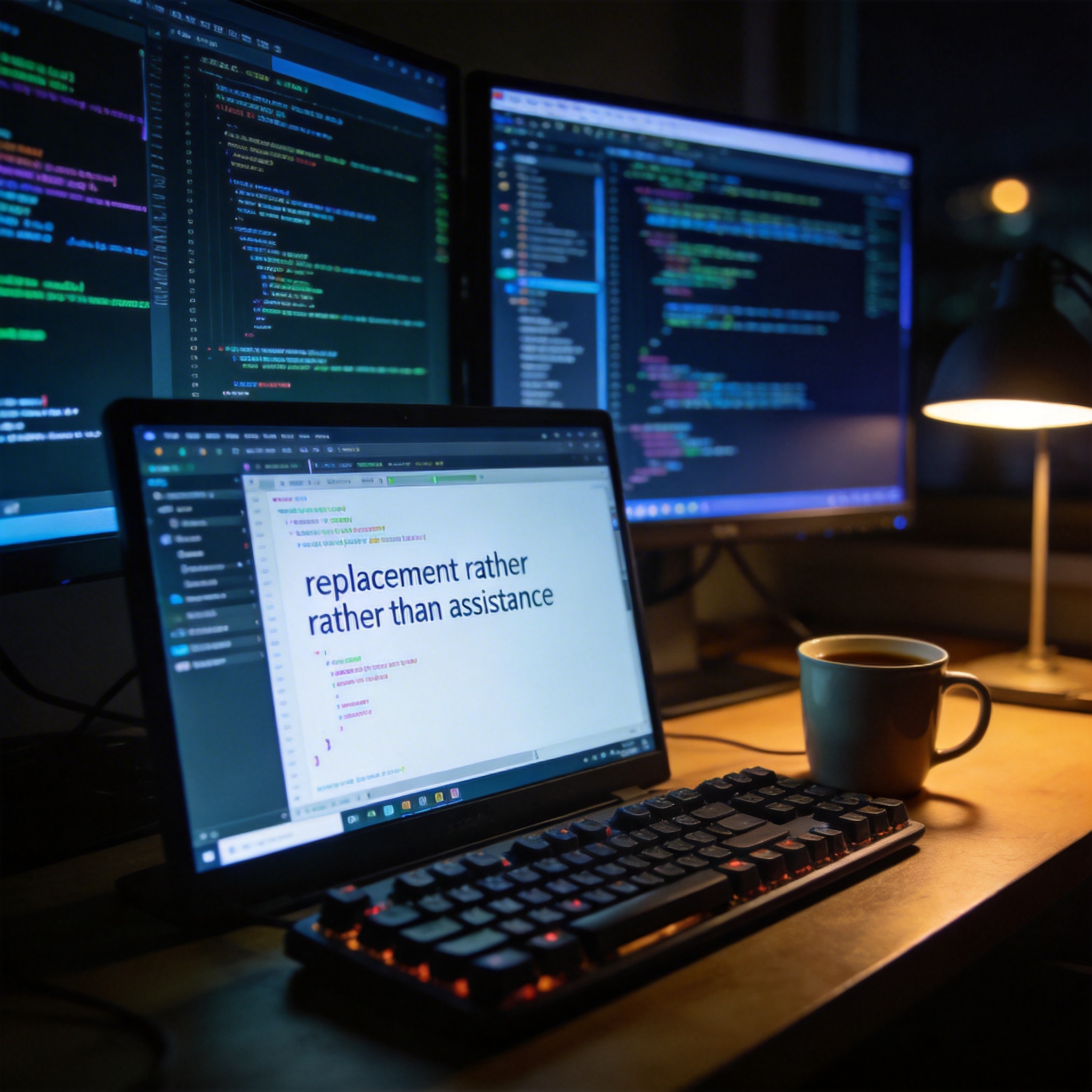
Developer's desk at night with multiple monitors displaying code and an integrated terminal, symbolizing advanced AI programming.
OpenAI's Counteroffensive and Microsoft's Influence
OpenAI began to re-evaluate its AI programming strategy in late 2024. Internal teams, including researchers Andrey Mishchenko and Thibault Sottiaux, and product lead Alexander Embiricos, developed new approaches. Embiricos's "Jam" demo, which allowed AI to access the command line directly rather than simulating mouse clicks, demonstrated a new paradigm where AI could run code autonomously.
Following this internal shift, OpenAI attempted to acquire Windsurf for $3 billion. However, Microsoft, seeking to protect its investment in GitHub Copilot, which was beginning to appear less advanced compared to new agent-based programming experiences, demanded access to Windsurf's intellectual property. The negotiations ultimately failed in July, leading Windsurf's founder to join Google and the remaining team to be acquired by Cognition.

Exterior view of Microsoft's corporate campus, representing its influence in the tech industry.
The stalled acquisition compelled OpenAI to accelerate its internal development. Sottiaux formed a "sprint team" in March 2025 to rapidly develop an AI programming product. The team leveraged the "verifiability" of code—its ability to either run or fail—to provide clear feedback for continuous model improvement.
Brockman recounted that a computer game he developed years ago, "Reverse Turing Test," which previously took OpenAI's most advanced model hours and human assistance to create, could be instantly generated by Codex with the new GPT-5.2 model using a single prompt.
This progress is reflected in user growth figures: Codex usage, which was 5% of Claude Code's in September 2025, surged to nearly 40% by January 2026, indicating a narrowing gap in the market.
Safety Concerns Amidst Rapid AI Advancement
The increasing reliance on AI for coding within OpenAI has raised questions about safety. Engineers at the company reportedly use Codex extensively, even for tasks like building internal tools during hackathons. Kevin Weil, Head of Applications, plans to develop fully automated AI research interns by 2026. Fidji Simo, also Head of Applications, is leveraging ChatGPT's brand to market Codex to enterprises, with Cisco executives reportedly advising employees to adopt these tools to remain competitive.
However, the rapid deployment of AI also brings scrutiny regarding safety. The non-profit Midas Project accused OpenAI of compromising on previous safety commitments with GPT-5.3-Codex, particularly concerning cybersecurity risks. Amelia Glaese, OpenAI's head of alignment, denied claims of sacrificing safety for Codex, stating that Midas misunderstood the company's commitments.

Digital shield made of code protecting against a swirling vortex of data, symbolizing AI safety concerns.
Brockman, known for his dedication to engineering, expressed a complex view on the future of AI. While he believes OpenAI is on track for AGI, he noted that the "hands-off era" of AI-driven development, where humans become "CEOs of a fleet of hundreds of thousands of agents," might lead to a loss of deep engagement with problem-solving. He questioned whether humanity would retain a fundamental understanding of how the world operates once machines fully control code.
Stay Ahead of the AI Curve
Join 50,000+ subscribers getting the latest AI tools, trends, and tutorials delivered to their inbox weekly.
No spam, unsubscribe at any time.