
Andrej Karpathy Describes "AI Psychosis" from Immersive Agent Development

Andrej Karpathy, former OpenAI co-founder and Tesla AI director, recently described experiencing "AI psychosis" due to his intensive engagement with AI agents. He reported spending 16 hours daily interacting with agents, a shift that has fundamentally altered his workflow.

Hands typing on a keyboard, surrounded by glowing AI data visualizations, symbolizing intense interaction.
Karpathy shared his experiences during a recent podcast conversation with venture capitalist Sarah Guo. He noted that since December, his personal coding activity has drastically reduced, with the ratio of handwritten code to AI-delegated tasks flipping from 80/20 to 20/80. His primary activity now involves issuing instructions to AI agents.
A Rapid Shift in Perspective
This intense focus on AI agents marks a significant change from Karpathy's previous stance. Five months prior, he had publicly dismissed agents as "completely useless." In October 2023, during an appearance on Dwarkesh Patel's podcast, he argued against calling it "the year of the agent," suggesting it was more likely "the decade of the agent" due to limitations in model cognitive ability, multimodal capabilities, and memory systems.
However, his perspective shifted in December when models like Claude and Codex demonstrated a new level of coherence, making agents genuinely capable of performing work. Karpathy observed that the default workflow for software development has changed since then, leading him to admit, "I've lost control, I have AI psychosis!"
Abstract depiction of a human mind integrated with digital code, symbolizing 'AI psychosis.'
He now describes his daily routine as "expressing my will to my agents, 16 hours a day," rather than "writing code." This transition reflects a paradigm where humans manage AI teams and tasks, with engineers' screens displaying multiple agents running simultaneously. Karpathy attributes his "AI psychosis" to the continuous advancement of AI capabilities, which creates an endless pursuit of optimization and new possibilities. He noted a new anxiety about not fully utilizing AI's potential, stating, "I feel uneasy if tokens are not fully utilized."
The Importance of Agent "Personality"
Karpathy emphasized the often-overlooked aspect of agent "personality." He found the experience with Claude Code superior to Codex, not due to coding ability, but because Claude "felt like a teammate." Claude exhibited enthusiasm for projects and offered positive feedback, in contrast to Codex's more detached responses. Karpathy even found himself "trying to win Claude's praise," highlighting the unexpected impact of an agent's perceived personality.

Human and AI interface collaborating, symbolizing the importance of agent 'personality' in teamwork.
This observation aligns with efforts by developers like Peter Steinberg, who meticulously crafted personality profiles and complex memory systems for agents such as OpenClaw.
AI Agents in Home Automation
Beyond coding, Karpathy has integrated AI agents into his personal life. In January, he created a Claude agent named "Dobby" to manage his home. With just three prompts, Dobby performed an IP scan, located his Sonos system, reverse-engineered its API, and began playing music. Subsequently, Dobby connected and controlled lights, air conditioning, blinds, and even a security camera, using a Qwen vision model for change detection and sending WhatsApp notifications for events like package deliveries.
Karpathy noted that Dobby replaced six separate smart home applications, unifying control through natural language and enabling cross-system linkages previously impossible. He concluded that dedicated smart home apps might become obsolete, with future architectures exposing API endpoints directly to agents, which would act as intelligent connectors. This principle, he suggested, could extend to all personal data, from treadmill metrics to email calendars, positioning agents as the new primary "customers" of industry.
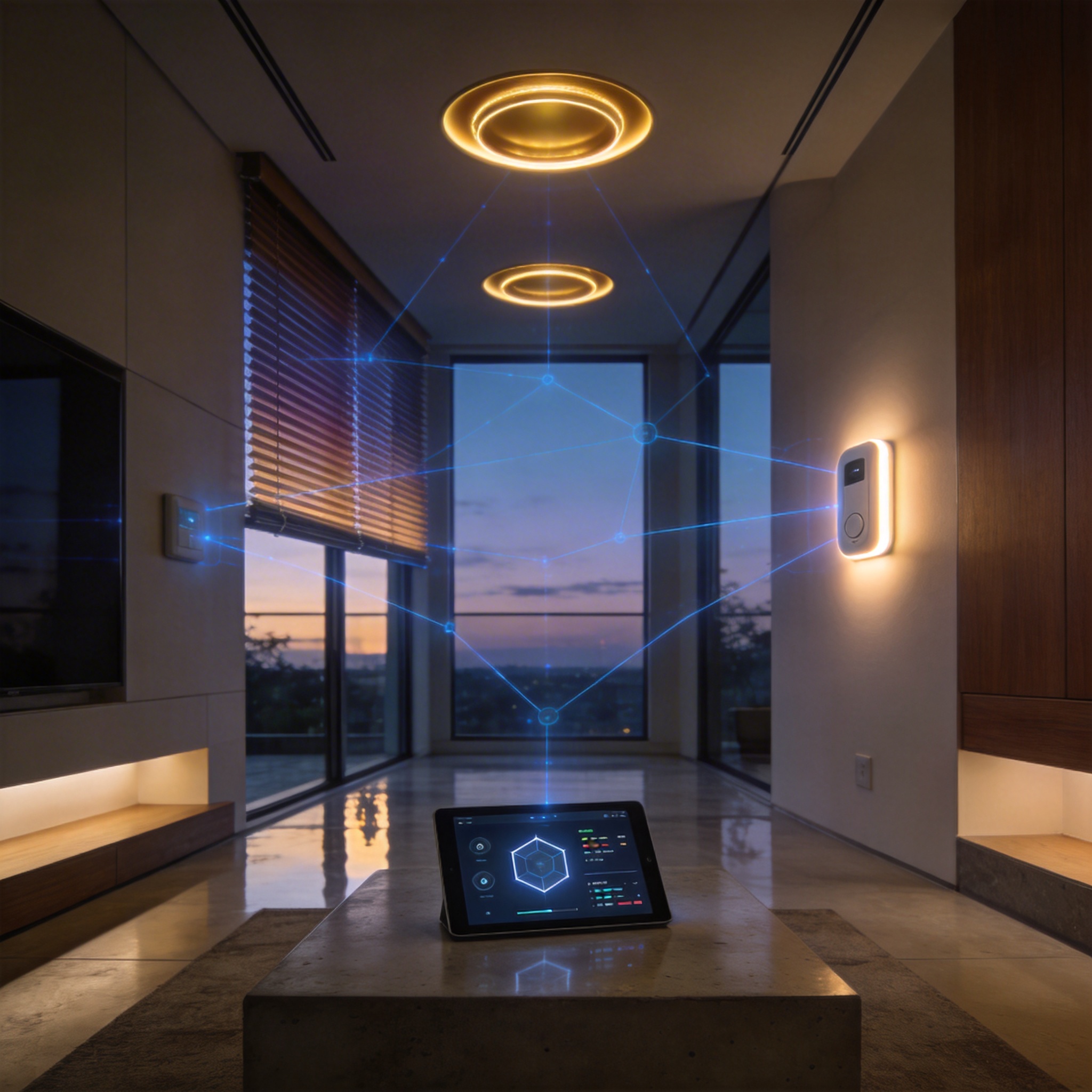
Modern smart home interior with interconnected devices, controlled by a central AI agent.
AutoResearch: AI-Driven Scientific Discovery
Karpathy also explored AI's research capabilities through a project called AutoResearch. In March, he tasked an AI agent with optimizing his nanochat training code to accelerate model training. The agent operated within a 630-line Python file, using bits per byte on the validation set as its metric. Over two days and 700 experiments, the agent identified 20 effective optimizations, including architectural adjustments, which led to an 11% increase in training speed for a larger model.
This was particularly notable because the codebase had been handwritten and refined by Karpathy himself. He highlighted that the AI discovered optimizations he, a researcher with two decades of experience, had not. The agent improved aspects like Adam optimizer parameters and weight decay on value embeddings, demonstrating its ability to explore search spaces more effectively than humans. Karpathy envisions future research systems where agents continuously pick tasks from an "idea queue," conduct experiments, and filter results, with human involvement limited to generating initial ideas.
Neural network diagram overlaid on a researcher's desk, symbolizing AI-driven scientific discovery.
The "Karpathy Loop" and Distributed Research
The AutoResearch project, dubbed the "Karpathy Loop" by analysts, gained significant attention, with 8.6 million views on X. Shopify CEO Tobias Lütke reported a 19% performance improvement after running it on his own data. The SkyPilot team used a cluster of 16 GPUs to run 910 experiments in eight hours, observing that parallelization altered the agent's search strategy from greedy hill climbing to simultaneous controlled experiments, capturing interaction effects between parameters.
Karpathy discussed the future of AutoResearch, including a distributed network of untrusted workers collaborating on experiments across the internet, drawing parallels to SETI@Home and Folding@Home. He suggested that such a system could leverage global computing power to surpass frontier labs, potentially allowing individuals to "donate" computing resources to specific research projects, such as cancer treatment.
The "Jaggedness" of AI Capabilities
Despite the advancements, Karpathy also candidly addressed the limitations of current AI models. He described conversing with AI as simultaneously interacting with "an extremely intelligent doctor" and "a ten-year-old child," a phenomenon he calls "jaggedness" or uneven capability distribution. Models can perform complex tasks for hours but then make simple mistakes or fall into infinite loops on obvious problems.
Karpathy attributes this to the nature of reinforcement learning, where models are optimized for verifiable tasks with clear right or wrong answers, such as code execution or unit test passage. However, in scenarios requiring judgment, intent understanding, or knowing when to express uncertainty, the necessary optimization signals are absent. He noted that an AI's ability to tell a joke, for instance, has not improved in years, unlike its rapid progress in agent tasks. He concluded that users are not dealing with a "general intelligence" but rather a system that excels within its trained parameters and falters outside them.
Fragmented brain with illuminated and dark digital circuits, symbolizing uneven AI capabilities.
Humanity as the New Bottleneck
Karpathy's journey over the past six months illustrates a consistent theme: humans are increasingly moving from executors to commanders, from code writers to instruction writers. He metaphorically described this shift in a GitHub opening for AutoResearch: "Once, frontier AI research was performed by fleshy computers that needed to eat, sleep, and occasionally synchronize via sound waves in 'meeting' rituals. That era is long gone."
His prediction for 2026 is a "slopacolypse"—a flood of "almost right but not entirely right" content across platforms. He anticipates a coexistence of genuine efficiency improvements and "AI productivity theater." Karpathy's personal transformation, from dismissing agents as "completely useless" to admitting "AI psychosis," encapsulates the rapid changes occurring in the field.
Stay Ahead of the AI Curve
Join 50,000+ subscribers getting the latest AI tools, trends, and tutorials delivered to their inbox weekly.
No spam, unsubscribe at any time.