
HKUST and Partners Introduce Robust-R1, a Degradation-Aware Reasoning Paradigm for MLLMs

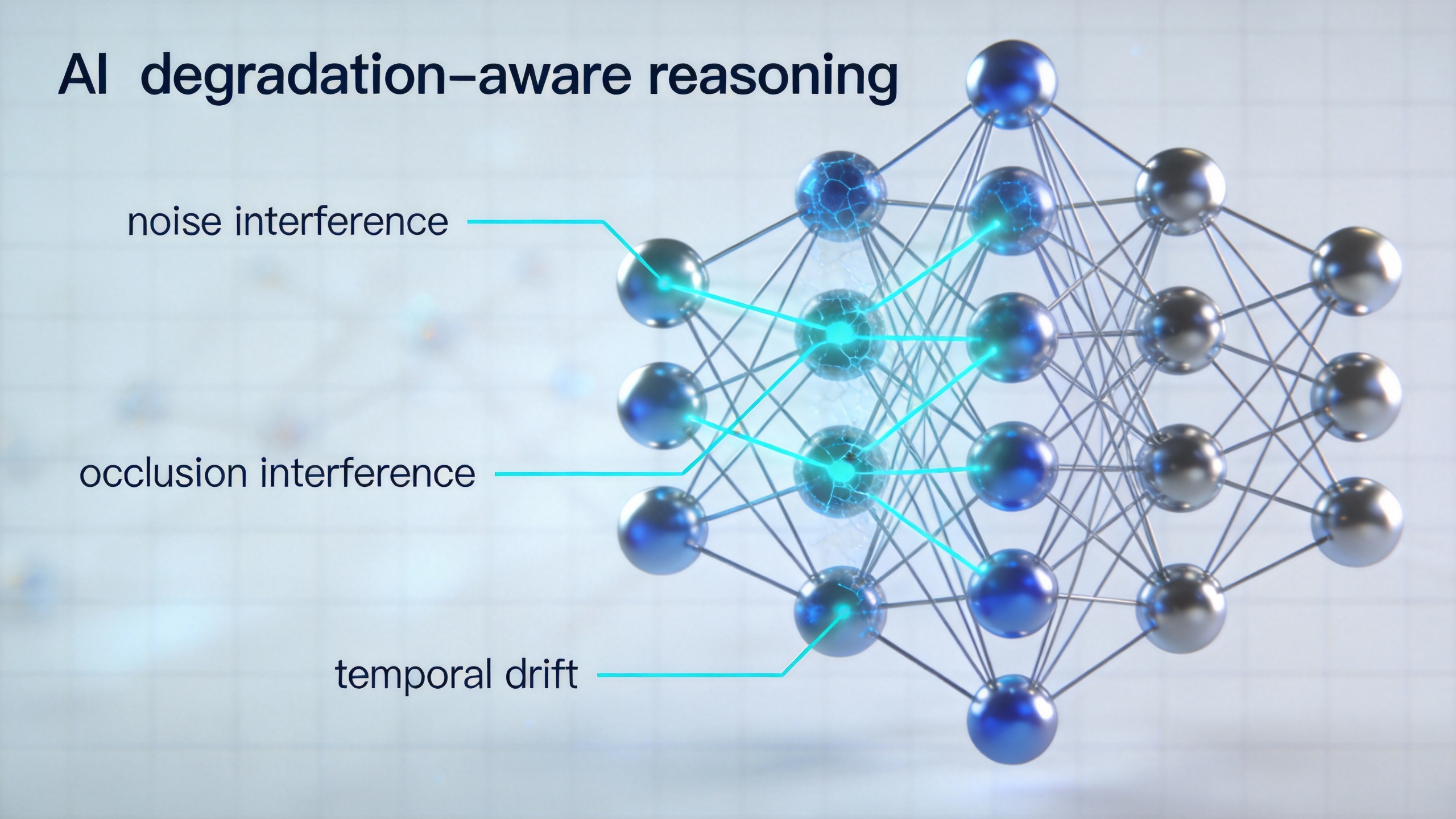
Multimodal Large Language Models (MLLMs) are central to AI visual understanding, but their performance often falters when encountering real-world visual degradations such as blur, noise, or occlusion. This limitation has historically hindered their deployment in industrial applications. Researchers from the Hong Kong University of Science and Technology (HKUST), Northwestern Polytechnical University, and other institutions have introduced Robust-R1, a new approach that redefines the visual degradation problem as an explicit structured reasoning task.

Surveillance camera lens covered in rain streaks, with a digital overlay showing AI analysis of the visual degradation.
Accepted as an Oral presentation at AAAI 2026, Robust-R1 moves beyond implicit adaptation by enabling models to not only withstand interference but also diagnose it. This development aims to improve both the quality and robustness of MLLMs, as demonstrated across multiple evaluations.
Addressing Visual Degradation in MLLMs
Visual degradation presents a significant challenge for MLLMs transitioning from controlled laboratory settings to real-world environments. Factors like rain-streaked windows, low-quality surveillance footage, compressed images, and inherent noise in medical scans can cause even advanced models like GPT-4V and Qwen-VL to produce inaccurate outputs. This vulnerability affects critical applications such as autonomous driving, medical imaging, and security.
Existing methods typically rely on "implicit adaptation," using techniques like adversarial training and data augmentation to make models more resilient to interference. However, this approach often treats symptoms rather than root causes, offering limited interpretability. While these models might improve performance for specific degradations, they often fail to understand the degradation itself, limiting their ability to generalize to unknown interferences and keeping their decision-making processes opaque.

Conceptual image showing a blurred eye transforming into a clear eye with digital analysis, symbolizing AI's shift to understanding degradation.
Robust-R1 aims to shift this paradigm by enabling models to "understand interference" rather than merely "resist interference." The system introduces degradation awareness as an explicit structured reasoning capability, allowing visual models to perform "self-diagnosis."
The research paper and associated resources are publicly available:
Paper Link: https://arxiv.org/abs/2512.17532
Open-Source Code: https://github.com/jqtangust/Robust-R1
Open-Source Model: https://huggingface.co/Jiaqi-hkust/Robust-R1
Open-Source Data: https://huggingface.co/datasets/Jiaqi-hkust/Robust-R1
Online Demo: https://huggingface.co/spaces/Jiaqi-hkust/Robust-R1
Robust-R1's Degradation-Aware Reasoning System
Robust-R1's core concept involves a "degradation-aware reasoning system" for visual models. When presented with a degraded image, the model executes a three-step diagnostic process:
Degradation Parameter Perception: The model first diagnoses the input image for degradation, identifying the type (e.g., motion blur, lens flare, noise) and quantifying its intensity. For example, it might identify "motion blur with intensity 0.47 and lens flare with intensity 0.31."
Semantic Influence Analysis: After identifying the degradation, the model analyzes how these degradations specifically affect the image's semantic understanding. This step translates abstract degradation parameters into concrete impacts on visual perception, allowing the model to recognize which information might be unreliable. An example output might be: "These degradations cause object edges to blur, and some continuity features of the runway texture are lost."
Robust Conclusion Generation: Based on the diagnosis and analysis, the model adjusts its reasoning strategy, prioritizing visual cues less affected by degradation and integrating contextual information to form comprehensive judgments. For instance, it might conclude: "Despite the blur, based on the remaining spatial structure and context, it is inferred that the aircraft is located in the runway area."
This process emphasizes "explicitness" and "interpretability." Robust-R1 provides a complete reasoning chain for each judgment, presenting each step of thought in structured text. This transparency aims to make the model's decision-making process traceable and verifiable, similar to a radiologist providing a diagnosis and noting image quality factors.
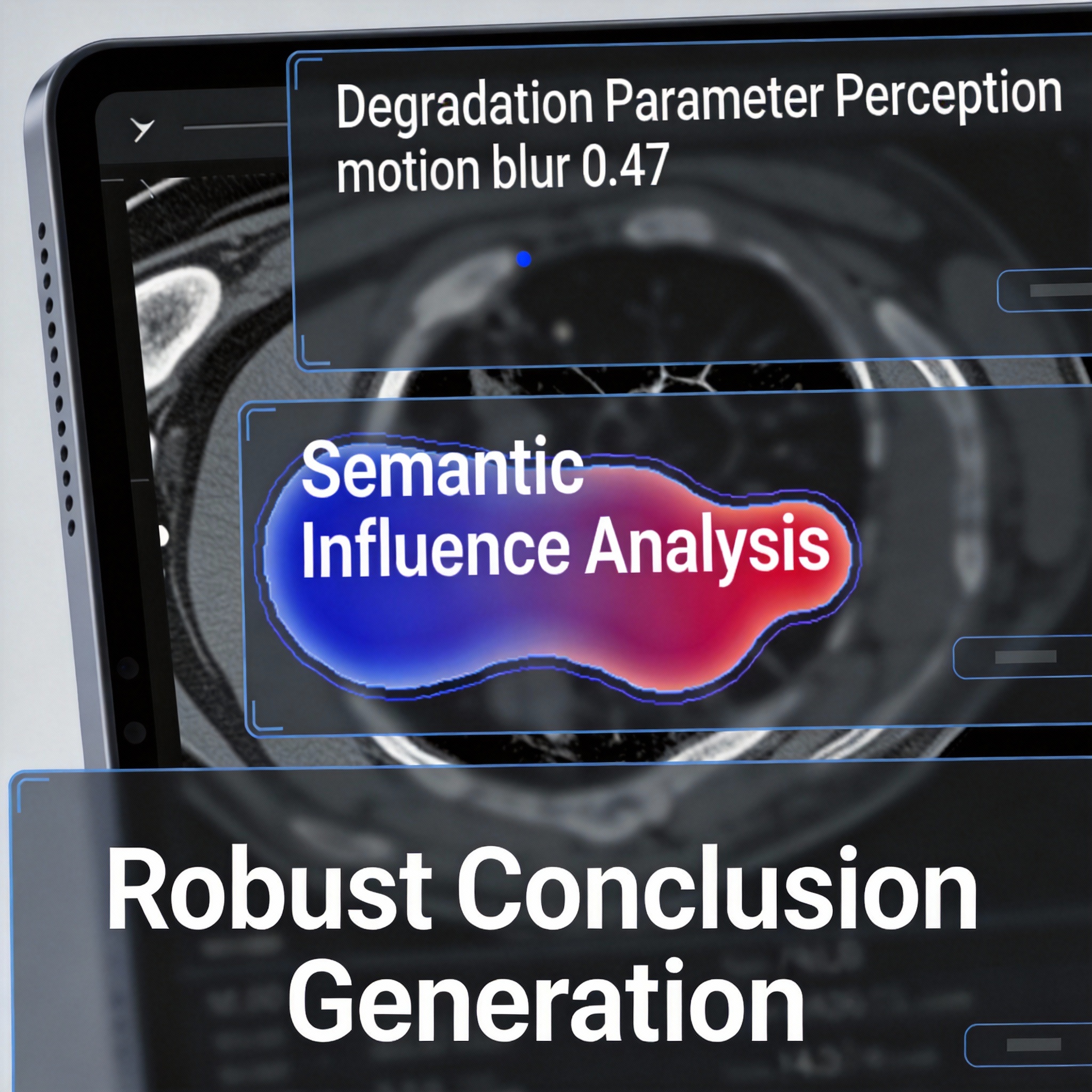
Digital interface showing a three-step AI diagnostic process: degradation perception, semantic influence analysis, and robust conclusion generation.
Technical Foundations: A Three-Stage Reasoning Engine
Robust-R1 constructs its "degradation-aware reasoning engine" through three key stages:
Structured Reasoning Chain Supervised Fine-tuning: The team developed a specific labeling system that structures the reasoning process. This includes tags for degradation type and intensity (
<TYPE>), how degradation distorts semantics (<INFLUENCE>), logical reconstruction based on original semantics (<REASONING>), and the final robust conclusion (<CONCLUSION>). Supervised fine-tuning on synthetic degraded data helps the model learn to "diagnose first, then reason."Precise Degradation Parameter Alignment Reward: Unlike traditional methods where degradation perception is often vague, Robust-R1 uses a reward function to optimize the accuracy of the model's judgment of degradation type and intensity. This involves precisely matching degradation types (e.g., "motion blur" vs. "Gaussian noise") and minimizing intensity estimation errors.
Dynamic Reasoning Depth Adaptive Adjustment: Robust-R1 incorporates a dynamic chain length adjustment mechanism to adapt to varying degradation levels. Mild degradations, such as slight noise, trigger a short reasoning chain for rapid processing, while severe degradations, like blur combined with occlusion, activate a longer chain for deeper analysis.
Data Engine: 11,000 "Degradation Diagnosis Textbooks"
To train this system, researchers created a large-scale degradation-aware reasoning dataset. This dataset covers four stages of real-world degradation—acquisition, transmission, environment, and post-processing—and includes 16 fine-grained degradation types, ranging from optical distortion to network compression and insufficient lighting. Each sample in the dataset includes not only degradation parameters but also a complete "diagnosis → analysis → reasoning → conclusion" chain.

Vast digital library with glowing data points, symbolizing 11,000 'degradation diagnosis textbooks' used to train the AI.
Experimental Validation and Interpretability
Robust-R1's performance was evaluated against various benchmarks:
Real Degradation Benchmark Test (R-Bench): On R-Bench, a benchmark designed for real-world degradation understanding, Robust-R1 outperformed existing general and specialized robust MLLM baselines across low, medium, and high degradation intensities.
Adversarial Degradation Stress Test: When images from three major general VQA benchmarks (MMMB, MMStar, RealWorldQA) were subjected to synthetic degradation (25%, 50%, 100% intensity), Robust-R1 demonstrated strong anti-degradation robustness. Its performance drop was significantly smaller than baseline models, maintaining accuracy even under extreme degradation. Under 100% degradation, Robust-R1 still outperformed specialized robust models like TeCoA and Robust CLIP.
The interpretability of Robust-R1 is demonstrated through its reasoning chain output. For example, when processing a degraded image of a garden statue, the model provided a diagnosis of "lens blur(0.31), lens flare(0.05)," followed by an influence analysis, original semantic reasoning, and a conclusion.
This work introduces "explicit degradation-aware reasoning" as a new paradigm for robust MLLM research. By providing an interpretable reasoning chain, it aims to enhance the transparency and trustworthiness of models in critical applications. The dynamic reasoning mechanism also seeks to balance performance and efficiency. This development represents a step towards enabling multimodal large models to make reliable decisions in complex, real-world conditions.
Stay Ahead of the AI Curve
Join 50,000+ subscribers getting the latest AI tools, trends, and tutorials delivered to their inbox weekly.
No spam, unsubscribe at any time.