
OpenAI's GPT-5.4 Integrates with Excel as Claude's Code Modernization Impacts IBM

Wall Street is experiencing heightened anxiety as artificial intelligence (AI) technologies demonstrate capabilities that could reshape industries. Concerns have shifted from AI's impact on individual jobs to its potential to disrupt entire companies and sectors, a phenomenon some are calling "creative destruction." Recent developments, including OpenAI's integration of GPT-5.4 into Excel and Anthropic's Claude automating COBOL code modernization, have intensified these discussions.
GPT-5.4 Enters Financial Modeling
OpenAI recently released GPT-5.4, which includes a ChatGPT plugin for Excel. This integration allows the AI model to operate directly within spreadsheets, enabling investment bank analysts to use ChatGPT for financial modeling and generating investment memos in Microsoft Excel and Google Sheets.

Investment bank analyst using ChatGPT plugin integrated into Excel for financial modeling.
In internal benchmarks, GPT-5.4 Thinking achieved a score of 87.3% in OpenAI's investment banking tests, an increase from GPT-5's initial score of 43.7%. Across 44 professions assessed by GDPval, GPT-5.4 matched or surpassed industry practitioners in 83% of cases. The model also features "native computer control," allowing it to operate desktop software using mouse and keyboard inputs. In the OSWorld desktop navigation test, GPT-5.4 scored 75.0%, compared to an average human score of 72.4%. OpenAI has integrated GPT-5.4 with financial data platforms such as FactSet, Third Bridge, Moody's, Dow Jones Factiva, and MSCI.
Claude's Impact on Legacy Systems
Anthropic's Claude Code has demonstrated the ability to automate COBOL code modernization. This development coincided with a 13.2% drop in IBM's stock price, its most significant single-day decline since 2000, resulting in an approximate $40 billion reduction in market value.

Exterior view of a modern IBM corporate building, symbolizing the company's legacy.
COBOL, a programming language developed in the late 1950s, underpins many global banking, insurance, and government systems. Modernizing these legacy codes, often written in the 1960s and 1970s, typically involves substantial costs and time. Anthropic's claim that Claude can handle COBOL modernization suggests a potential reduction in the need for traditional maintenance services. While IBM stated that "translating COBOL is the easy part; the real work is data architecture redesign, runtime replacement, and transaction processing integrity," Bloomberg data indicates IBM's cumulative decline in February reached 27%, its largest monthly drop since at least 1968.
Block's Workforce Reduction and Market Reaction
Block, Inc. CEO Jack Dorsey announced a reduction of over 4,000 employees, decreasing the workforce from over 10,000 to under 6,000. Dorsey stated that "intelligent tools have changed what it means to build and operate a company," allowing "smaller, flatter teams" to achieve more. Following this announcement, Block's stock price surged by up to 25% after hours, adding approximately $8 billion to its market capitalization. This event is noted as one of the largest AI-driven layoffs in S&P 500 history.

Empty corporate office with a holographic organizational chart, symbolizing workforce reduction and efficiency.
The Concept of "Creative Destruction"
These events align with the economic concept of "Creative Destruction," first described by economist Joseph Schumpeter in 1942. This theory posits that capitalism's essence lies in the disruptive replacement of old products, technologies, and organizational forms by new innovations. Historical examples include the impact of Netflix on Blockbuster and digital cameras on Kodak.
Anton Korinek, an AI expert at the University of Virginia, suggests that AI's impact may be significantly greater than that of the internet. While the internet primarily changed information dissemination, AI affects "cognitive production" by replacing information processors rather than just transporters. This shift targets intellectual labor and white-collar roles, distinguishing it from previous technological revolutions that primarily affected manual labor.
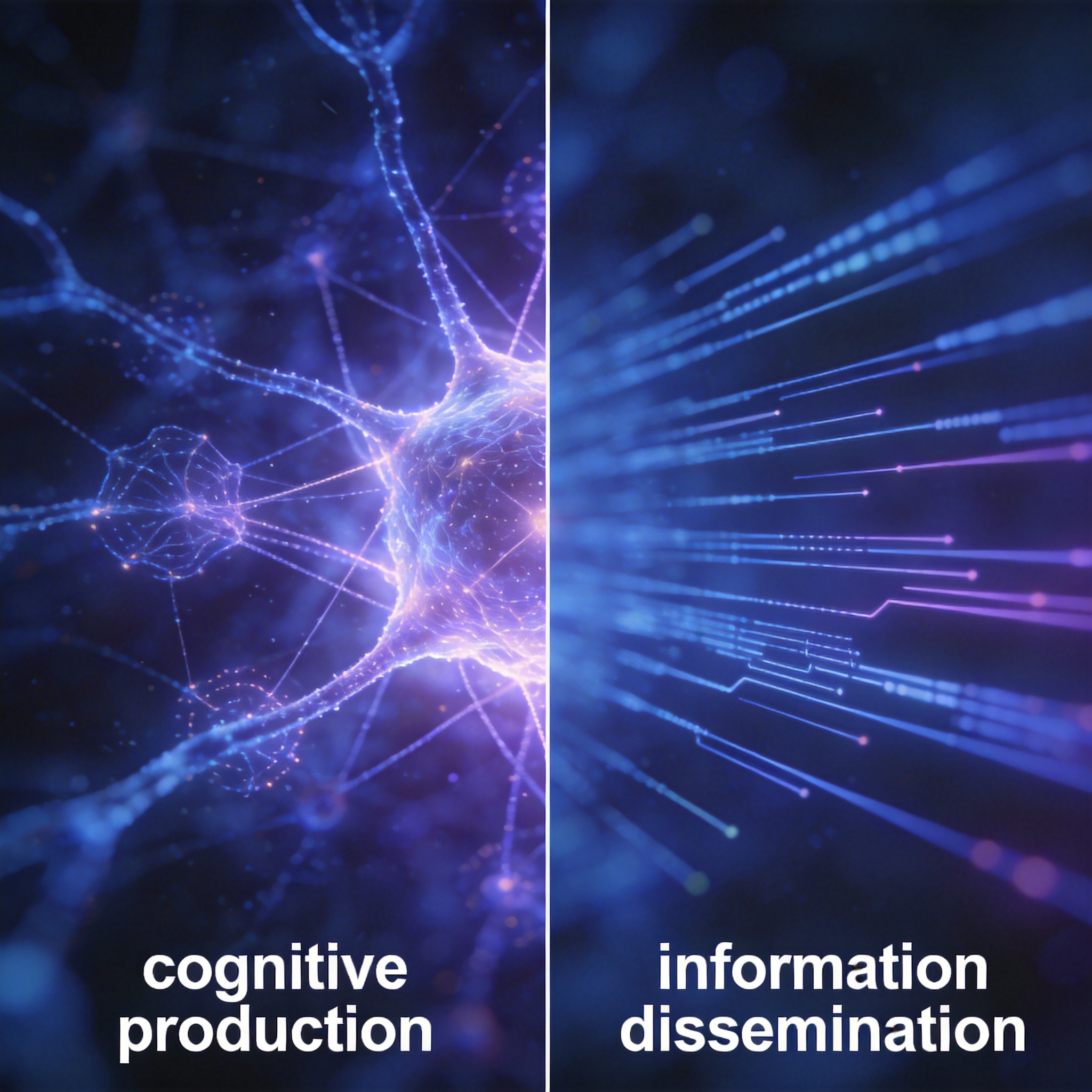
Abstract visual contrasting complex neural networks with linear data streams, symbolizing AI's impact on cognitive production.
Divergent Views on AI's Economic Impact
The potential economic consequences of AI have led to contrasting perspectives. A report titled "Global Intelligence Crisis 2028" projected scenarios of widespread white-collar unemployment and significant market declines due to AI. Conversely, firms like Citadel Securities have published rebuttals, arguing that such predictions ignore macroeconomic fundamentals and technology adoption curves.
Optimists contend that AI-driven productivity gains will foster long-term economic growth, citing recent increases in U.S. labor productivity. They argue that technological revolutions historically create more jobs than they eliminate. Pessimists, however, warn of a potentially severe transition period, with Nobel laureate economist Simon Johnson highlighting the risk of credit system collapse and financial instability. Daniel Keum of Columbia Business School observes a trend in earnings calls where executives increasingly view employees as "costs" rather than "assets," leading to cuts in benefits even before direct layoffs.
Richmond Fed President Tom Barkin has noted that technological disruptions and industry reshuffles have been a recurring theme throughout economic history, with economies eventually rebuilding and advancing. However, the current wave of AI targets core human abilities such as thinking, analyzing, and creating, raising questions about the nature and duration of this transformation.
Stay Ahead of the AI Curve
Join 50,000+ subscribers getting the latest AI tools, trends, and tutorials delivered to their inbox weekly.
No spam, unsubscribe at any time.