
GPT-5.2 System Achieves 75% on ARC-AGI-2 Benchmark, Outperforming Human Baseline


A system leveraging OpenAI's GPT-5.2 model, named Poetiq (GPT-5.2X-High), has set a new record on the ARC-AGI-2 benchmark, achieving 75% accuracy. This performance surpasses the human average of 60% and represents a 15 percentage point improvement over previous state-of-the-art results.
The achievement was highlighted by OpenAI co-founder Greg Brockman, who noted that GPT-5.2 performed above human baseline levels on the benchmark. This development comes as OpenAI suggests that large language models are entering a period of "capability overhang," where their inherent abilities exceed current human utilization.

OpenAI co-founder Greg Brockman speaking at a conference.
ARC-AGI-2 Benchmark Redefines AI Evaluation
The ARC-AGI-2 benchmark, or "Abstraction and Reasoning Corpus for Artificial General Intelligence-Version 2," was introduced in 2025 by François Chollet, creator of Keras and a former Google Brain researcher, and his team. Its design aims to assess an AI's abstract, inductive, and transfer reasoning capabilities—qualities considered essential for Artificial General Intelligence (AGI)—rather than relying on memorization or statistical pattern matching.
Unlike traditional benchmarks that use large training datasets, ARC-AGI-2 presents each problem as a novel, unseen task. This structure prevents models from achieving high scores through data cramming and instead necessitates genuine reasoning and generalization abilities, similar to human cognition. Chollet has previously stated that systems performing well only on familiar data distributions do not possess AGI-level capabilities.

Abstract geometric patterns merging, symbolizing AI's abstraction and reasoning capabilities.
Poetiq's Meta-System Architecture Enhances Performance
The record-breaking performance was not achieved by a standalone model but by Poetiq (GPT-5.2X-High), a system developed by Poetiq, an AI company specializing in Meta-System architecture. Poetiq's approach focuses on automatically constructing "systems that call models" through software-level design, rather than training larger models.
Poetiq (GPT-5.2X-High) achieved its 75% accuracy on the ARC-AGI-2 dataset at a cost of less than $8 per problem. Before the integration of Poetiq, the base GPT-5.2(X-High) model had an accuracy of approximately 60%, aligning with the human average on the benchmark. The Poetiq system boosted this score by 15 percentage points without any specific training or optimization of the underlying GPT-5.2 model.
For comparison, Gemini 3 Deep Think (Preview) scored approximately 46% on ARC-AGI-2, lagging behind the GPT-5.2 series. Poetiq's developers stated that their meta-system is designed to build complete solutions for specific tasks by leveraging existing cutting-edge models. This demonstrates that effective software architecture can significantly improve AI performance without solely relying on increased computational power.
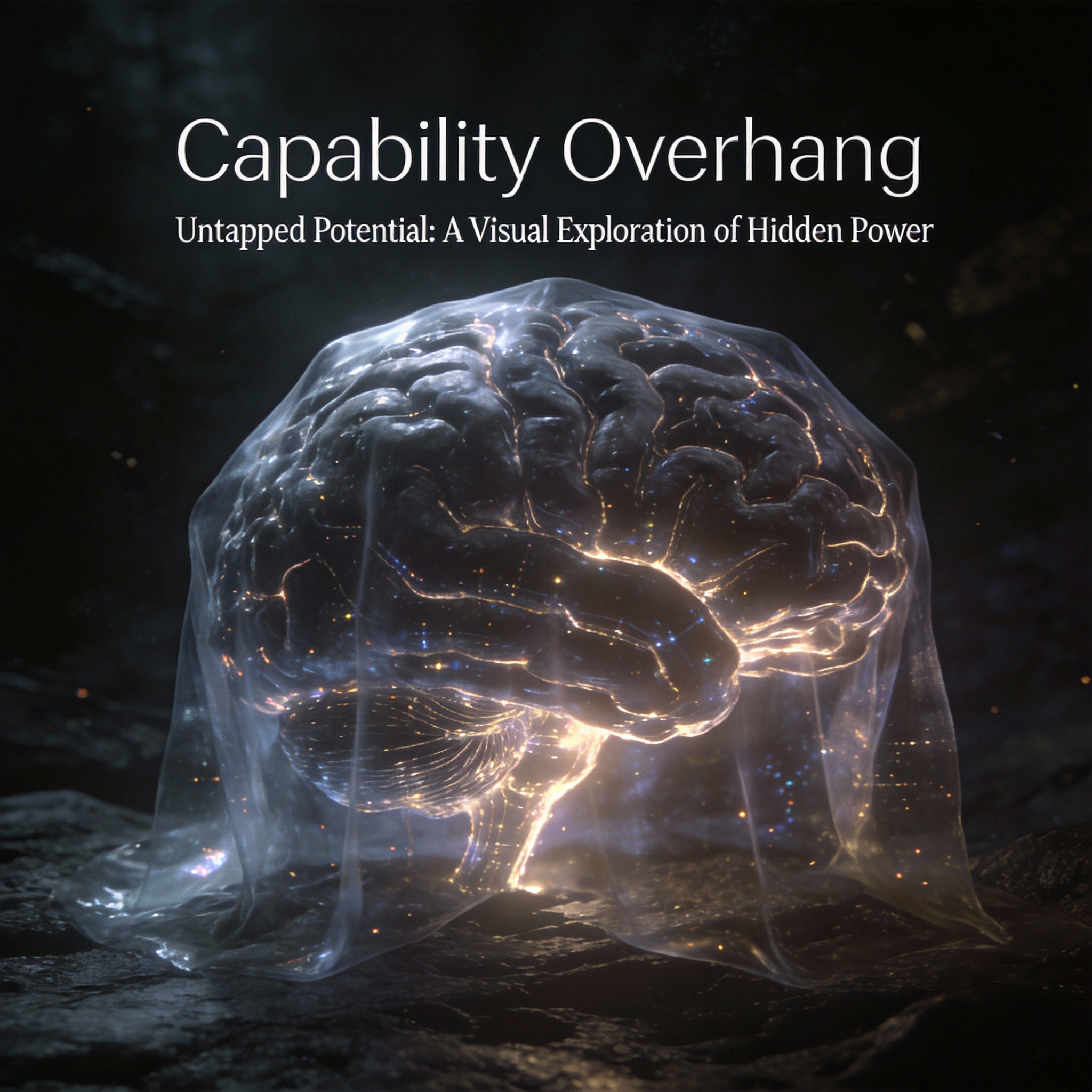
Abstract digital core partially obscured by a veil, symbolizing AI 'capability overhang.'
OpenAI Highlights "Capability Overhang" in Large Models
OpenAI recently posted on X, introducing the concept of "Capability Overhang" in large language models. This term describes a significant disparity between the capabilities of current models and how effectively humans utilize them to produce results.
OpenAI suggests that future AGI progress will depend not only on model breakthroughs but also on how people effectively use AI, integrate it into work and daily life, and translate model capabilities into practical value. For 2026, OpenAI plans to continue frontier research while emphasizing application layers, system layers, and human-computer collaboration, particularly in healthcare, business, and daily life.

Diverse professionals collaborating with a holographic AI interface in a modern office.
Human-Computer Collaboration as Key to AGI
OpenAI's communication underscores the importance of human-computer collaboration for achieving AGI. The company posits that AGI involves not just model advancements but also educating users on how to effectively leverage AI. By maximizing AI's potential, its role can shift from demonstrating capabilities to providing widespread benefits, impacting billions of lives.
The performance of Poetiq (GPT-5.2X-High) on ARC-AGI-2, exceeding the human average by 15 percentage points, supports the notion that large models possess significant, potentially underutilized, capabilities. OpenAI previously noted that GPT-5 achieved expert-level performance in complex interdisciplinary problem-solving, which has been interpreted as "doctoral-level intelligence" in certain specialized tasks.
This situation suggests that while models may not be inherently "overqualified," their capabilities are severely underutilized. This could stem from model designers not keeping pace with user scenarios, a lack of fundamental breakthroughs in reasoning, or the rapid iteration of models, which forces users to constantly adapt. The emergence of Poetiq and OpenAI's assessment of "capability overhang" indicate that the future of AI competition may increasingly focus on systems, processes, and human-computer collaboration, rather than solely on model parameters.
Stay Ahead of the AI Curve
Join 50,000+ subscribers getting the latest AI tools, trends, and tutorials delivered to their inbox weekly.
No spam, unsubscribe at any time.