
US Department of Energy Launches AI "Genesis Project" with 24 Tech Firms


The U.S. Department of Energy (DOE) has initiated the "Genesis Project," a national artificial intelligence (AI) initiative, in collaboration with 24 technology companies, including OpenAI and Google. This program aims to integrate advanced AI and supercomputing capabilities into national laboratories to accelerate scientific discovery in fields such as nuclear energy, quantum computing, and materials science.
The Genesis Project, formalized by a cooperation agreement between the DOE and the White House, seeks to establish the nation's first AI-driven research platform. The initiative, launched via a presidential executive order in November 2025, will apply AI models and computing platforms to critical research areas including controllable nuclear fusion, energy material discovery, climate simulation, and quantum computing algorithms. This marks a strategic shift towards systematic, collective problem-solving in U.S. technology development.

Diverse hands reaching towards a holographic scientific data projection, symbolizing tech collaboration.
Unprecedented Collaboration Between Tech Giants
The project brings together a broad spectrum of U.S. technology companies, including Microsoft, Google, Nvidia, OpenAI, DeepMind, and Anthropic. Notably, it represents a rare collaboration between OpenAI and Google, typically competitors in the AI sector, as they unite to advance frontier sciences.
Both Google DeepMind and OpenAI have publicly supported the initiative. Google stated its commitment to providing advanced AI tools to American scientists, pledging to apply its Gemini 3 reasoning capabilities to areas like nuclear fusion plasma simulation and climate modeling. Google also plans to supply AlphaEvolve, AlphaGenome, and WeatherNext to national laboratories in 2026. OpenAI has signed documents with the DOE to accelerate AI-driven science and submitted recommendations to the White House Office of Science and Technology Policy on strengthening U.S. technological leadership through AI.
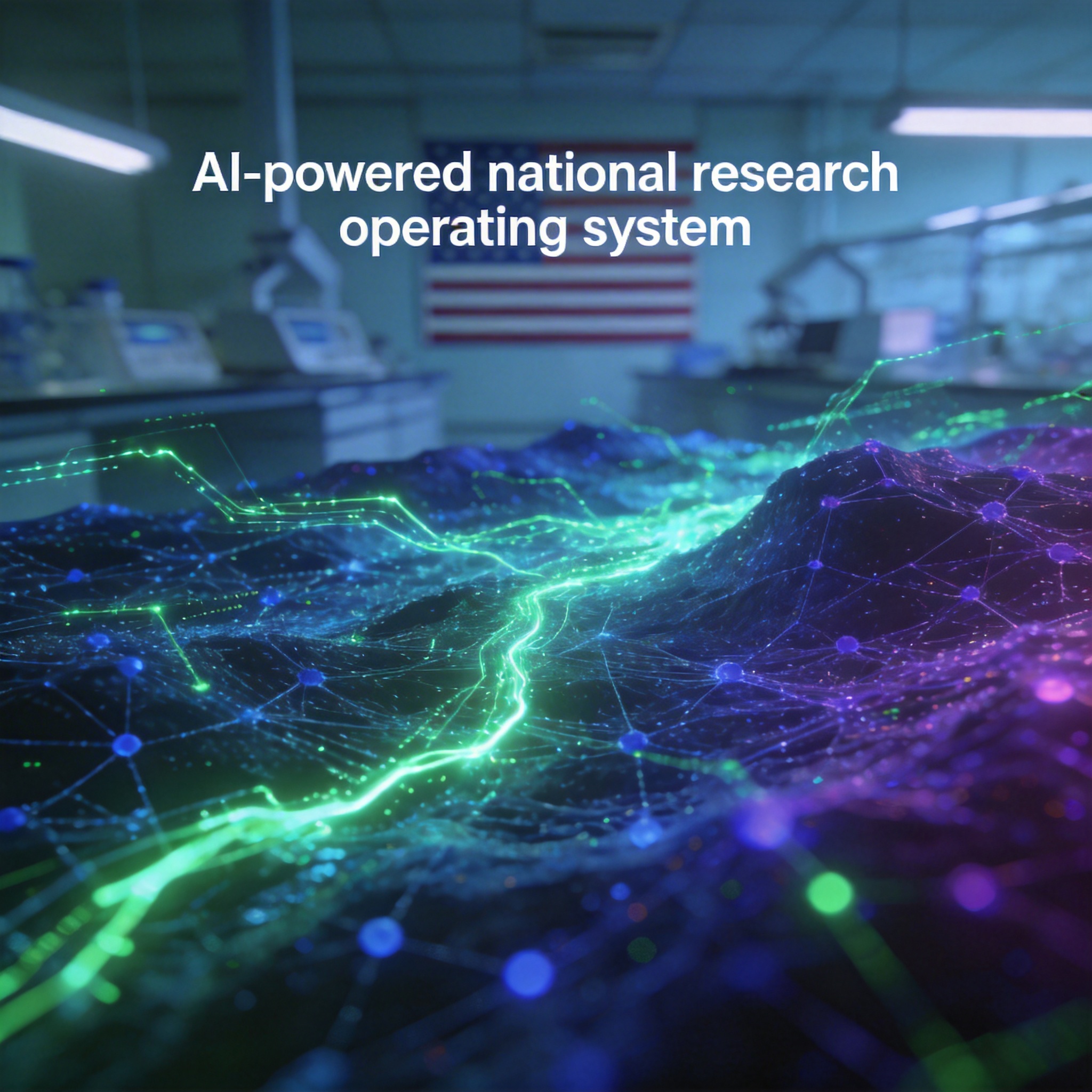
Abstract network of glowing data streams overlaying a national laboratory, symbolizing an AI research operating system.
AI as a National Research Operating System
The Genesis Project is envisioned as an AI-powered national research operating system, aiming to make AI the default tool for scientific research. It seeks to unify national laboratories, supercomputers, and data assets onto a single AI platform, integrating advanced AI capabilities into the public research system.
The initiative primarily leverages the DOE's 17 national laboratories, including Los Alamos National Laboratory, Berkeley Lab, Argonne National Laboratory, and Oak Ridge National Laboratory. These facilities house core U.S. scientific research assets in nuclear energy, materials science, climate models, high-energy physics, and supercomputing systems like Frontier and Aurora. The project's goal is to dramatically increase the speed of scientific discovery using AI and supercomputing.
The DOE's leadership in this project stems from its management of advanced supercomputers, access to non-commercial research data, and its role in strategic research tasks such as nuclear fusion simulation and national climate change prediction. These areas require significant computing power, involve high experimental costs, and have long research cycles, making them suitable for AI intervention.

Close-up of a server rack with glowing indicator lights, symbolizing high-performance computing infrastructure.
Industry-Wide Participation
The 24 participating technology companies represent a "full stack" of the U.S. AI industry. Categories of participants include:
Cloud and Platforms: Microsoft, Google, AWS, Oracle, IBM
AI Model Companies: OpenAI, Anthropic, xAI
Chips and Computing Power: Nvidia, Intel, AMD, HPE
New AI Chips: Cerebras, Groq
Data and Analytics Companies: Palantir
Microsoft and Google are expected to provide cloud computing infrastructure and AI development platforms, supporting national laboratories in deploying and running large models. Nvidia is identified as a critical technological pillar due to its dominance in GPUs for national laboratory supercomputers and its focus on AI and high-performance computing (HPC).
For OpenAI and Anthropic, this collaboration extends their large language models beyond internet-based applications into scientific fields such as nuclear physics, materials science, and climate simulation, positioning AI as an engine for scientific discovery.

Stylized atomic structure with overlaid code snippets, symbolizing AI-driven scientific discovery.
Accelerating Scientific Discovery
The Genesis Project has been compared to the original Manhattan Project due to its national mobilization, concentration of top resources, and clear strategic goals of accelerating scientific discovery and ensuring technological leadership. While the Manhattan Project addressed the feasibility of building an atomic bomb, the Genesis Mission aims to fundamentally transform the speed of future scientific research.
The project seeks to automate aspects of the research process, with AI generating hypotheses, designing experiments, running simulations, and analyzing results, thereby shortening research cycles that traditionally span several years. Examples include AI's ability to screen millions of material combinations, replace expensive physical simulations in climate research, and optimize plasma control parameters in nuclear fusion.
This initiative signals a shift in AI's role from a commercial tool to a national scientific and strategic capability. The DOE's long-term experiment aims to integrate AI into research infrastructure, potentially leading to a new scientific revolution.
Stay Ahead of the AI Curve
Join 50,000+ subscribers getting the latest AI tools, trends, and tutorials delivered to their inbox weekly.
No spam, unsubscribe at any time.