
ChatGPT Traffic Declines 22% Amid Shifting AI Landscape


ChatGPT's website traffic saw a 22% year-on-year decline in the final quarter of 2025, according to Similarweb's Global AI Industry Traffic Tracking Report, with data extending to January 2, 2026. Similarweb, an established authority in global traffic analysis, provides data frequently referenced by investors to assess the performance of technology companies. The double-digit drop for ChatGPT signals a significant shift in the AI market.

Digital graph showing a sharp decline for one entity and strong growth for others, representing market shifts.
Market Dynamics: Winners and Losers
The Similarweb report focuses on website visits, excluding API calls or third-party integrations. Despite this scope, the trends among major AI players offer insights into the evolving industry.
ChatGPT's decline was not sudden. Its 12-week year-on-year growth rate steadily decreased from August to January, moving from positive figures (+4%, +5%, +3%) to negative territory in October (-2%, -4%, -8%), culminating in the recent -22%. This trend began before the holiday season, suggesting more than just seasonal fluctuations. Possible factors include increased competition, with users diversifying their tool choices, and a deconstruction of the "super app" narrative as specialized AI tools gain traction.

Diverse users engaging with multiple AI tools on different devices in a modern co-working space.
Gemini emerged as a significant gainer, achieving 49% year-on-year growth and maintaining double-digit growth for most of the year. This performance, despite earlier industry skepticism about Google's AI strategy, highlights the advantage of Google's extensive distribution channels, including Search, Chrome, and Android.
Claude experienced a "rollercoaster" trajectory. From August to October, its growth rates were robust (33%, 46%, 42%, 34%, 35%, 47%), peaking at 56% by late October. This period coincided with Anthropic's release of new features, such as the Claude 3.5 Sonnet upgrade, Artifacts, and Computer Use, driving developer community interest and a perception of Claude's coding superiority. However, growth sharply declined from mid-November, falling from 49% to 16%, stabilizing around 12% in December, and turning negative at -14% in January. While holiday effects likely played a role, the cumulative annual performance for Claude remains strong, indicating a correction from a higher user base rather than a fundamental product issue.

Abstract glowing line graph depicting a rollercoaster-like trajectory of data growth, symbolizing market volatility.
Manus, an AI Agent platform, illustrates the challenges in that sector. After an initial 25% year-on-year growth in early August, it faced a prolonged decline (-11%, -19%, -23%, -17%, -16%), only bottoming out in November. This pattern reflects user impatience with AI Agents that fail to complete complex tasks reliably. Recent months show a recovery for Manus, with growth moving from -2% to 12%, potentially indicating product improvements or broader advancements in AI Agent usability.
The data suggests that "model as product" approaches, like Claude, tend to establish more stable user bases than "Agent as product" offerings. While the vision for Agents is compelling, their current capabilities and user experience may not yet meet expectations.
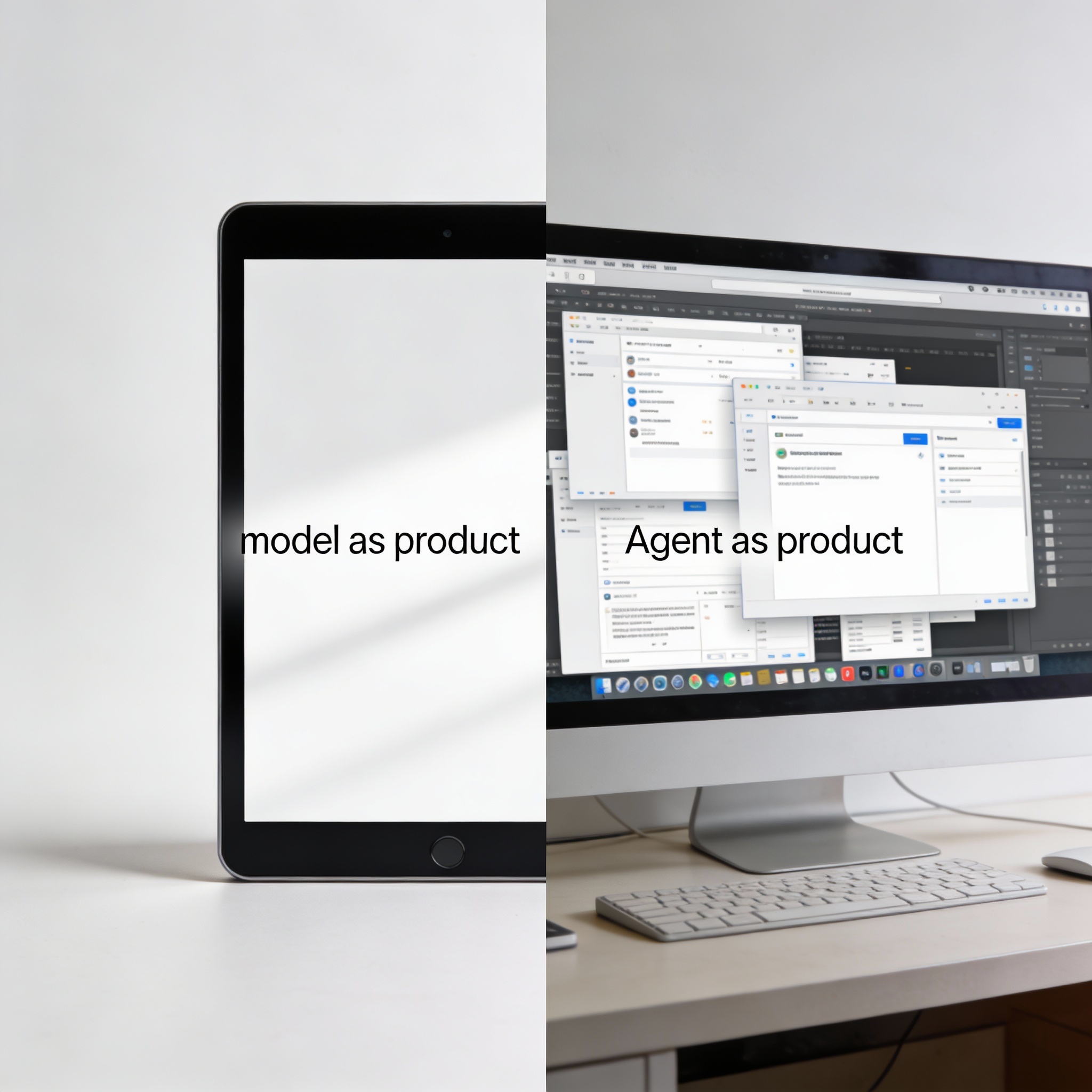
Comparison of a stable 'model as product' interface on a tablet and a complex 'Agent as product' interface on a desktop.
Other notable movements include Grok's surge from 9% in August to 52% in January, benefiting from exposure on Elon Musk's X platform. Perplexity, after rapid mid-year growth, saw its latest data drop to -27%, possibly due to competition from Google and OpenAI's search functionalities. Meta AI, despite a recent -3% decline, recorded over 100% year-on-year growth in November and December, indicating success in integrating AI into Facebook, Instagram, and WhatsApp.
AI Programming Tools: Real Demand, Shallow Moats
The Code Completion & DevOps category, after a significant decline, has stabilized and recovered, with the 12-week change improving from -31% to +9%.
Product-level differentiation is evident. Lovable, a "natural language application generation" tool, recovered from a -50% decline to +23%. Cursor, an AI editor, maintained positive growth of 8-10% in the last three months after earlier traffic declines, suggesting it addresses genuine developer needs. Base44 showed explosive growth, though from a very small base. Bolt, an early star product, saw a continuous fall to -39%, potentially displaced by newer alternatives. Other tools like Windsurf (-6%), Tabnine (-25%), and Cognition (-22%) also experienced declines. This sector is characterized by intense competition and low user loyalty.
The demand for AI programming tools is robust, but individual products often lack strong competitive advantages, leading to continuous market reshuffling.

Abstract digital network with easily bypassed pathways, symbolizing shallow competitive moats in AI programming.
AI Writing: General-Purpose AI Dominance
The Writing & Content Generation sector recorded an overall decline of -10%, with most players experiencing drops. Growthbarseo, an SEO writing tool, plummeted from +60% to -100%, effectively ceasing traffic, indicating displacement by general-purpose AI. Jasper (-16%), Wordtune (-16%), and Writesonic (-17%) all saw significant declines. Writer plunged from +15% to -38%, and Surferseo from +4% to -23%.
The only outlier was Originality, an AI content detection tool, which grew by 17%. This suggests market concern over AI-generated content is driving demand for detection tools. The decline in AI writing tools highlights a trend: products that merely wrap general-purpose AI with templates are being superseded as users directly access core AI models like ChatGPT or Claude.

User directly interacting with a general-purpose AI interface, with blurred specialized writing tool icons in foreground.
AI Image Generation: Cooling Down
The Design & Image Generation sector showed an overall decline of -10%, a surprising figure given its previous prominence. Midjourney, once a leader, fell from +33% in August to -16%. Leonardo (+2%) remained stable, while Deepai (-33%) and Ideogram (-22%) saw significant drops. The sector has not experienced positive growth for six months.
This suggests the "toy phase" of AI image generation may be ending, with casual users departing. Additionally, the integration of image generation capabilities into general-purpose AI tools reduces the need for dedicated platforms. Skylum, an AI tool for photo post-processing, grew by 67%, indicating a shift towards "enhancement" rather than pure "generation" as a future direction for AI image tools.

Digital canvas with a partially rendered, fading image, symbolizing the 'cooling down' of AI image generation.
AI Video: Stable Growth, Niche Focus
The Video Generation sector saw an overall growth of 5%, but with stark internal differentiation. Kuaishou's Klingai led with +36%, recognized for coherent action video generation. Typecast grew by 53%, focusing on AI virtual human broadcasting. HeyGen (+8%) and Synthesia (+13%) also maintained positive growth, both specializing in "digital human + video" for enterprise applications.
Conversely, Runway, a former benchmark, fell by 32%. Captions dropped by 37%, and Descript by 10%. Tools focused on "general video generation" performed poorly, while those targeting specific scenarios (digital humans, virtual anchors, special effects) thrived. This indicates that the video generation market is not yet consolidated, with vertical applications offering more opportunities.

Split image showing a generic AI video generation interface versus a specialized one with a digital human anchor.
Other Notable Trends
Music generation is the fastest-growing AI sub-segment, with an overall increase of 30%. Suno leads with +46%, dominating the market despite ongoing copyright challenges. Voice AI is also recovering, up 14%, with ElevenLabs maintaining its lead (+27%) through superior voice cloning quality and real-world applications in podcasts and audiobooks.
Automation tools like n8n (-27%), Zapier (-24%), and Make (-11%) collectively declined, possibly due to general-purpose AI handling simpler automation tasks. AI travel planning, despite initial hype, saw an overall -4% decline, with Mindtrip plummeting from +153% to -6%. Travel's low-frequency nature and integration of AI into existing platforms like Google and Ctrip make it challenging for independent AI travel apps. Browser automation tools also saw a collective 22% decline, indicating that the "infrastructure" concept for AI Agents is still largely experimental.

Ancient stone monument with subtle, glowing digital cracks, symbolizing gradual AI disruption of traditional industries.
AI's Impact on Traditional Industries
The report also tracked traditional industries believed to be impacted by AI. Traditional search (Google, Bing) remained stable at around -3%, with Google showing minimal change (-1% to -2%). Bing, despite Microsoft's aggressive AI integration, fell more sharply (-12%). Digital freelance platforms (Fiverr, Upwork) stabilized at 0% change, suggesting AI has not yet caused a massive loss of users. Online education platforms (Udemy, Coursera, Duolingo) improved from -8% to +2% overall. Stock media (Shutterstock, Getty) remained stable at around -3%. Design platforms (Canva, Figma) maintained over 15% positive growth, though slowing. Web & Shop Builders like Squarespace (+19%) and Square (+17%) grew, while Wix, Shopify, and Woocommerce declined. Reddit stood out in Discussion & Q&A Forums (+12%), while Quora dropped by half (-53%), possibly due to AI's ability to directly answer questions.
These findings suggest that AI's disruption of traditional industries is a gradual process, not an overnight shift.
Emerging Patterns
Several patterns emerge across all sectors:
"Tool-oriented" AI applications, solving real productivity problems, show more vitality than "toy-oriented" applications.
Vertical scenarios offer stronger competitive advantages than general scenarios.
"Wrapper" products built around general-purpose AI face significant risk of being absorbed by the underlying models.
"Model as product" approaches demonstrate greater stability than "Agent as product" offerings.
The report's core message is that the AI industry is transitioning from an early phase of broad growth to a more competitive, differentiated market. ChatGPT's traffic decline indicates market maturation rather than a peak in AI development. Users are becoming more discerning, leading to a diversified landscape rather than a winner-take-all scenario. This differentiation benefits users through increased choice and innovation, while providing a more objective perspective for industry professionals and investors.
Stay Ahead of the AI Curve
Join 50,000+ subscribers getting the latest AI tools, trends, and tutorials delivered to their inbox weekly.
No spam, unsubscribe at any time.