
Bad Boy Browser Enables AI Agents to Directly Interact with Websites Using User Accounts

A new tool named Bad Boy Browser allows AI agents to directly use a user's logged-in browser accounts to access and interact with websites. This system eliminates the need for API keys or custom web crawlers by controlling a real Chrome browser through a Chrome extension and the Chrome DevTools Protocol (CDP).

Laptop screen showing a web browser with a subtle digital overlay, representing AI control.
Unlike traditional headless browsers or methods that simulate requests or steal cookies, Bad Boy Browser operates within the user's existing login state. It executes JavaScript directly in the browser console, bypassing common authentication challenges and anti-crawler mechanisms.
Capabilities and Features
The tool enables AI agents to utilize a user's logged-in accounts on platforms such as Weibo, Zhihu, Bilibili, Xiaohongshu, Twitter, and GitHub. Examples of commands include searching tweets (bb-browser site twitter/search "AI agent"), checking Zhihu hot topics (bb-browser site zhihu/hot), or retrieving real-time stock quotes (bb-browser site eastmoney/stock "茅台"). The system currently supports 36 platforms and 103 commands, all leveraging the real browser's login state.

Abstract digital network of platforms with a glowing AI agent navigating, symbolizing seamless interaction.
The core principle behind Bad Boy Browser is to allow machines to use human interfaces, making websites perceive the AI agent's actions as originating from the logged-in user. This approach aims to avoid detection by anti-crawler systems, as the interaction is indistinguishable from human browsing.
Supported platforms span various categories, including search engines (Google, Baidu), social media (Twitter/X, Reddit, Weibo), video platforms (YouTube, Bilibili), tech development sites (GitHub, StackOverflow), finance (Xueqiu, East Money), job search (BOSS Zhipin, LinkedIn), knowledge bases (Wikipedia, Zhihu), and news outlets (BBC, Reuters). The list of supported sites is community-driven and maintained via bb-sites.
Impact on AI Agents
Bad Boy Browser expands the operational scope of AI agents beyond file systems, terminals, and API-keyed services to include the entire internet. This allows agents to conduct cross-platform research rapidly. For instance, an agent can simultaneously search for information on "retrieval augmented generation" across arXiv, Twitter, GitHub, StackOverflow, Zhihu, and 36Kr, generating structured JSON output.
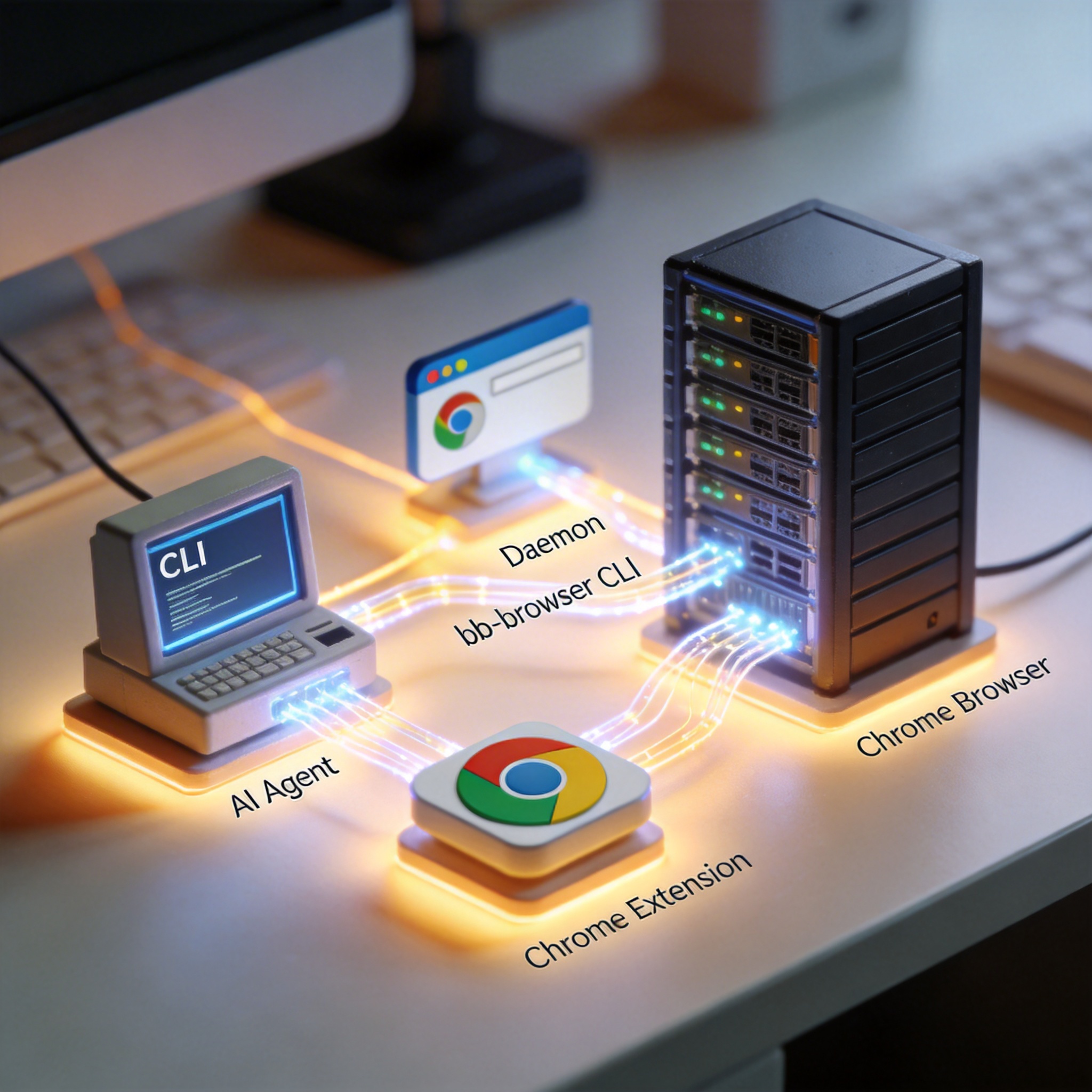
3D physical model illustrating the architecture of Bad Boy Browser, showing interconnected components.
The architecture involves an AI agent (such as Claude Code or Cursor) communicating via CLI or MCP to the bb-browser CLI. This CLI then uses HTTP to interact with a daemon, which in turn uses Server-Sent Events (SSE) to communicate with a Chrome extension. The extension then uses chrome.debugger (CDP) to control the user's real browser.
Installation and Advanced Usage
Installation is performed via npm install -g bb-browser. Users can update community adapters, view recommended adapters based on browsing habits, and execute commands like bb-browser site zhihu/hot.
For users of OpenClaw, the tool can run directly through its built-in browser without requiring an additional Chrome extension. An example command is bb-browser site reddit/hot --openclaw.
Bad Boy Browser also offers integration with Multi-Command Protocol (MCP) servers, allowing AI agents to directly interact with the tool.
The system provides a guide for users to "CLI-ify" any website, enabling AI agents to reverse-engineer websites, capture network packets, write adapters, and submit them to a community repository automatically. Adapters vary in complexity, from simple cookie-based authentication (Tier 1, ~1 minute) to more complex methods involving Bearer and CSRF tokens (Tier 2, ~3 minutes) or Webpack injection (Tier 3, ~10 minutes). Tests have shown that 20 AI agents can concurrently reverse-engineer websites and produce usable adapters, suggesting a near-zero marginal cost for integrating new websites into an agent's accessible range.
Multiple abstract AI agents concurrently reverse-engineering various website interfaces, symbolizing rapid adaptation.
Beyond its adapter functionality, Bad Boy Browser serves as a comprehensive browser automation tool. It supports direct browser operations such as opening URLs (bb-browser open https://example.com), taking snapshots (bb-browser snapshot -i), clicking elements (bb-browser click @3), filling input fields (bb-browser fill @5 "hello"), executing JavaScript (bb-browser eval "document.title"), fetching URLs with login state (bb-browser fetch URL --json), capturing network requests (bb-browser network requests --with-body --json), and taking screenshots (bb-browser screenshot). All commands support JSON output, inline filtering with jq, and concurrent multi-tab operations.
The project's source code is available on GitHub.
Stay Ahead of the AI Curve
Join 50,000+ subscribers getting the latest AI tools, trends, and tutorials delivered to their inbox weekly.
No spam, unsubscribe at any time.