
AI Agent Systems Transform Workflows and Economic Landscape in Early 2026
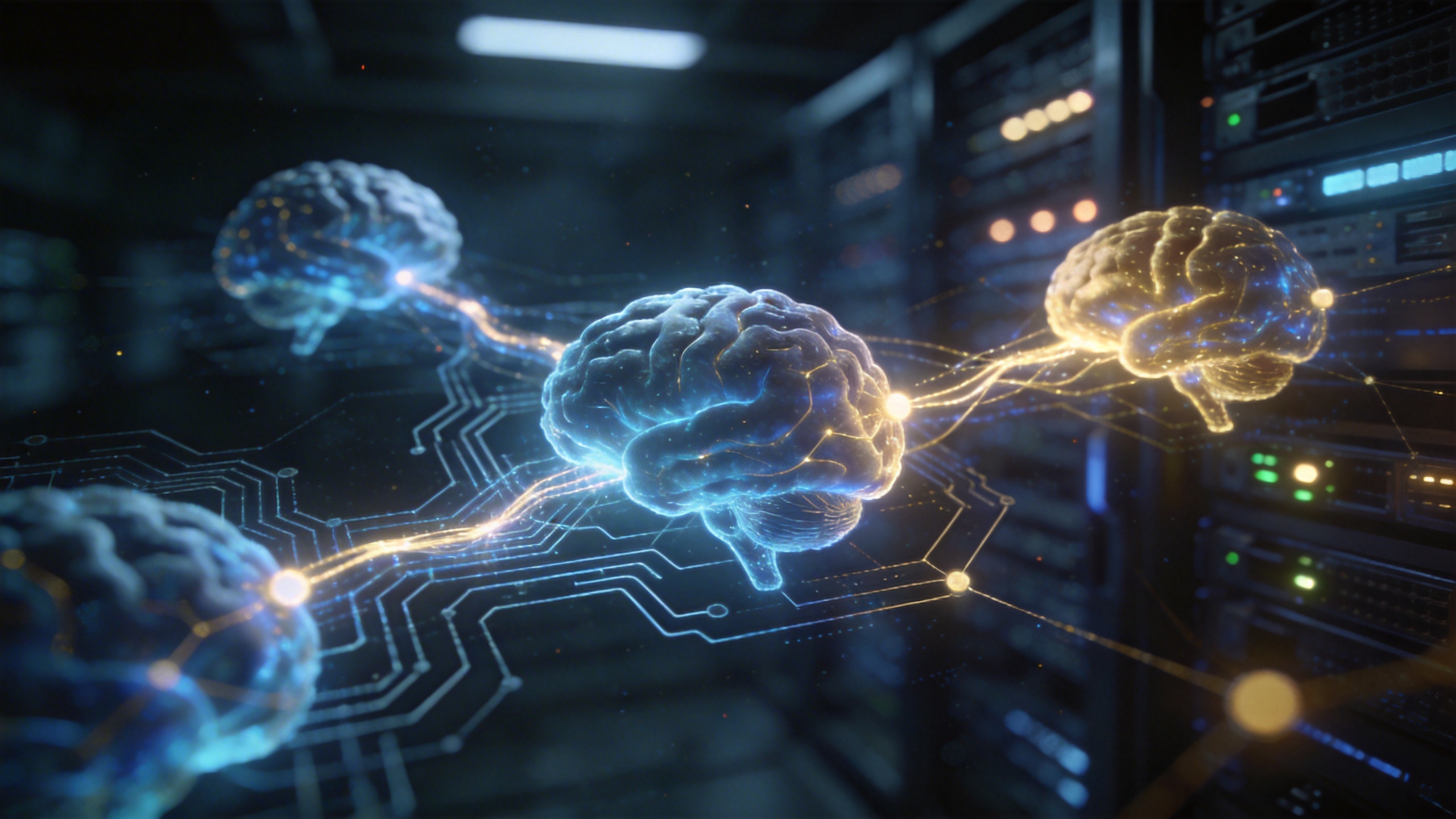
The artificial intelligence landscape has undergone a significant transformation by early 2026, shifting from AI as a question-answering tool to a sophisticated, autonomous workforce. This evolution is characterized by advancements across four key areas: enhanced model intelligence, expanded operational capabilities, the emergence of multi-agent collaboration, and the development of self-evolutionary mechanisms.
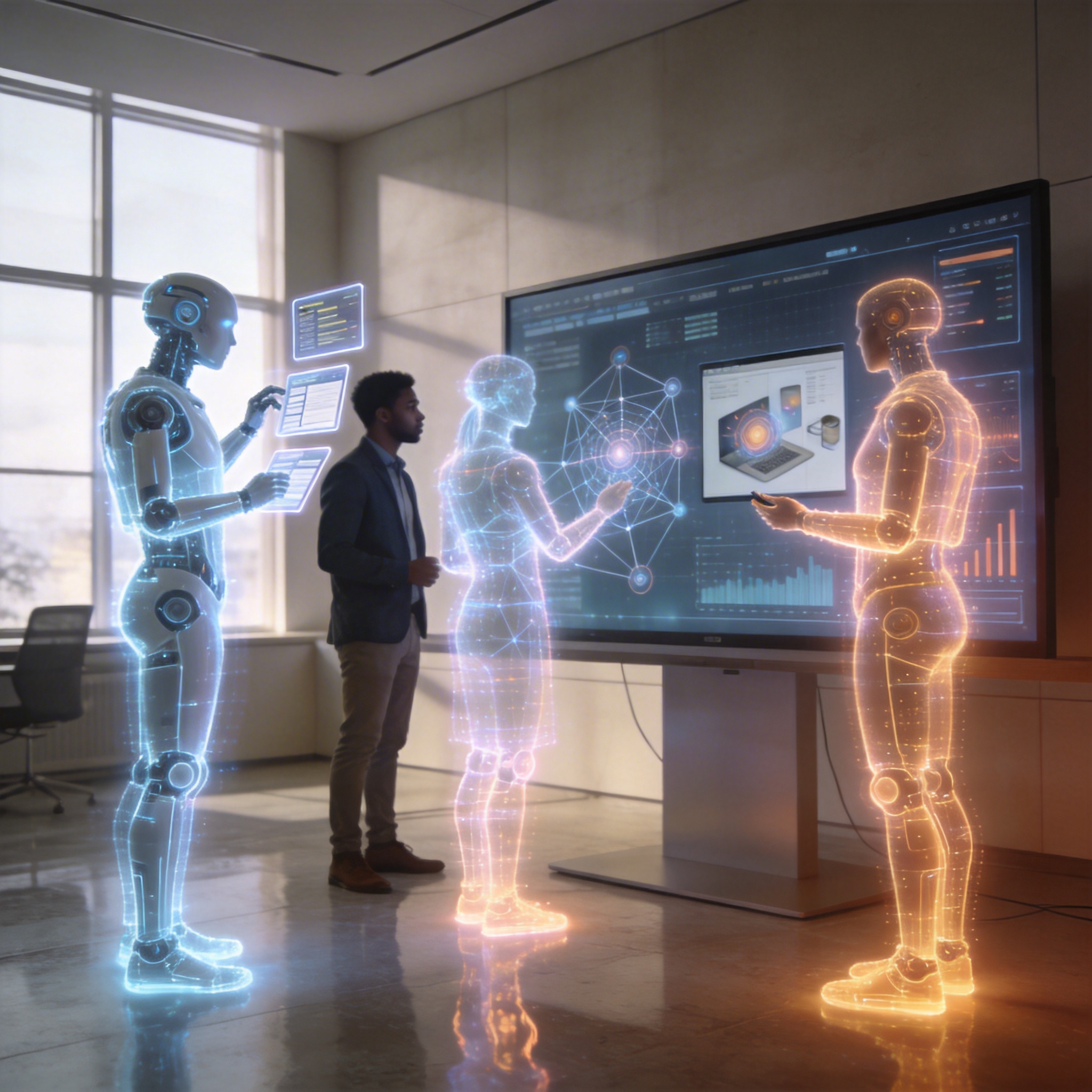
Holographic AI agents collaborating around a digital display in a modern office, symbolizing autonomous task execution.
The Evolution of AI Capabilities
In 2025, user interaction with AI typically involved direct queries to a chatbot, with the user responsible for evaluating and executing the AI's responses. By early 2026, this paradigm has changed. Users now describe an intent to an AI Agent, which then autonomously breaks down the task, dispatches sub-agents, integrates various tools and data sources, explores multiple solutions in parallel, self-assesses quality, and delivers a finished product.
This shift is underpinned by four layers of technological advancement:
Layer 1: Enhanced AI Brainpower
Significant model upgrades in early 2026, such as Anthropic's Claude Opus 4.6 and OpenAI's GPT-5.3 Codex, mark a new era for AI. These models demonstrate vastly improved programming capabilities, setting new benchmarks in coding tests with greater resource efficiency and enhanced bug detection and self-correction.
A notable development is the models' nascent "judgment." Unlike previous versions that merely followed instructions for tool use, new models can independently decide which tools to employ, when, and how to combine them, exhibiting what some describe as "judgment and taste."
AI's ability to sustain continuous, expert-level tasks has also expanded. Research indicates that the duration AI can independently complete such tasks has grown from minutes to several hours, with this capability roughly doubling every 4 to 7 months. Opus 4.6, for instance, features a 1 million token context window, enabling it to process extensive information, such as an entire project's codebase and documentation, without losing context. A token represents the basic unit of information processed by AI, with the context window defining the amount of information an AI can "see" simultaneously.
Dario Amodei, CEO of Anthropic, speaking at a conference.
Perhaps the most profound change is AI's increasing involvement in its own creation. GPT-5.3 Codex was instrumental in debugging its own training process and managing deployments. Anthropic's CEO, Dario Amodei, noted that AI now writes "most of Anthropic's code," accelerating a feedback loop where smarter AI develops better code, leading to even smarter AI. This allows users to delegate complex tasks, returning hours later to find completed, high-quality work.
Layer 2: Expanded Operational Reach
Previously confined to chat interfaces, AI in 2026 can now act directly on behalf of users. New-generation Agents, exemplified by Claude Code, operate locally on users' computers. This allows Agents to access local files, documents, and other data without requiring uploads or copy-pasting, ensuring data remains user-owned and model-agnostic. An Agent is defined as a system that, given a goal, independently determines how to achieve it, selects tools, and verifies its own output.
The Model Context Protocol (MCP), an open-source standard promoted by Anthropic, OpenAI, and Google, facilitates Agent connectivity to external services like GitHub, Slack, and databases. This protocol standardizes external service interfaces, enabling plug-and-play integration for any AI.
Agents also leverage "Skills," which are pre-defined, loadable capability modules. These allow Agents to acquire specialized knowledge, such as best practices for frontend development or data analysis, without requiring extensive prompting. Skills can be created and shared by the community, expanding an Agent's potential capabilities beyond its core development.
Furthermore, Agents are becoming more personalized. While Claude Code uses a CLAUDE.md file for project-specific preferences, OpenClaw, an open-source local AI agent tool, extends this to a "sovereign AI" concept. OpenClaw uses plain-text Markdown files like SOUL.md (Agent personality), USER.md (user preferences), and MEMORY.md (long-term context) to manage an Agent's identity and memory. These files are dynamic, allowing Agents to learn and adapt to user interactions over time.
Agents can also utilize existing command-line tools like ffmpeg for video processing or ImageMagick for image manipulation. By abstracting the complex command-line syntax, Agents make these powerful tools accessible to general users. OpenClaw further enables Agents to interact with graphical interfaces, operating applications on computers and phones by simulating human clicks and inputs, even for software without APIs. A "heartbeat" mechanism allows Agents to perform scheduled tasks or proactively monitor systems.
The physical world is also becoming accessible to Agents, with electric vehicles emerging as a primary physical carrier. Integrated with autonomous driving, Agents in cars can execute tasks like ordering food, planning routes, and managing pickups, extending AI's reach beyond digital interfaces.

Futuristic electric vehicle driving autonomously through a smart city, with holographic AI interfaces.
Multimodal capabilities allow Agents to process and generate various forms of content. Models like Google's Nano Banana Pro can understand complex natural language to generate charts, while ByteDance's Seedance 2.0 supports mixed input (text, images, audio, video) and can "shoot" videos based on storyboards. These multimodal models can be integrated into Agent systems, creating teams with diverse capabilities.
Layer 3: Collaborative Agent Teams
The 2025 limitation of interacting with only one Agent at a time has been overcome by Multi-Agent systems. Agents can now form teams, enabling collaborative work.
SubAgents allow a main Agent to temporarily create specialized sub-agents for specific sub-tasks. These sub-agents process information, summarize results, and then disappear, keeping the main Agent's context clean and efficient. This approach is cost-effective, often utilizing smaller, faster models for exploratory tasks.
Agent Teams represent a more advanced form of collaboration, where multiple Agents exist simultaneously, work independently, and coordinate with each other. Anthropic's Agent Teams feature allows a main Agent (Team Lead) to manage persistent team members, each with specialized expertise and tools. For example, a team of 16 Claude Opus 4.6 instances successfully developed a C language compiler for the Linux kernel using Rust, demonstrating sophisticated coordination through mechanisms like Git's file locking.
Beyond Anthropic, the Agent-to-Agent (A2A) protocol, developed by Google in collaboration with over 50 companies, enables Agents from different vendors to communicate and collaborate, fostering an interconnected Agent ecosystem.
Git Worktree, a feature for managing code versions, allows Agents to explore multiple solutions in parallel. By creating independent workspaces, Agent Teams can simultaneously develop and test different approaches to a problem, significantly reducing development time and expanding exploration possibilities.
Proactive work mechanisms, similar to OpenClaw's scheduling, enable Agents to monitor systems, identify issues, and attempt self-correction, notifying users only when human intervention is required. This shifts the interaction from active user requests to continuous, autonomous monitoring and action.
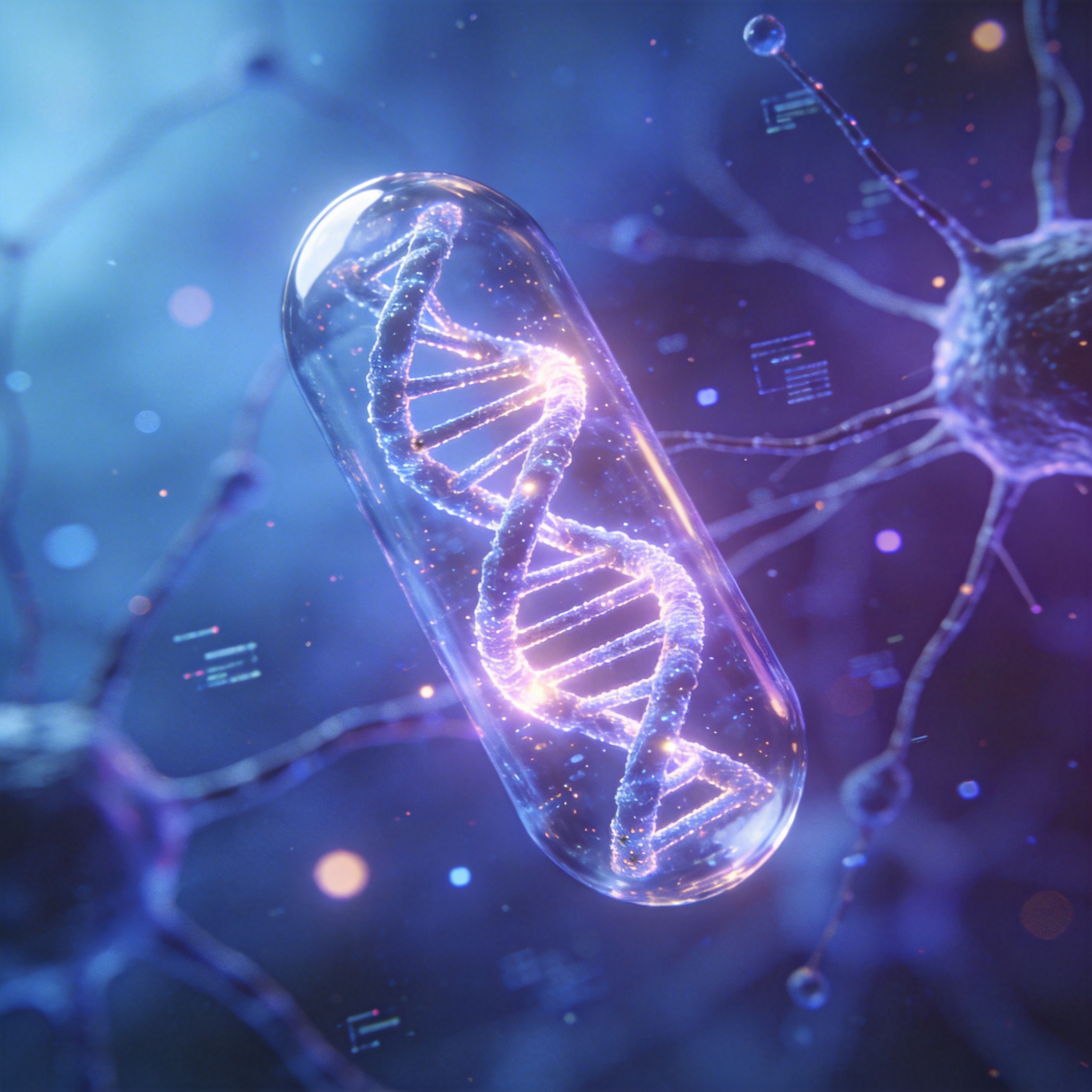
Abstract digital 'gene capsule' resembling a double helix, symbolizing the transfer of AI Agent experience.
Layer 4: Evolutionary Learning
A new layer addresses the previous limitation of Agents not learning from experience. The Genomic Evolution Protocol (GEP) allows Agent experience to be saved and transferred. Inspired by biological gene expression, successful approaches are packaged into "gene capsules" that other Agents can inherit.
Unlike fixed "Skills," GEP Genes represent dynamic, evolving experience. For example, a "naming isolation strategy" developed by an Agent in game design could be packaged as a gene capsule and later inherited by a backend engineer's Agent to resolve variable naming conflicts, demonstrating cross-domain knowledge transfer. GEP is an open protocol, ensuring that accumulated Agent experience remains user-owned and transferable across platforms.
The Multiplicative Impact of Layered Advancements
The combined effect of these four layers is multiplicative:
Layer 1 (Brain): Individual Agents achieve expert-level output quality.
Layer 2 (Hands and Feet): Agents possess diverse tool-use capabilities spanning multiple job functions.
Layer 3 (Organization): Multiple Agents collaborate simultaneously, operating continuously.
Layer 4 (Evolution): Agent experiences are accumulated, transferred, and evolve.
This integrated system transforms the user experience from interacting with a single chatbot to managing a capable team. Tasks such as coding, design, testing, video editing, mobile app operation, and even physical world interactions via cars can be delegated. This allows for parallel exploration of solutions, self-assessment of quality, and continuous work, even while the user is away. The ability to build a complex product in a week, a task that previously required a large company's team for a month, illustrates the leverage provided by these stacked advancements.

Executive surrounded by swirling holographic AI agents and data, symbolizing the challenge of Agent management.
Remaining Challenges
Despite these advancements, several challenges persist:
Agent Management: Overseeing multiple Agents simultaneously, each working in different domains, can be complex. Tools are needed to track Agent actions, reasoning, and manage token consumption effectively.
Security and Trust: As Agents gain more permissions to operate computers and access sensitive data, defining the boundaries between automated execution and required user confirmation is critical.
Economic Identity: Agents can incur costs (tokens, paid APIs) and generate value (bounty tasks, gene capsule contributions). However, they lack bank accounts or identity verification, raising questions about accountability, profit distribution, and inter-Agent financial settlements.
Societal and Economic Implications
These changes are expected to have profound impacts:
Corporate Restructuring: The ability of one person, augmented by Agents, to perform tasks previously requiring multiple roles will lead to significant downsizing in companies.
Education Gap: Traditional education, focused on "execution ability," may struggle to adapt to the Agent era's demand for "judgment ability"—identifying problems, evaluating solutions, and making decisions under uncertainty.
Middle-Class Vulnerability: While manual labor may be less immediately affected, and top-tier individuals gain leverage, the middle class, including white-collar workers and middle management, faces the highest risk of job displacement as their tasks are easily automated by Agents.
Content Reshuffling: The cost of content production will plummet, shifting value from "being able to create" to "knowing what to create." Taste, judgment, and unique perspectives will become paramount.
Geopolitical Shifts: In the Agent era, national strength may be increasingly tied to energy efficiency, which directly impacts computing power and the cost of intelligence. Developing countries' previous advantage of cheap labor may diminish as Agents offer a more cost-effective and stable alternative.

Digital fault line through a cityscape, symbolizing the shifting economic landscape due to AI.
Recommendations for Adaptation
To navigate this evolving landscape, individuals are advised to:
Embrace Advanced Tools: Utilize paid versions of AI models like Claude Code or ChatGPT, as free versions often lag significantly in capability.
Integrate AI into Workflows: Move beyond casual chat and integrate AI into daily tasks, allowing it to assist with data analysis, content drafting, or document creation.
Understand Agent Systems: Grasp the underlying logic of Agent systems, including concepts like MCP, Skills, and local document systems, to effectively command and leverage these tools.
Re-evaluate Personal Value: Shift focus from "personal execution" to "defining problems and judging quality." Agents can realize ideas, but human judgment remains crucial for generating them.
Act Promptly: The rapid pace of AI development means that waiting for maturity or formal training will only widen the gap. Investing in AI tools and understanding their capabilities is an investment in future productivity and relevance.
The current stage of AI development is akin to the "adolescence of technology"—a period of rapid change, immense energy, and uncertain direction. Understanding these shifts is crucial for individuals to prepare and adapt.
Stay Ahead of the AI Curve
Join 50,000+ subscribers getting the latest AI tools, trends, and tutorials delivered to their inbox weekly.
No spam, unsubscribe at any time.