Dewy Chat attracts 5,889× more visits than the next tool, so backers|AI Anime Girlfriend

Executive Summary
Dewy Chat attracts 5,889× more visits than the next tool, so backers must either underwrite its moat or fund challengers with a truly orthogonal wedge.
The mean tool sees 24,053,964 visits while the median manages 15,919, a 1,511× gap that renders percentile-based decks useless; diligence has to focus on absolute user counts.
Direct arrivals control 50% of category traffic versus 26% from search, so SEO-only roadmaps will stall without early investment in brand, creator, or partnership channels.
xeve.ai leans on referrals (28%), display (19%), and limited direct demand (25%), locking it into a paid/affiliate treadmill that will spike CAC when partner terms tighten.
dmwithme fell 18% month over month to 16,188 visits, making it a churn cautionary tale rather than a momentum proof point for the segment.
Dewy Chat pulls just 27% of its traffic from the United States and already logs double-digit share from Japan plus China, so localization and cross-border compliance are day-one requirements.
dehouse.ai depends on U.S. referrals for 93% of its 1,907 visits, leaving the funnel one algorithm tweak away from zero throughput.
The snapshot covers six tools, so treat these numbers as directional guardrails paired with qualitative research before greenlighting spend.
Monolithic Reach Concentrates Power
Dewy Chat produces nearly all measurable volume, logging 5,889× more visits than the runner-up, so newcomers must assume it stays the main discovery surface for now. Challengers need halo strategies—integrations, companion utilities, obsessive vertical fantasies—rather than pretending they can outrank it head-on.
The mean tool counts 24,053,964 visits while the median musters 15,919, a 1,511× split that screams power law. Blended benchmarks become noise, so investors should rebuild bottom-up funnels such as cost per live chat room instead of leaning on skewed “category averages.”
Dewy Chat’s 144,265,546 monthly visits versus xeve.ai’s 24,496 show how concentrated the market already is. Cross-promotions or licensing deals with Dewy therefore offer more leverage than incremental ad spend elsewhere because the leader acts like the default distribution rail.
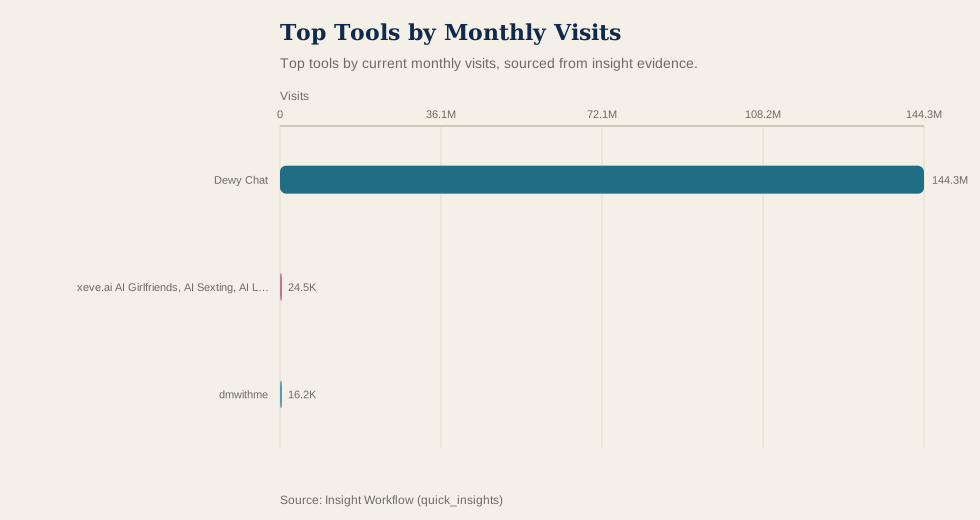
Top tools by current monthly visits, sourced from insight evidence.
Why it matters: The imbalance proves product differentiation alone cannot unlock mindshare without channel plans tied to the leader. Operator takeaway: Secure placement, affiliate status, or co-branded events with Dewy before burning budget on parallel acquisition streams that cannot reach its scale.
Even with just six tools, the spread shows “top five” lists are statistically meaningless, so the real thesis is whether a bet can ride or route around Dewy’s orbit. That clarity helps: either fund infrastructure that feeds the leader or back orthogonal experiences—safer romance, heavier moderation—that can win buyers Dewy cannot.
Direct-First Channel Architecture
Direct arrivals already outrun search and referrals combined, which means this category rewards owned brands and parasocial loyalty more than algorithmic arbitrage. Teams need creator partnerships, paid media, or community loops before they pour money into SEO tooling constrained by the remaining minority channels.
Direct holds 50% of traffic while search and referrals trail at 26% and 19%; long-tail SEO experiments will merely defend existing awareness unless paired with distinctive brand moments or celebrity distribution spikes.
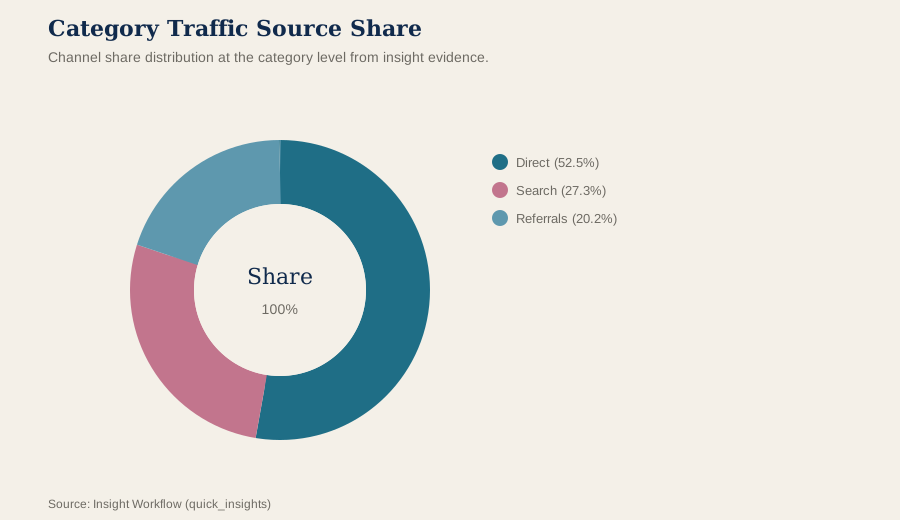
Channel share distribution at the category level from insight evidence.
Why it matters: Channel concentration collapses the classic “publish and pray” playbook, so only teams ready to buy or borrow audience can scale. Operator takeaway: Budget for programs that deepen direct recall—Discord servers, live drops, persistent communities—before hiring incremental SEO contractors.
xeve.ai gets 28% of visits from referrals, 19% from display ads, and only 25% direct, which means it rents attention from affiliates and ad networks instead of owning it. As more players court the same affiliates, payouts will rise and margins will compress, especially in adult-themed inventory where regulators already push CPA higher. Founders copying this play need rev-share caps or in-house referral aggregators, and investors should price in volatile working capital.
dmwithme’s 16,188 monthly visits are already down 18% month over month, showing how quickly small wins evaporate when the top of funnel is thin. With no SERP context in the snapshot, the cause is unclear, so treat the decline as a churn flag and demand retention cohorts before calling it traction.
dehouse.ai draws 93% of visits from referrals and operates entirely in the United States, leaving its 1,907-visit funnel one partner algorithm tweak away from zero while payouts arrive only after conversions, making cash timing lumpy.
Builders should read the 50% direct share as an API constraint: if the core experience never earns bookmarks or daily rituals, demand will not compound. Investors face concentration risk because xeve.ai’s 28% referral mix and dehouse.ai’s 93% mix show how fast valuations crack when partners churn, so term sheets need contingency capital for channel shocks. Product managers inside larger platforms should require proof of stable direct intent plus diversified channels before integrating a vendor; otherwise the partnership adds novelty, not durable usage.
Localization Splits Strategies
Dewy Chat pulls only 27% of its traffic from the United States while Japan contributes 6.95% and China 5.17%, so its moat now hinges on multilingual culturalization rather than English-only scale. Challengers need translation pipelines, voice models, and compliance expertise in place before they can match the leader’s baseline.
dehouse.ai is the opposite case: 100% of its 1,907 visits come from the United States and 93% from referrals, which may simplify moderation but leaves the business exposed to U.S. regulatory or payment shocks just as its channels remain fragile.
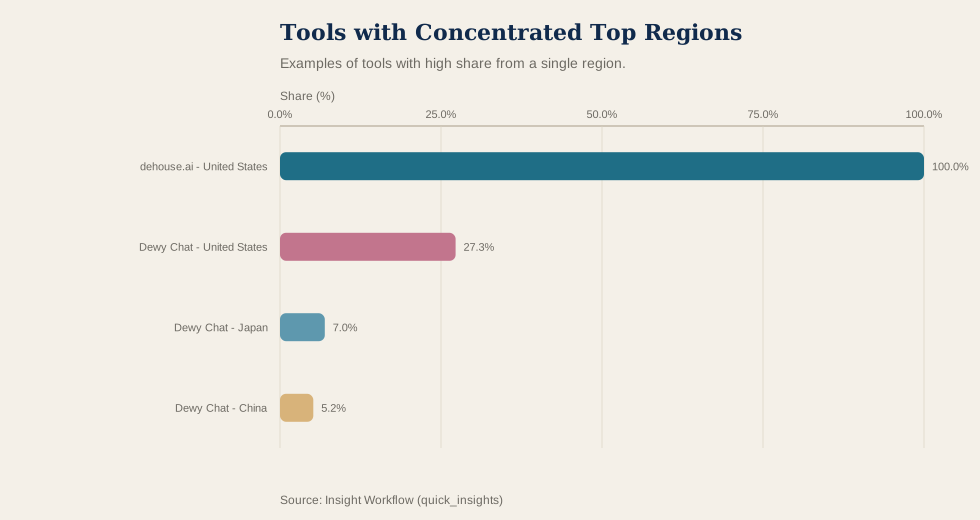
Examples of tools with high share from a single region.
Why it matters: Regionally concentrated funnels are single points of failure, so the long tail cannot claim global demand as a hedge. Operator takeaway: Either secure multi-region traffic sources early or run a U.S.-only play with contingency plans for payment and partner churn baked in.
The contrast between Dewy’s global mix and dehouse’s hyperlocal footprint forces operators to choose between two paths: scale-wide licensing plus localization muscle, or tightly regulated specialist products that accept limited TAM for higher compliance comfort. Investors should reject middle-ground pitches promising both, because this sample shows only a heavyweight with diversified regions and micro players stuck in one market. That reality pushes diligence toward funding infrastructure that accelerates Dewy’s internationalization or backing regional upstarts differentiated by regulation instead of reach.
Playbooks From Representative Tools
Dewy Chat pairs a “create your own worlds” pitch with AI companion narratives, and the traffic mix proves that story resonates far beyond the United States, giving it a cultural buffer rivals must respect. Direct clones should instead chase underserved subcultures or white-label Dewy’s tech for enterprise intimacy training rather than pursue the mainstream user it already owns.
xeve.ai sells an AI videochat fantasy experience, but its traffic mix shows that glossy positioning cannot replace owned demand because roughly half of visits come through paid or partner-dependent routes. Developers need referral-friendly hooks—clip-sharing widgets, revenue-sharing fan sites—built into the product so partners see immediate upside. Investors should treat marketing working capital as a permanent line item, and PMs should demand channel transparency before relying on inventory that could vanish as ad platforms tighten rules.
dmwithme offers “realistic” AI companion chats, yet the 18% MoM drop at a low base underscores how fragile lightweight differentiators look without defensible channels. Developers should prioritize linkable features such as shareable transcripts over incremental prompt tweaks, and investors must confirm whether the decline reflects channel throttling or actual user abandonment before investing. PMs should require stability clauses or short pilots because the dataset lacks SERP evidence to explain the reversal.
dehouse.ai promises monetizable AI twins while depending entirely on U.S. referral traffic, showing how quickly monetization dreams collapse when distribution rests on one geography plus one channel. Developers need at least one repeatable direct surface—bookmarked apps, community hubs—or else partner algorithm shifts will strand monetization layers. Investors evaluating white-label twin platforms should discount pipelines that rely on a single referral partner, and PMs should insist on multi-geo compliance evidence before integrating sensitive identity replicas.
Data Constraints and Monitoring Priorities
The 1,511× mean-to-median gap stems partly from the six-tool sample, so treat these numbers as framing devices rather than definitive market share. Because one leader swings the aggregate so dramatically, monitoring should focus on Dewy’s traffic rather than category totals; the space effectively behaves like a single-company early-warning system. Set up instrumentation that tracks Dewy’s regional and channel mix monthly so you can pivot go-to-market the moment its halo weakens.
Channel and geography readings arrive without keyword or SERP diagnostics, limiting our ability to tie moves such as dmwithme’s 18% drop to specific causes. That uncertainty should push teams to run controlled experiments—swap referral partners, test localized creatives—and feed results into private dashboards instead of waiting for public benchmarks that may never appear. Pair this snapshot with qualitative interviews and paid cohort analysis before committing to investment or product bets.
Rankings (Data Appendix)
Snapshot: current; tools in category: 6. MoM Growth is a growth ratio (e.g., 0.147 = 14.7%). Shares are proportions (e.g., 0.211 = 21.1%).
Visual Summary
Top tools by current monthly visits, sourced from insight evidence.
Channel share distribution at the category level from insight evidence.
Top 5 tools by Monthly Visits
Dewy Chat
Visits: 144,265,546
MoM: +3.9%
Search: 26.07%
Direct: 50.24%
Top Region: United States (27.27%)
xeve.ai AI Girlfriends, AI Sexting, AI Live Video Chat and AI Striptease
Visits: 24,496
MoM: +3.6%
Search: 16.77%
Direct: 25.27%
Top Region: United States (33.86%)
dmwithme
Visits: 16,188
MoM: -17.9%
Search: 39.66%
Direct: 47.01%
Top Region: United States (26.54%)
FLIRTcam.ai - unique video AI girlfriend & boyfriend
Visits: 15,650
MoM: -5.0%
Search: 20.01%
Direct: 19.22%
Top Region: India (32.32%)
dehouse.ai
Visits: 1,907
MoM: -57.1%
Search: 2.09%
Direct: 2.09%
Top Region: United States (100.00%)
MoM Growth leaders (within top 5 by Monthly Visits)
Dewy Chat
Visits: 144,265,546
MoM: +3.9%
Search: 26.07%
Direct: 50.24%
xeve.ai AI Girlfriends, AI Sexting, AI Live Video Chat and AI Striptease
Visits: 24,496
MoM: +3.6%
Search: 16.77%
Direct: 25.27%
FLIRTcam.ai - unique video AI girlfriend & boyfriend
Visits: 15,650
MoM: -5.0%
Search: 20.01%
Direct: 19.22%
dmwithme
Visits: 16,188
MoM: -17.9%
Search: 39.66%
Direct: 47.01%
dehouse.ai
Visits: 1,907
MoM: -57.1%
Search: 2.09%
Direct: 2.09%
Top 3 (by Monthly Visits): Channel Mix
Dewy Chat
Visits: 144,265,546
Search: 26.07%
Direct: 50.24%
Referrals: 19.30%
Social: 2.47%
Display: 1.81%
Mail: 0.11%
xeve.ai AI Girlfriends, AI Sexting, AI Live Video Chat and AI Striptease
Visits: 24,496
Search: 16.77%
Direct: 25.27%
Referrals: 28.37%
Social: 10.77%
Display: 18.74%
Mail: 0.07%
dmwithme
Visits: 16,188
Search: 39.66%
Direct: 47.01%
Referrals: 7.74%
Social: 4.47%
Display: 1.00%
Mail: 0.12%
Note: “—” means missing or zeroed data in the source dataset.