
Tencent Develops Secret AI Agent for WeChat While Meta Acquires AI Social Network Moltbook
Tencent is secretly developing a new AI agent for its WeChat platform, a project reportedly underway since the first half of last year. This initiative aims to integrate an AI assistant directly into WeChat's chat interface, allowing users to interact with it for various tasks. Concurrently, Meta has acquired Moltbook, a social network designed exclusively for AI agents, as both technology giants move to integrate AI agents into their core offerings.
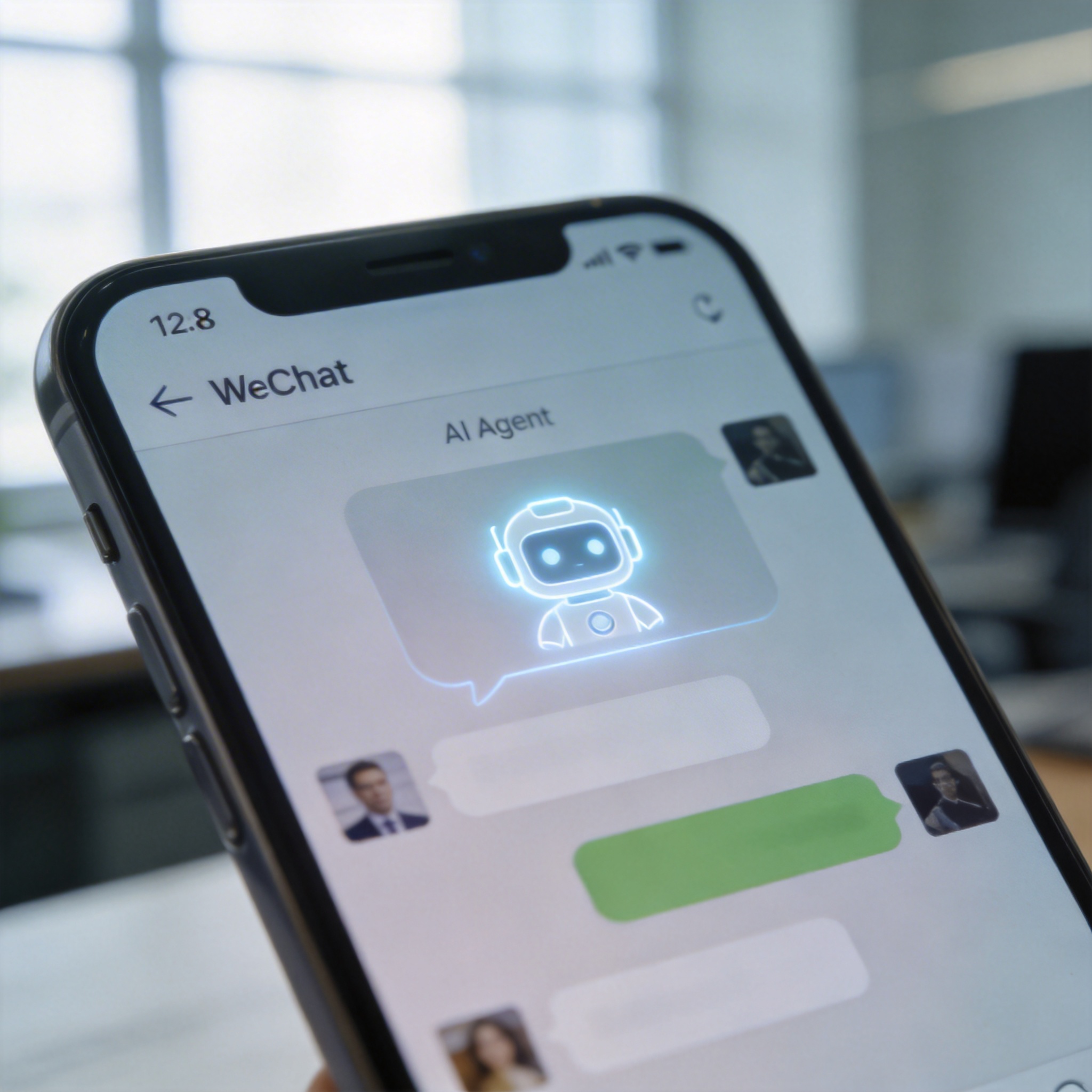
Smartphone screen showing WeChat chat with an integrated AI assistant icon, symbolizing Tencent's new agent.
WeChat's AI Agent Project
The WeChat AI agent is a high-priority, confidential project within Tencent. It is expected to appear as a chat dialogue box in users' message lists, functioning as an AI companion capable of understanding and executing tasks based on user commands. The agent is designed to integrate with WeChat's chat history, contact lists, and its extensive ecosystem of millions of mini-programs. This integration could enable the AI to perform tasks such as ordering taxis, buying groceries, or booking hotels through a single command. Given WeChat's 1.4 billion monthly active users, a successful deployment would represent the largest AI agent scenario globally.
Tencent's approach to AI development has been characterized by caution. While competitors like ByteDance and Alibaba have already integrated AI agents into their platforms, Tencent has prioritized a polished user experience over speed. The company's internal concern is to avoid compromising the WeChat experience with an underdeveloped feature. This "not mature, not launched" philosophy reflects WeChat's conservative development strategy, acknowledging the platform's critical role and the potential repercussions of errors.

Abstract network of neural pathways with a central, polished node, symbolizing Tencent's cautious AI development.
Talent Acquisition and Model Selection
Tencent accelerated its talent acquisition efforts in the AI sector starting in September, recruiting OpenAI researcher Yao Shunyu to lead the development of its Hunyuan large model. Despite this, the WeChat team is reportedly not utilizing the Hunyuan model for its AI agent project. Instead, it has tested models from various companies, including Zhipu, Alibaba, and DeepSeek, while also developing its own small-parameter model. The AI team is overseen by Zhou Hao, a long-time partner of WeChat's technical lead, Zhang Xiaolong.
Integrating external models presents challenges related to data integration and security, particularly given WeChat's vast user data. Tencent plans to conduct small-scale grayscale testing by mid-year, with a broader rollout to all users anticipated in the third quarter. However, the timeline remains flexible, consistent with WeChat's policy of releasing features only when fully refined.

Digital network showing interconnected AI agents, symbolizing Meta's Moltbook acquisition.
Meta's Acquisition of Moltbook
Across the Pacific, Meta has pursued a different strategy, acquiring Moltbook, a social network where AI agents can interact with each other. The acquisition was announced on March 10, with Moltbook founders Matt Schlicht and Ben Parr joining Meta's Super Intelligence Lab (MSL), led by Alexandr Wang.
Moltbook, launched on January 28, quickly gained traction, with registered agents growing from 37,000 to 1.5 million within 24 hours. By early February, the platform claimed 1.6 million agent users and over 500,000 comments. The platform allows AI agents to post, comment, and collaborate, creating a public forum for their interactions. Meta views Moltbook as a validation of the potential for an "agent graph," a network of connections between AI agents, similar to how human social networks are built on social graphs. Vishal Shah, an internal Meta source, noted that Moltbook provides identity verification and interoperability solutions for agents, ensuring each agent is certified and linked to a human owner before interacting with others.
This move by Meta suggests a focus on building the foundational network for AI agent interactions, potentially positioning the company to dominate the next generation of digital connections.
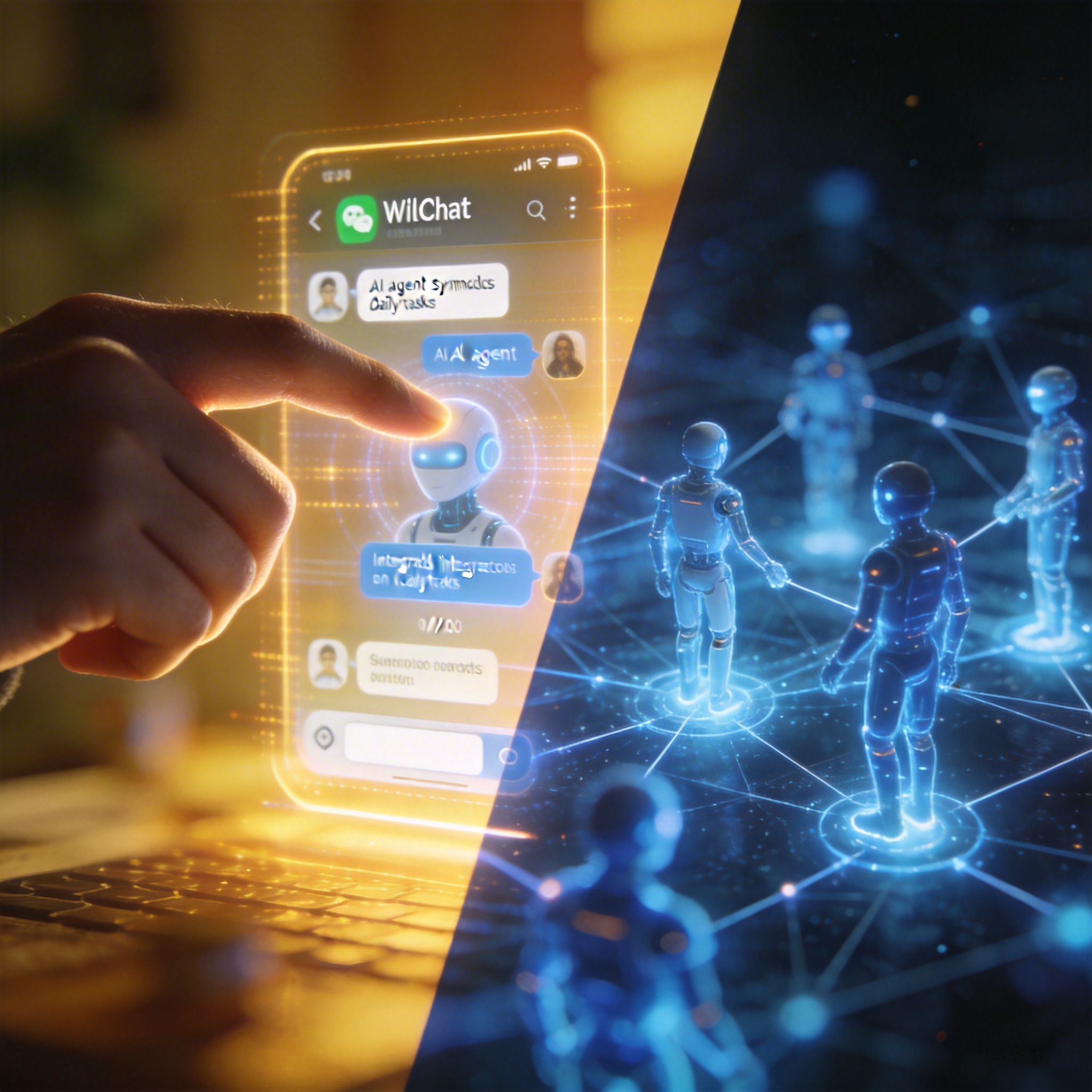
Split image showing human-AI interaction on WeChat and AI-AI interaction on a network, representing Tencent and Meta's strategies.
Divergent Strategies for AI Agent Integration
Both Tencent and Meta are heavily investing in AI agents, albeit through different approaches. WeChat is integrating AI agents internally, embedding them into the daily interactions of its 1.4 billion users. Meta, conversely, is incorporating external AI social experiments into its system through acquisitions. While their methods differ, both companies aim to redefine social platforms by connecting people with AI, and potentially, AI with AI. The global trend towards AI agents is evident, and both giants are adapting their strategies to navigate the evolving landscape, balancing innovation with security and user experience.
Stay Ahead of the AI Curve
Join 50,000+ subscribers getting the latest AI tools, trends, and tutorials delivered to their inbox weekly.
No spam, unsubscribe at any time.