
Supermemory's ASMR System Achieves 99% Accuracy in Advanced AI Memory Test


A new system named ASMR (Agent Search and Memory Retrieval), developed by Supermemory, has achieved a 99% accuracy rate on the LongMemEval benchmark, a challenging test for AI memory. This performance surpasses previous state-of-the-art results in the field.
The ASMR system addresses the persistent challenge of AI "amnesia" by implementing a novel approach that avoids traditional vector databases and embedding models. Instead, it operates entirely in memory, utilizing a multi-Agent parallel inference pipeline.

Holographic display showing a multi-agent AI architecture with Observer and Search Agents.
ASMR's Multi-Agent Architecture
ASMR's design incorporates a specialized division of labor among multiple AI agents. It employs three "Observer Agents" that concurrently process raw data, extracting information across six dimensions, including personal details, preferences, and timelines. When a user query is initiated, three "Search Agents" are deployed for active inference and retrieval.
This architecture aims to overcome limitations of conventional retrieval methods, particularly in handling complex, high-information-density, and time-series data. LongMemEval, the benchmark used, simulates real-world scenarios involving extensive dialogue histories, conflicting information, and fragmented events requiring temporal reasoning.

Luminous pathway cutting through fragmented data, symbolizing complex data resolution.
Technical Implementation and Performance
The ASMR system's technical implementation is designed for simplicity and efficiency. It does not rely on vector databases or embeddings, allowing it to be integrated into various systems, including hardware.
For answering questions, Supermemory explored two distinct AI Agent workflows:
8-Variant Cluster: This approach routes retrieved context to eight specialized prompt variants running in parallel. Each variant independently evaluates the context and generates an answer. If any of these reasoning paths yield a correct answer, the question is marked as correct. This method achieved an overall accuracy of 98.60%.
12-Variant Decision Forest: This workflow extends ASMR into a decision forest with 12 specialized AI Agents, each independently answering prompts. An "aggregation large model" then synthesizes these 12 answers using majority voting, domain trust, and conflict resolution mechanisms to produce a single consensus. This model achieved an accuracy of 97.2%.
These results indicate that agent-based retrieval can be superior to vector search by eliminating semantic similarity traps and addressing information invalidation due to temporal changes. Parallel processing among specialized agents also improves extraction speed and granularity.
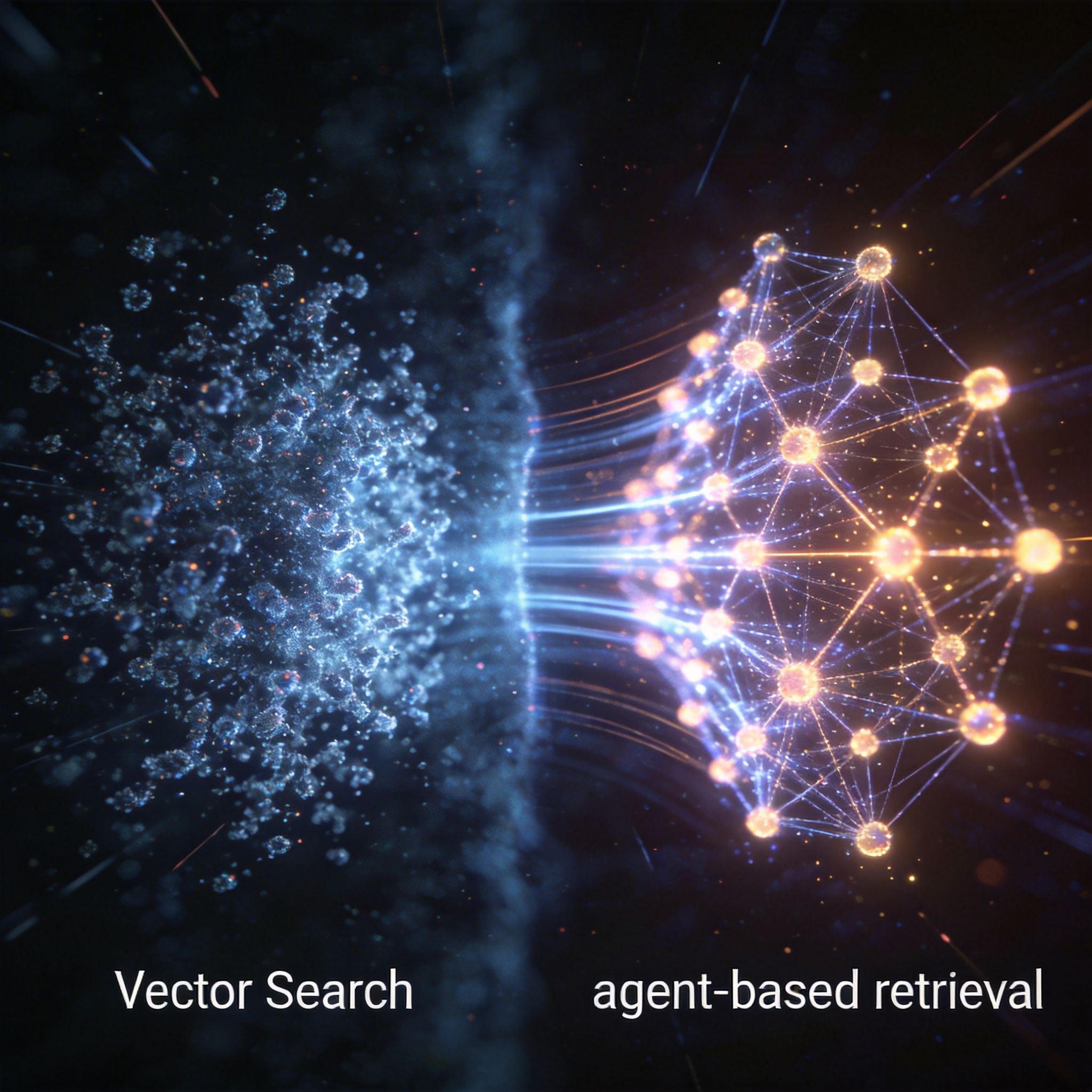
Abstract comparison of chaotic vector search vs. organized agent-based retrieval.
Beyond Retrieval: Supermemory's Broader Ambition
Supermemory aims to provide a comprehensive memory and context infrastructure for AI applications. The company differentiates its approach from traditional Retrieval Augmented Generation (RAG) by focusing on enabling AI to truly "remember" rather than merely retrieve.
While RAG systems may return the same information to different users or fail to update facts, Supermemory actively extracts facts from conversations, tracks changes, manages contradictions, and incorporates an "automatic forgetting" mechanism for temporary information. For instance, if a user's address changes, Supermemory ensures the AI system recognizes the updated information and disregards the old.

AI system on a tablet actively updating a user's address in a profile, symbolizing dynamic memory management.
Supermemory also offers user profiling capabilities, automating the process of building and maintaining user profiles. This system categorizes user information into static facts and dynamic context, allowing AI agents to access comprehensive user profiles with a single API call, with a latency of approximately 50 milliseconds.
Integration and Future Outlook
The Supermemory platform provides "all-in-one" connectivity, integrating with external data sources such as Google Drive, Gmail, Notion, OneDrive, and GitHub through real-time Webhooks. It also processes documents, including PDF parsing, image OCR, video transcription, and code analysis, making the content searchable without additional configuration.
For developers, Supermemory offers minimal integration costs, with support for mainstream AI development frameworks like Vercel AI SDK, LangChain, LangGraph, OpenAI Agents SDK, and Mastra. The company also provides an MCP server for direct use with applications such as Claude Desktop, Cursor, Windsurf, and VS Code.

Holographic interface showing AI memory as a foundational digital infrastructure.
Supermemory views AI memory as an infrastructural layer rather than an add-on feature. The company believes that enabling AI agents to remember user interactions and context will lead to a qualitative shift in human-computer interaction, transforming AI from a mere tool into a more effective partner. The company plans to open-source all ASMR code in early April.
Stay Ahead of the AI Curve
Join 50,000+ subscribers getting the latest AI tools, trends, and tutorials delivered to their inbox weekly.
No spam, unsubscribe at any time.