
OpenRouter's Anonymous "Pony Alpha" Model Sparks Global Speculation on Its Origin

OpenRouter, a platform for large language models, recently introduced an anonymous "Pony Alpha" model, which has generated significant online discussion due to its performance in programming, reasoning, and its 200K context window. The model's unannounced release has led to widespread speculation among the tech community regarding its developer, with various theories pointing to major AI labs.
On February 7, OpenRouter quietly launched Pony Alpha. The model appeared with minimal fanfare, featuring only a blue logo and a brief description, yet it quickly garnered attention for its capabilities.
Unveiling an Unexpected Performer
The model's introduction was marked by a casual tweet from OpenRouter, describing Pony Alpha as a "new generation foundational model, strong in programming, reasoning, and role-playing, optimized for Agent workflows, with extremely high tool-calling accuracy." The tweet did not disclose the model's developer.
Users quickly reported impressive results. One user noted that Pony Alpha accurately identified logical flaws in complex code and refactored backend architecture. Another generated a radio web application with 35 global stations, a smooth animated user interface, and over 500 lines of code from a single prompt. A third user created a 1990s retro-style football mini-game with a high degree of completion using a single prompt. Observers highlighted the model's "extremely high logical density" and absence of "hallucinatory nonsense," suggesting a level of performance not commonly found in existing large language models.

Human hand reaching towards a glowing, abstract digital brain, symbolizing the search for AI's creator.
The Search for Pony Alpha's Creator
The model's strong performance initiated a "Guess the Parent Contest" across the internet. The online tech community began analyzing model parameters, output styles, and linguistic patterns to identify its origin.
One group of developers suggested the model resembled Claude, citing its use of ACES tone mapping for lighting, a characteristic preference of Claude models. Some users directly queried Pony Alpha, which reportedly identified itself as "Claude, developed by Anthropic." Developer Sami Hindi commented on X, questioning if Pony Alpha was an Anthropic model, while ChatGPT also reportedly concluded it was likely Claude Sonnet 5.
Conversely, Replit CEO Amjad Masad speculated that Pony Alpha could be a new version of DeepSeek, noting its launch coincided with the Chinese Lunar New Year. DeepSeek-V3 had previously received global attention, making a stronger V4 version a logical possibility.
Abacus.AI CEO Bindu Reddy proposed xAI as the developer, reasoning that Pony Alpha's emphasis on role-playing capabilities aligned with the Grok series. The timing also coincided with xAI's merger with SpaceX and the potential release of Grok 4.2.
A fourth theory emerged when Pony Alpha, when asked about its identity, reportedly responded, "I'm GLM, a large language model developed by Z.ai." This response fueled discussions on Reddit, with blogger karminski-dentist also speculating that Pony Alpha could be DeepSeek-V4 or a new GLM model.
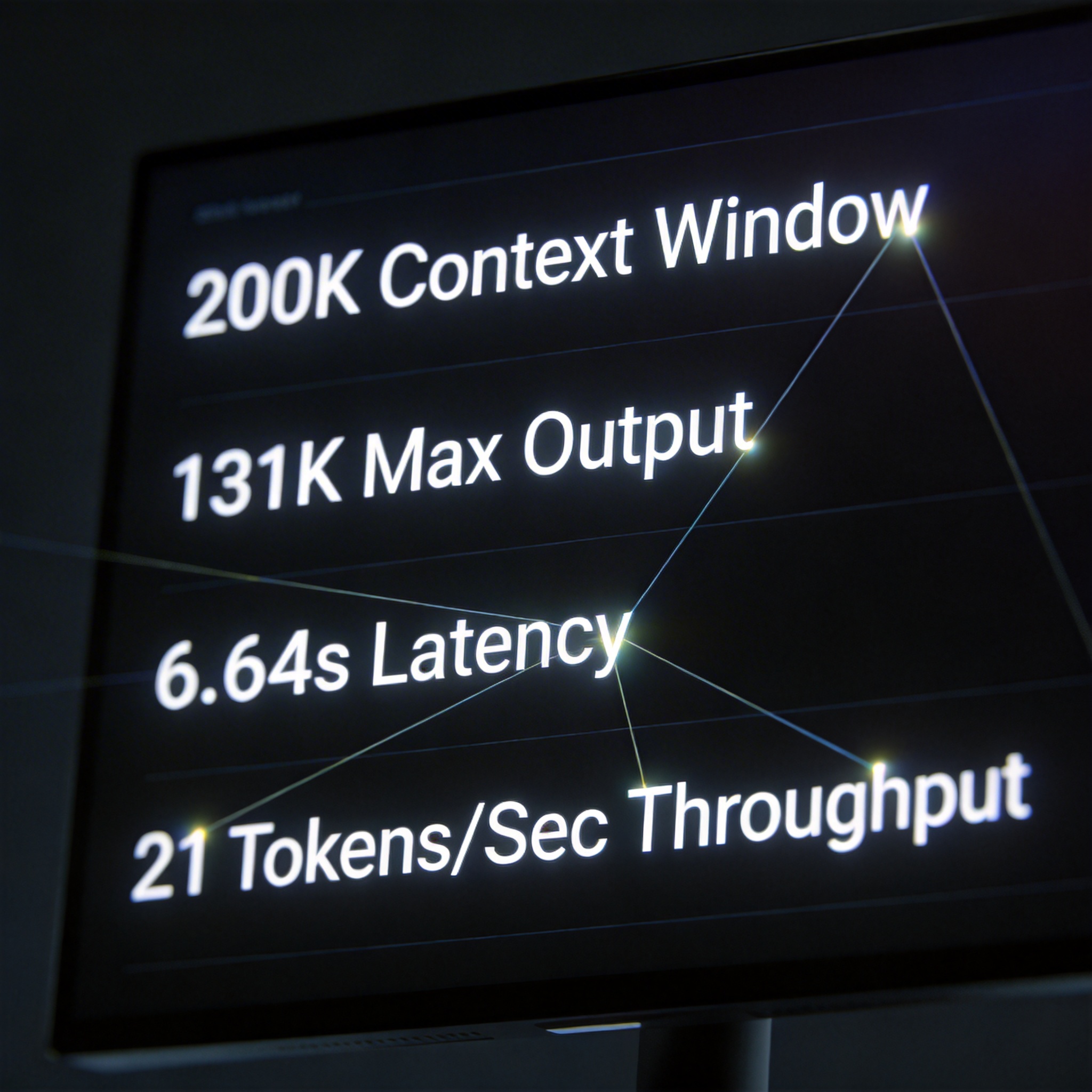
Digital interface showing 'Pony Alpha' technical specs: 200K context, 131K output, 6.64s latency, 21 tokens/sec throughput.
Technical Clues and Naming Hints
Beyond subjective impressions, technical specifications provided additional clues. OpenRouter's page for Pony Alpha indicates support for reasoning capabilities, a 200K context window, a maximum output of 131K tokens, a latency of approximately 6.64 seconds, and a throughput of 21 tokens per second. The 200K context length is notable, matching parameters seen in the Claude Sonnet series and some advanced models from China.
The name "Pony" itself has drawn attention. With 2026 being the Year of the Horse in the Chinese zodiac, some speculate the name could be a subtle hint from a Chinese development team. This interpretation led some to consider the possibility of Tencent, given the nickname "Pony" associated with a prominent figure in Chinese tech.
The Rise of Anonymous Blind Testing
The Pony Alpha incident highlights a growing trend in model release strategies: anonymous blind testing. Historically, large model releases involved press conferences, academic papers, and benchmark comparisons. However, with numerous companies claiming state-of-the-art performance and questions arising about benchmark validity, user trust has become more challenging to establish.
Anonymous blind testing offers an alternative by allowing users to evaluate a model's performance directly before its developer is revealed. This approach prioritizes user experience over marketing claims. Pony Alpha's rapid popularity, despite lacking benchmarks, white papers, or brand endorsement, demonstrates the effectiveness of this strategy in engaging the developer community through raw performance.

Abstract image of a white sphere (anonymous AI) surrounded by glowing figures (users) performing a blind test.
Potential Domestic Origin
While no official confirmation has been made, several clues suggest Pony Alpha could be a model from China. These include the model's self-identification as GLM, the "Year of the Horse" naming convention, its launch timing around the Chinese New Year, and technical characteristics identified by some users.
If Pony Alpha is confirmed to be a Chinese model, it would signify a shift in how domestic large models are perceived globally. This would indicate that such models can gain international recognition based solely on their capabilities, rather than through comparisons to established Western models. The model's success in an anonymous setting would underscore its inherent strength, independent of branding or narrative. As one user on Xiaohongshu commented, "If it's domestic, I'll absolutely rave about it," reflecting a sentiment that appears to be shared by many. The eventual revelation of Pony Alpha's developer is anticipated by the community.
Stay Ahead of the AI Curve
Join 50,000+ subscribers getting the latest AI tools, trends, and tutorials delivered to their inbox weekly.
No spam, unsubscribe at any time.