
OpenClaw Conference in San Francisco Showcases AI Agent Control Over Robots and Desktops

San Francisco recently hosted the inaugural OpenClaw "Crab Cult" gathering, drawing over 1,000 developers to discuss open-source projects and the expansion of AI agents into physical and digital environments. The event featured demonstrations of OpenClaw controlling robots and introducing a multi-player desktop environment for AI agents.

Large crowd of developers attending a tech conference in San Francisco, many standing.
Attendees gathered in a San Francisco venue, with many more queuing outside and directed to live streams due to capacity. The atmosphere was described as enthusiastic, with developers expressing strong support for Peter Steinberger, the founder of OpenClaw, whom they referred to as the "Cult Leader" or "ClawFather."
OpenClaw Agents Extend to Robotics
A key highlight of the conference was the demonstration of OpenClaw directly controlling robots. A humanoid robot, characterized by a "lobster head," navigated through the crowd, interacting with attendees by waving its claws. This robot was reportedly controlled in real-time by an AI agent. Another demonstration involved a crab-claw robot that could detect low beer levels and order refills.

Close-up of a humanoid robot with a crab head extending its claw towards a human hand.
Peter Steinberger addressed the attendees, stating that AI agents would integrate into personal, professional, and relational aspects of life, facilitating communication between different agents. He suggested this development brings humanity closer to Artificial General Intelligence (AGI).
Multi-Player Desktop for AI Agents Introduced
The conference also unveiled CuaBot, a new tool designed to provide AI agents with their own dedicated Linux desktops. This addresses a limitation in previous computer-use agents, which typically operated within a "single-player" desktop environment. CuaBot aims to allow multiple AI agents to operate simultaneously on separate virtual desktops without interfering with human users.

Multiple virtual Linux desktops displayed on a single monitor, each running a different AI agent.
CuaBot functions by launching a Docker container that hosts a complete X11 Linux desktop for each agent. This setup includes a window manager, browser, file system, and various graphical user interface applications, enabling agents to operate independently. The system uses Xpra to stream individual application windows to the user's computer.
To ensure security and prevent agents from directly accessing the host system, CuaBot employs a "hairpin communication" method. When an agent requests to perform actions like taking screenshots or typing, the request is routed through an MCP server to CuaBot on the host machine. CuaBot then uses Playwright to control Xpra's HTML5 client, which transmits the operation back to the agent's container. This "container → host → container" process ensures that agents do not directly interact with the user's system, maintaining data security.

Abstract visualization of data flowing in a hairpin loop between agent containers and a host machine.
The developers demonstrated the capability to run multiple agents concurrently, such as Claude for code writing and Gemini for information research, each operating within its own virtual desktop. CuaBot can automatically configure OpenClaw with a sandboxed desktop environment.
Embodied Intelligence and Human-Machine Interaction
The discussions at the conference also touched upon the concept of embodied intelligence, where AI agents gain a physical presence. The integration of OpenClaw with humanoid robots was presented as a step towards connecting digital autonomy with real-world actions. This development suggests a future where AI agents can interact with the physical environment through robotic forms, moving beyond purely digital existence.
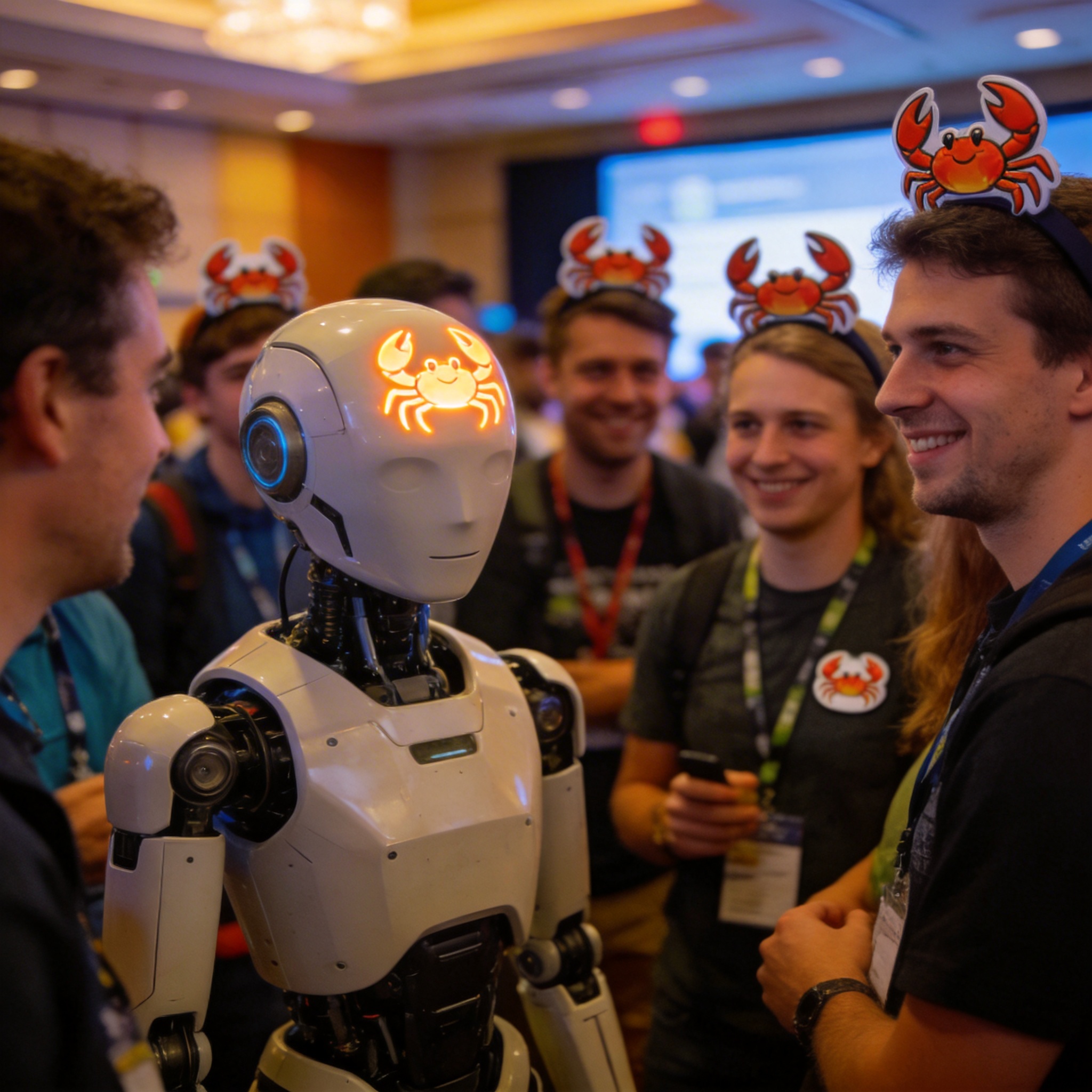
Developers wearing crab-themed attire interacting with a humanoid robot at a conference.
Attendees at the event wore crab-themed attire, reflecting the "Crab Cult" moniker. Christian Van Der Henst, a blogger, noted the presence of "Crabs, pizza, humanoid robots, over 500 people, an AI vending machine, and a queue two blocks long" as key elements of the gathering.
Stay Ahead of the AI Curve
Join 50,000+ subscribers getting the latest AI tools, trends, and tutorials delivered to their inbox weekly.
No spam, unsubscribe at any time.