
OpenAI's Sora Android App Developed with 85% AI-Generated Code in 28 Days


OpenAI's Android client application for Sora, its text-to-video model, was developed in 28 days with approximately 85% of its code generated by artificial intelligence. The project involved a four-person team and achieved a 99.9% crash-free rate on its first day, with users generating over one million videos within 24 hours.

A software developer reviewing code on a monitor, with abstract AI neural network patterns subtly integrated, illustrating human-AI collaboration.
The development approach, detailed by OpenAI, highlights a methodology where human developers focus on architectural design and strategic oversight, while AI agents handle the bulk of code generation. This process, which OpenAI described in an article, suggests a shift in software engineering practices.
Architectural Framework and AI Guidance
The development team began by defining the application's overall architecture, including modularization, dependency injection, navigation structure, authentication, and the basic network layer. They then manually created template functions to guide the AI. A critical step involved writing extensive AGENTS.md files, which served as a comprehensive guide for the AI, akin to an internal wiki for new hires. These files specified coding standards and best practices, such as requiring detektFix for formatting before commits. This ensured that each new AI session could quickly align with team-specific requirements.
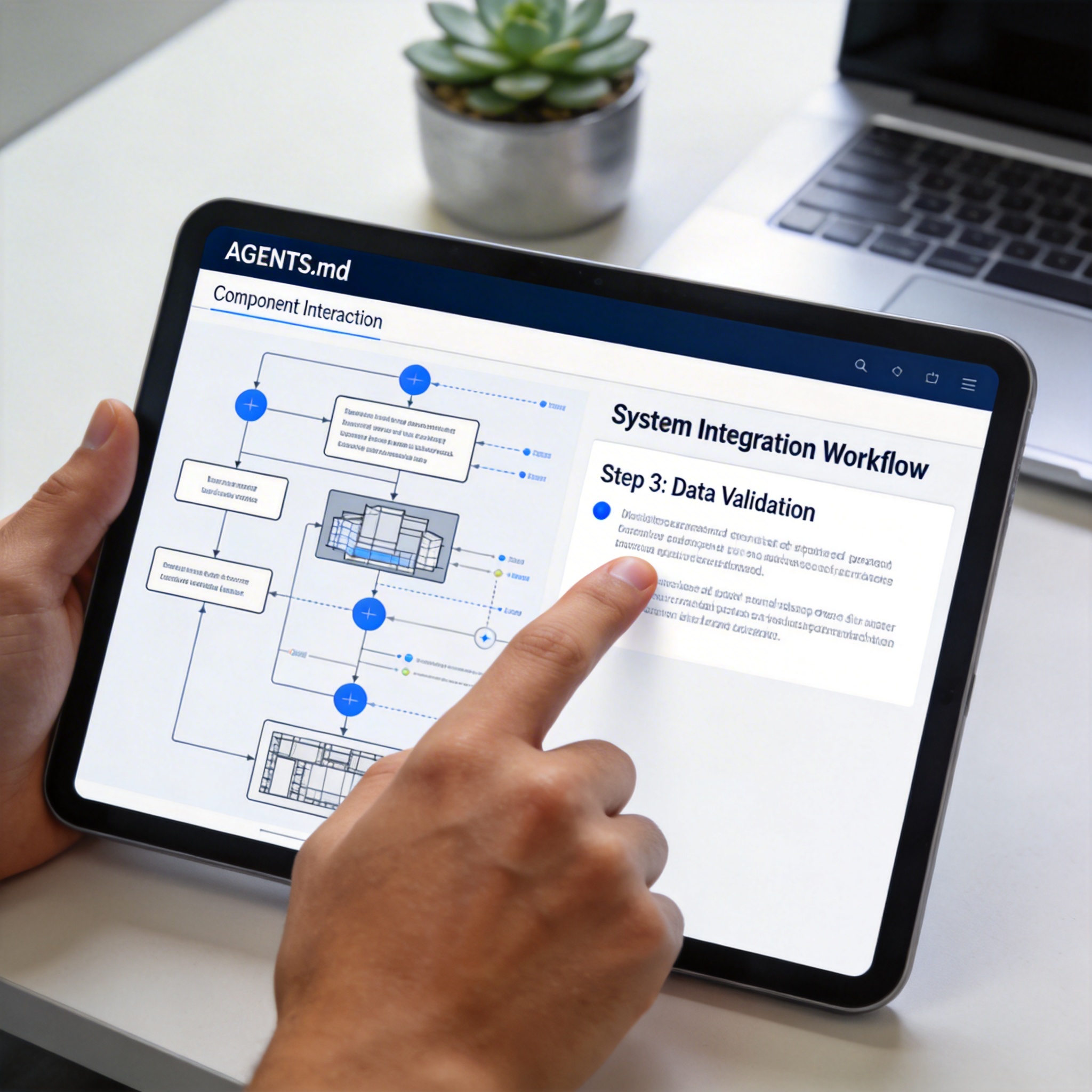
A close-up of a tablet displaying an architectural diagram or `AGENTS.md` file, with a hand pointing, symbolizing AI guidance and architectural framework.
The team emphasized that the goal was not to instruct the AI on how to write code, but rather to define what constitutes "correct" code within their specific development environment.
Phased Planning and Execution
Initially, the team attempted to provide the AI with functional requirements and relevant files, expecting it to generate complete implementations. This approach resulted in code that deviated significantly from architectural expectations. Consequently, they adopted a "plan first, then code" strategy.
For complex functions, the AI was first tasked with understanding the system. This involved having the AI read related files and summarize data flow, for instance, from API to repository, then to ViewModel, and finally to the UI. Human developers would then review and correct the AI's understanding. Once the understanding was validated, the AI would generate an implementation plan, detailing necessary file modifications, new states, and logic flow. Only after human approval of this plan did the AI proceed with code generation.
This planning phase, though seemingly slower, reduced rework and streamlined code review. Developers could verify if the AI's execution matched its approved plan, rather than scrutinizing extensive code differences without prior context. For longer tasks, the AI was instructed to save its plan to a file, allowing for continuity across multiple sessions. This enabled simultaneous execution of various development tasks, such as player optimization, search functionality, error handling, and test creation, with the AI agents independently progressing and reporting back. This shifted the human role from direct coding to decision-making and feedback provision, making human review and validation the primary bottleneck.

A multi-screen workstation showing project management and code, with abstract lines connecting elements, representing AI's phased planning and execution.
AI as a Cross-Platform Solution
The OpenAI team also employed AI for cross-platform development. Given that an iOS version of Sora already existed, the iOS codebase was included in the Codex environment. The AI was then instructed to reference the iOS implementation and the Android architecture to generate corresponding Kotlin code. This approach leveraged AI's capability to translate application logic, data models, network requests, and validation rules between programming languages, effectively acting as a cross-platform framework.

Two smartphones side-by-side, one iOS and one Android, displaying similar app interfaces with a digital bridge between them, symbolizing AI cross-platform development.
While the project demonstrated the efficiency of AI-assisted development, it also highlighted that human expertise remains crucial. The four-person team, described as highly skilled in leveraging AI agents, still needed to define tasks, verify results, and maintain overall control. The existence of the iOS codebase also allowed for significant logic reuse, with AI primarily handling the translation process.
The experience suggests that effective AI-assisted development requires a strong architectural foundation, meticulous planning, and clear guidance for AI agents. It also implies that future software engineers will need a deep understanding of systems and the ability to collaborate effectively with AI, as the value shifts from raw coding speed to defining elegant and future-proof solutions.
Stay Ahead of the AI Curve
Join 50,000+ subscribers getting the latest AI tools, trends, and tutorials delivered to their inbox weekly.
No spam, unsubscribe at any time.