
OpenAI Research VP Jerry Tworek Departs, Citing Difficulties for Core Research

Jerry Tworek, OpenAI's Vice President of Research and a key technical expert, resigned in early January 2026 after nearly seven years with the company. His departure has raised questions about OpenAI's research direction and resource allocation, particularly given his statement that he needed to leave to pursue research "hard to do at OpenAI."

Professional portrait of Jerry Tworek, former OpenAI VP of Research.
Tworek's exit follows other high-profile departures, including Ilya Sutskever in 2024. Tworek was instrumental in developing inference technology and logical capabilities for GPT neural networks. He led the development of Codex in 2021, which laid the groundwork for GPT's code abilities, and later spearheaded the o1 and o3 models from 2024 onward, establishing the "System2" chain-of-thought paradigm. His contributions were particularly significant as the effectiveness of Scaling Laws began to diminish.
Shifting Research Priorities
By 2025, a consensus emerged in the AI industry that Scaling Laws were no longer yielding expected returns. OpenAI's "Orion" project, despite significant investment, did not achieve the anticipated exponential leap and was subsequently downgraded to GPT-4.5 by CEO Sam Altman. This indicated that a pure pre-training scaling approach had reached its limits, and the benefits from pre-training data were becoming exhausted.

Abstract visualization of a plateauing graph, symbolizing diminishing returns of AI scaling laws.
The focus then shifted to post-training methods, specifically improving intelligence through "slow thinking" during the inference stage, an area where Tworek was a key contributor. However, this shift also highlighted a tension: while deep inference is considered closer to Artificial General Intelligence (AGI), it often involves higher latency and costs compared to faster, cheaper pre-trained models. In an environment prioritizing quarterly profits, management's tolerance for high-cost research reportedly decreased. Ashlee Vance noted in a Core Memory podcast interview that Tworek's departure reflects a broader trend of large labs becoming more risk-averse and adopting conservative strategies.
Commercial Pressures on AGI Research
Tworek's inference technology, which was seen as a potential next step for AGI, reportedly became subject to short-term business optimization goals at OpenAI. The o1/o3 models, designed for deep thinking by "trading time for intelligence," were, according to reports, simplified to a cost-latency trade-off within the company.
Before Tworek's resignation, OpenAI's research teams were reportedly under pressure to reduce latency, cut costs, and quickly implement commercial applications like Copilot. This focus on immediate commercialization reportedly caused disappointment for Tworek, who aimed for true AI thinking, while investors and Microsoft sought efficient, low-cost tools. This environment led to hardcore research being viewed as a financial burden and subsequently scaled back.
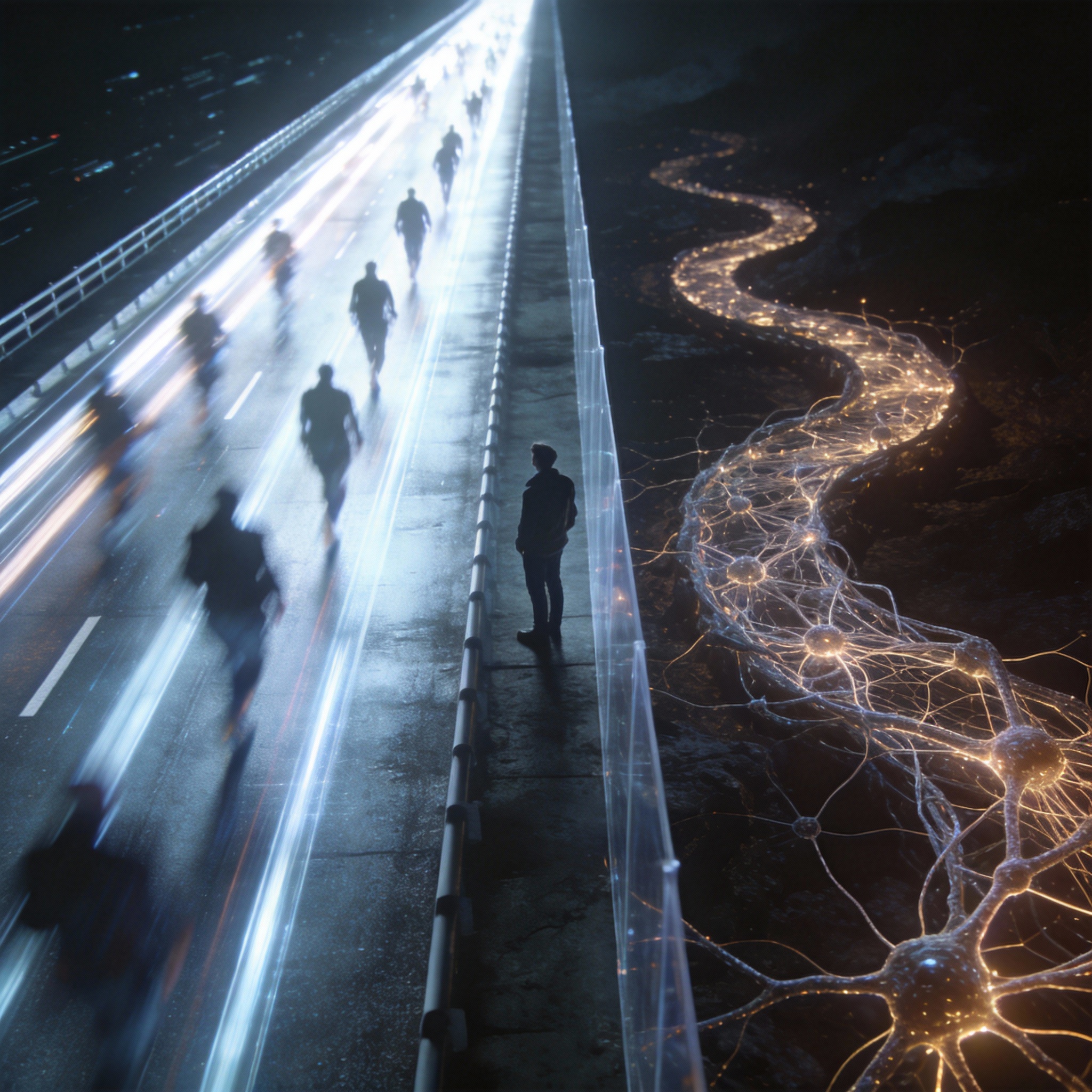
Two diverging paths: one commercial and fast, the other deep and complex, symbolizing the tension between profit and AGI research.
Systemic Challenges to Open Research
The challenges faced by researchers like Tworek are not solely technical but also systemic, stemming from the commercialization of the research environment. Tworek's departure is seen by some as a signal that OpenAI is transitioning from a research-focused frontier to a more commercially oriented entity.
Between 2025 and 2026, several core talents, including Shengjia Zhao and Jason Wei, reportedly left OpenAI, with many moving to Meta's Superintelligence Lab. This contrasts with OpenAI's increasing internal restrictions, driven by safety concerns, which reportedly direct scientists toward product development. Meta, in contrast, is noted for providing large H100 clusters and supporting open-weight approaches.
The "hard to do at OpenAI" sentiment expressed by Tworek is interpreted by some as less about technical difficulty and more about systemic friction within the organization. This includes potential restrictions on research into interpretability if findings are unfavorable to product image, blocking exploration of paths not immediately integrable into an API, and forbidding public discussion of AGI thinking to prevent competition. When scientific exploration is influenced by public relations and legal considerations rather than scientific principles, researchers may seek opportunities elsewhere.

Exterior view of OpenAI's modern corporate headquarters building.
OpenAI's Evolving Identity
Tworek's departure is viewed by some as marking OpenAI's entry into a "defender" phase, shifting from a disruptor to a guardian of existing interests. The company, once known for its unconventional approach, is now seen as building financial barriers through its use of Azure and H100 clusters.
Despite its large user base and numerous APIs, the core inference technology, particularly the o-series, faces challenges with Tworek's exit. In 2026, OpenAI reportedly faces a dilemma: maintaining its valuation necessitates avoiding high-risk research, as failure or negative public opinion could trigger panic. This transformation suggests OpenAI is evolving into a standard big tech company, focused on providing tokens as a utility, rather than solely an AGI lab. While it may have achieved commercial success, some observers suggest it risks losing its pioneering edge in the pursuit of AGI.
Stay Ahead of the AI Curve
Join 50,000+ subscribers getting the latest AI tools, trends, and tutorials delivered to their inbox weekly.
No spam, unsubscribe at any time.