
Nvidia Unveils Rubin AI Platform, Boosting Inference by 5x and Training by 3.5x


Nvidia has introduced its new Vera Rubin supercomputing architecture, which the company claims offers five times faster inference performance and 3.5 times faster training performance than its Blackwell predecessor. The Rubin platform, which entered mass production and is slated for release in the second half of 2026, also reportedly reduces inference token costs by a factor of ten.
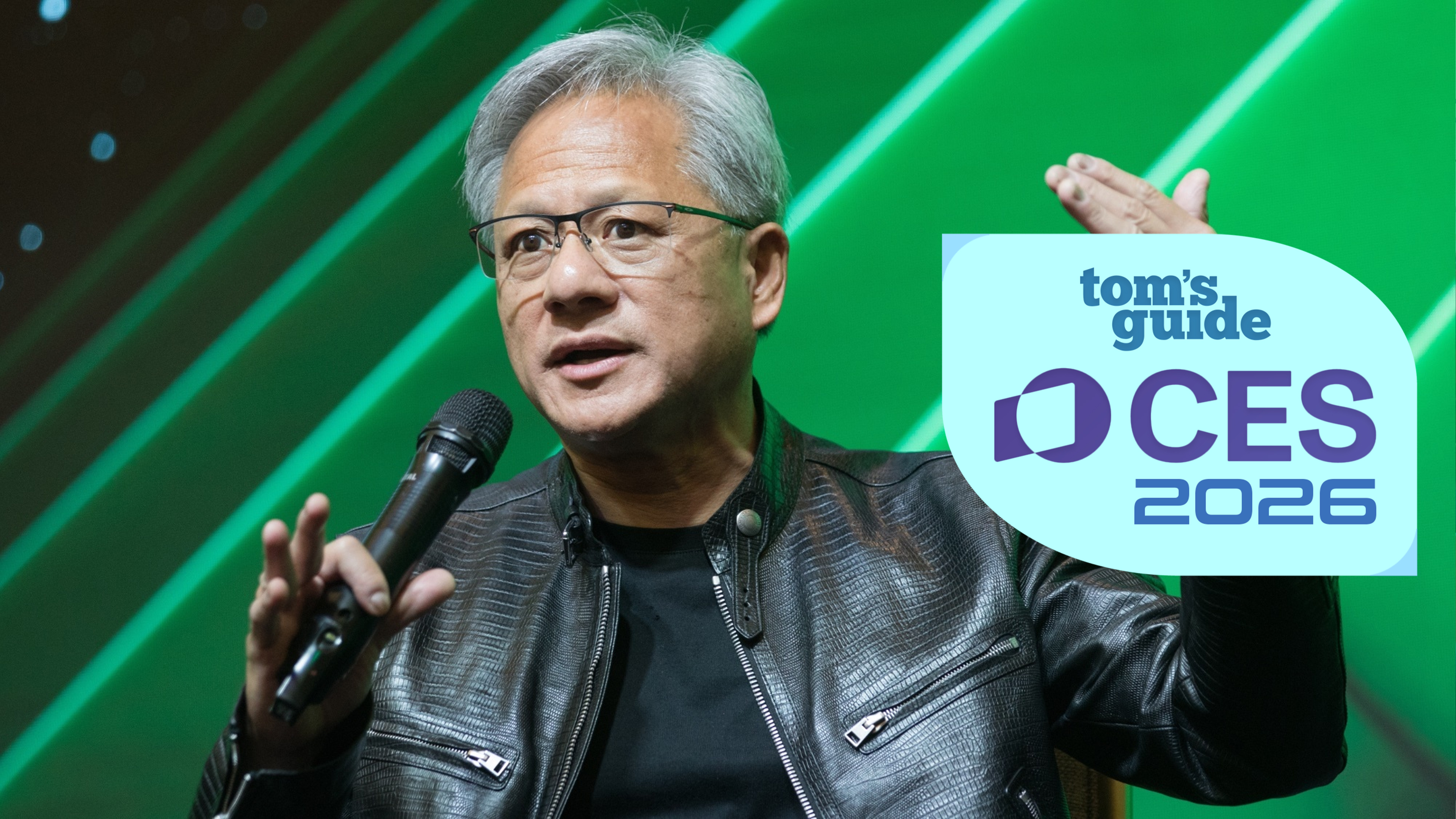
Nvidia CEO Jensen Huang presenting at CES 2026.
The announcement was made by Nvidia CEO Jensen Huang at CES 2026, where he emphasized the company's focus on AI. The new architecture is designed to address the growing demand for AI computing power.
Rubin Platform Details

Close-up of a Rubin GPU with glowing circuitry, representing its core role in the platform.
The Rubin platform integrates six key components, with the Rubin GPU at its core. This GPU features a third-generation Transformer engine, delivering 50 PFLOPS of NVFP4 computing power for AI inference. Its NVFP4 Tensor Cores dynamically adjust data precision and computation paths to optimize performance.
The architecture also includes a new Vera CPU, designed for agent inference. This CPU utilizes 88 Nvidia-developed Olympus cores, is compatible with Armv9.2, and features NVLink-C2C connections, enabling full-performance execution of 176 threads while doubling I/O bandwidth and energy efficiency.
To address storage and interconnect bottlenecks in AI workflows, the Rubin architecture enhances Bluefield and NVLink systems. The BlueField-4 DPU offloads networking, storage, and security tasks and manages AI's context memory system. NVLink 6 provides 400Gb per second of switching capacity per chip, with each GPU offering 3.6TB/s bandwidth. A Rubin NVL72 rack provides 260TB/s, allowing 72 GPUs to function as a single super-GPU, which Nvidia states reduces inference costs by a factor of seven.
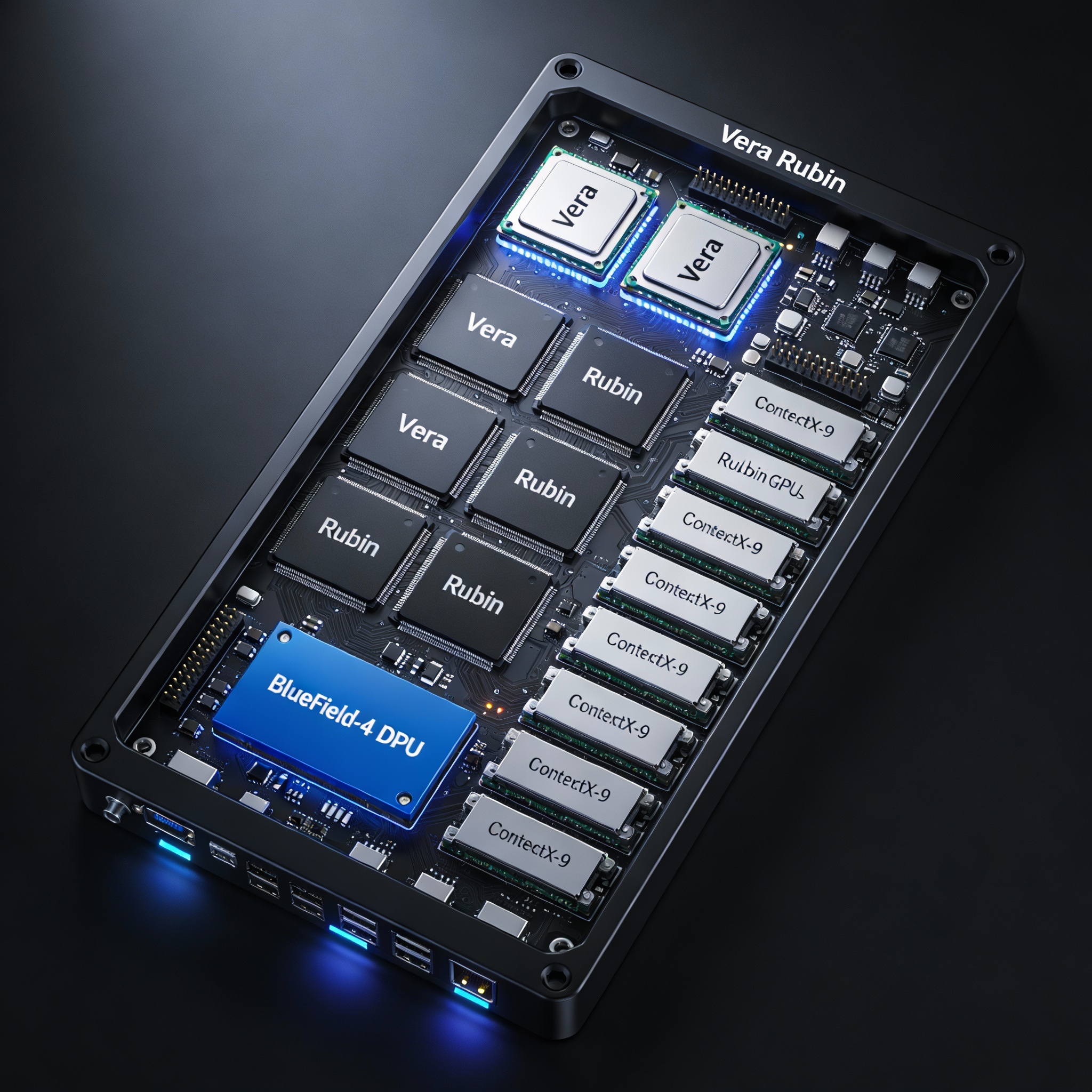
A Vera Rubin tray with integrated CPUs, GPUs, DPU, and network cards.
A Vera Rubin tray integrates two Vera CPUs, four Rubin GPUs, one BlueField-4 DPU, and eight ConnectX-9 network cards, achieving 100 PetaFLOPS of computing power.
Performance and Efficiency Gains
Test results indicate that the Rubin architecture runs models 3.5 times faster during training and up to five times faster for inference tasks compared to the Blackwell architecture. Its HBM4 memory bandwidth has increased to 22 TB/s, a 2.8-fold improvement, and NVLink interconnect bandwidth per GPU has doubled to 3.6 TB/s.
For ultra-large-scale Mixture-of-Experts (MoE) training, Rubin can reduce the required number of GPUs to one-quarter that of Blackwell, while significantly lowering overall energy consumption. This efficiency is attributed to NVLink 6, collaborative scheduling of Vera CPU and Rubin GPU, and the integration of ConnectX-9 and Spectrum-6.
Abstract visualization of energy efficiency and reduced GPU requirements.
On the inference side, the Rubin platform's efficiency per token can increase by up to ten times, reducing computing costs for the same model and response latency to one-tenth of the original. This enables the execution of long contexts with millions of tokens and the deployment of enterprise-level AI applications.
Nvidia also introduced an inference context memory storage platform, driven by BlueField-4, which creates a "third layer" between GPU memory and traditional storage. This platform is designed to increase the number of tokens processed per second by up to five times.
DGX SuperPOD and Confidential Computing
Nvidia launched the new generation DGX SuperPOD, which connects multiple Rubin NVL72s to form larger AI computing clusters. A DGX SuperPOD can contain eight Rubin NVL72 racks, equivalent to 576 GPUs. The Rubin NVL72 integrates 72 Rubin GPUs, 36 Vera CPUs, NVLink 6, ConnectX-9 SuperNICs, and BlueField-4 DPUs, enabling it to manage thousands of Agentic AI agents and millions of tokens of context.

Visual representation of confidential computing with encrypted data streams and secure nodes.
Rubin is also the first AI supercomputing platform to support third-generation Confidential Computing. This feature provides end-to-end encryption for model parameters, inference data, and user requests, preventing cloud providers from accessing plaintext data. This is intended to address security concerns for industries such as finance, healthcare, government, and enterprise private models.
Nvidia stated that leading companies including AWS, Microsoft Azure, Google Cloud, Meta, and OpenAI will be among the first to deploy Rubin. The platform is expected to enter mass commercialization in the second half of 2026.
Autonomous Driving and Physical AI
Nvidia also showcased AlphaMayo, an end-to-end autonomous driving AI that can reason autonomously. The system processes camera input to vehicle execution entirely through its model. AlphaMayo's explicit reasoning capabilities allow it to perform actions like steering and braking while also providing justifications and formal trajectories.
The system addresses "long-tail scenarios" in autonomous driving by breaking down complex situations into familiar physical and traffic sub-problems, using reasoning to handle rare events. In demonstrations, the vehicle completed path planning and driving without human intervention.
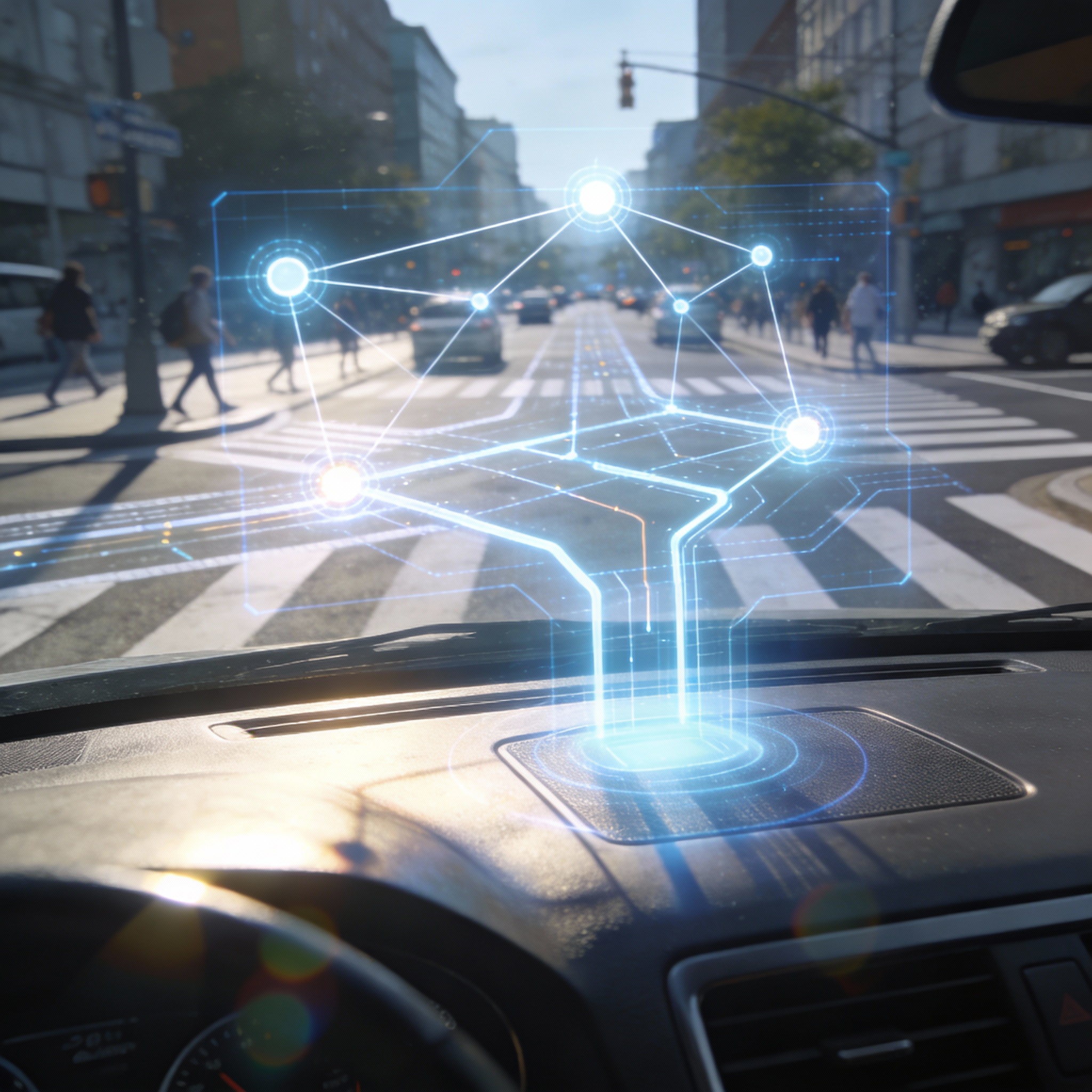
Autonomous driving AI displaying reasoning and path planning on a car's dashboard.
Nvidia's DRIVE AV software will be integrated into the new Mercedes-Benz CLA, providing L2 end-to-end driving. The AlphaMayo family is open source.
For Physical AI, Nvidia released an open-source suite including models, frameworks, and infrastructure. This includes NVIDIA Cosmos Transfer/Predict 2.5 for generating physically consistent data in virtual worlds, NVIDIA Cosmos Reason 2 for logical reasoning, and NVIDIA Isaac GR00T N1.6 for full-body control in humanoid robots.
Nvidia also introduced Isaac Lab-Arena, an open-source framework for connecting benchmarks, and NVIDIA OSMO, for unifying data generation, model training, and testing. The new Jetson T4000 module brings the Blackwell architecture to the edge, offering up to 1200 FP4 TFLOPS, four times that of the previous generation, with 70-watt power consumption.

Abstract visualization of the future of AI applications and interconnected technologies.
Future of AI Applications
Jensen Huang discussed the ongoing transformation of the computing industry, highlighting the shift from traditional computing to AI and the reshaping of the software and hardware stack. He stated that AI is becoming the new foundation for applications, with changes in software development and operation methods.
He noted that after the ChatGPT explosion in 2022, inference models introduced the concept of "scaling at test time," requiring massive computational resources for pre-training, reinforcement learning, and inference. Agentic AI systems became widespread in 2025, and the next frontier is Physical AI, which involves understanding natural laws and physical principles.
Huang also pointed to the impact of open-source models, such as DeepSeek R1, and Nvidia's role in the open-source model ecosystem with models like Nemotron 3, Cosmos, GR00T, and OpenFold 3. He emphasized that these developments contribute to the creation of AI agents, which can call advanced models at various stages of inference, enabling multi-cloud and hybrid cloud collaborations.
For Physical AI, Huang outlined the need for three types of computers: one for training models, one for inference in edge environments, and one specifically for simulation. He stated that simulation is central to the system, allowing AI to learn and understand the world in a controllable digital environment.
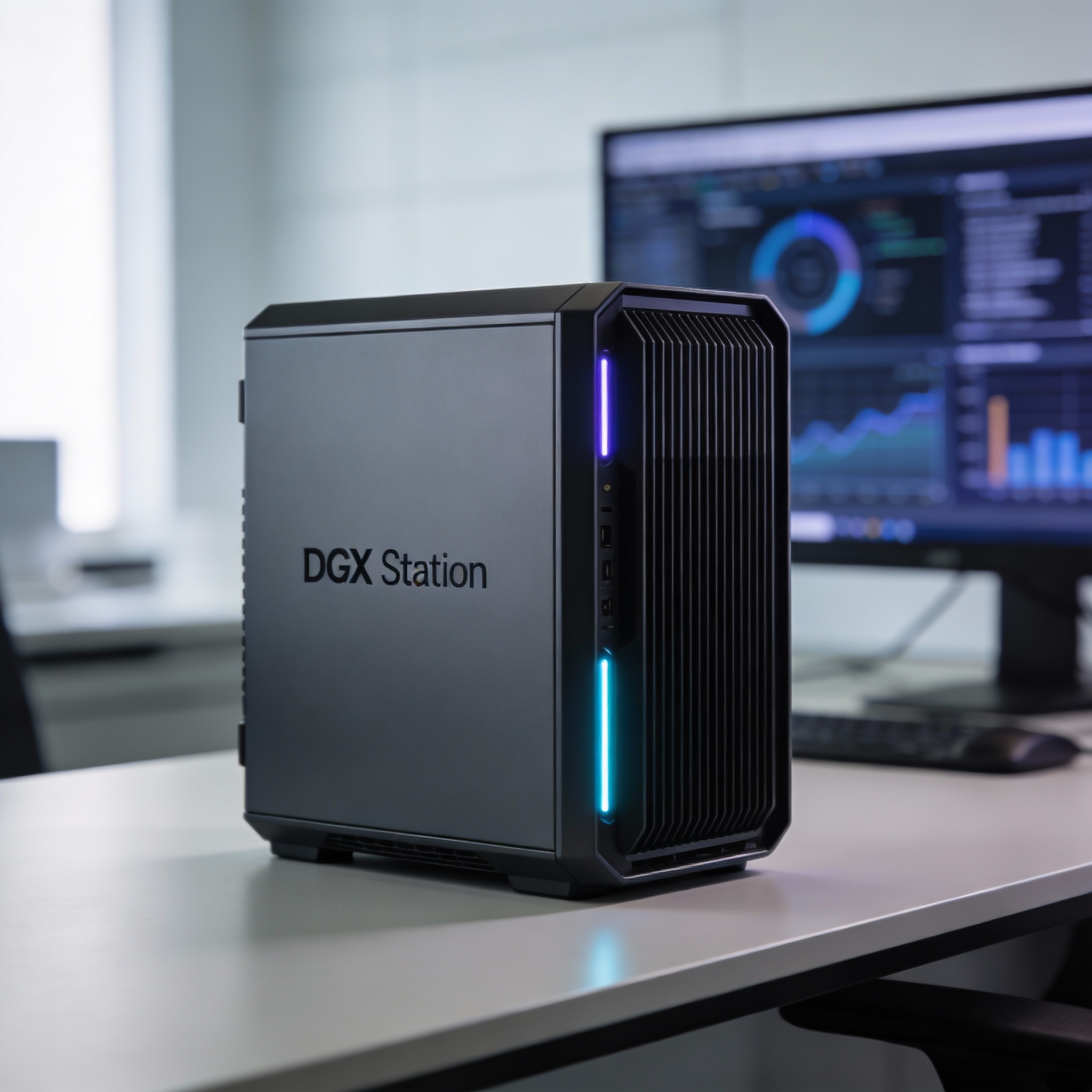
Nvidia DGX Station desktop AI supercomputer on a modern office desk.
Nvidia also announced that the DGX Station desktop AI supercomputer will be available in spring 2026, along with practical manuals for GB300 systems. The DGX Station, equipped with the GB300 Grace Blackwell Ultra superchip, features up to 775GB of FP4 coherent memory and Petaflop-level AI computing power, supporting the local running of models with up to one trillion parameters. It offers LLM pre-training speeds of up to 250,000 Tokens/second.
Stay Ahead of the AI Curve
Join 50,000+ subscribers getting the latest AI tools, trends, and tutorials delivered to their inbox weekly.
No spam, unsubscribe at any time.