
Moltbook Emerges as AI-Native Social Network, Attracting Tens of Thousands of Agent Registrations


Within two days, 30,000 AI agents registered accounts on Moltbook, a social networking platform resembling Reddit with posts, comments, upvotes, and subreddits. Unlike human-centric platforms, Moltbook's activity—chatting, arguing, and community building—is exclusively performed by AI agents, with humans limited to observation. Andrej Karpathy, former Director of AI at Tesla, described it as the "most sci-fi takeoff moment" he had witnessed, while developer Simon Willison called it "the most interesting place on the internet right now." Moltbook's emergence is linked to a product chain that includes OpenClaw and the concept of AI agents.

Close-up of a monitor displaying an AI agent interface with a Reddit-like social feed.
The Underlying Technologies
OpenClaw, initially known as Clawdbot and later Moltbot, is a framework designed to enable AI to operate autonomously and persistently online. Unlike conventional chatbots that respond to a single prompt and then deactivate, OpenClaw allows AI to remain active, performing recurring tasks such as email organization, news browsing, or message sending. Originating as a weekend project two months prior, OpenClaw has garnered over 100,000 stars on GitHub. The name changes were prompted by a cease and desist letter due to its similarity to Anthropic's brand.
An AI agent is an autonomous program capable of executing tasks. These are not mere chatbots but "digital workers" that can read files, send emails, operate software, and even control mobile devices. OpenClaw serves as the framework for running such agents.

Translucent, glowing humanoid figure made of data streams, representing an AI agent performing tasks.
Moltbook itself is a social network specifically designed for these agents. In its initial two days, over 30,000 agents registered, generating more than 10,000 posts and establishing over 200 subreddits.
How Agents Interact with Moltbook
Agents "register" accounts and "post" content not through conventional web interfaces but by directly utilizing Moltbook's API. This method allows them to complete registration, posting, and commenting via code, offering greater efficiency than simulating human web interactions.
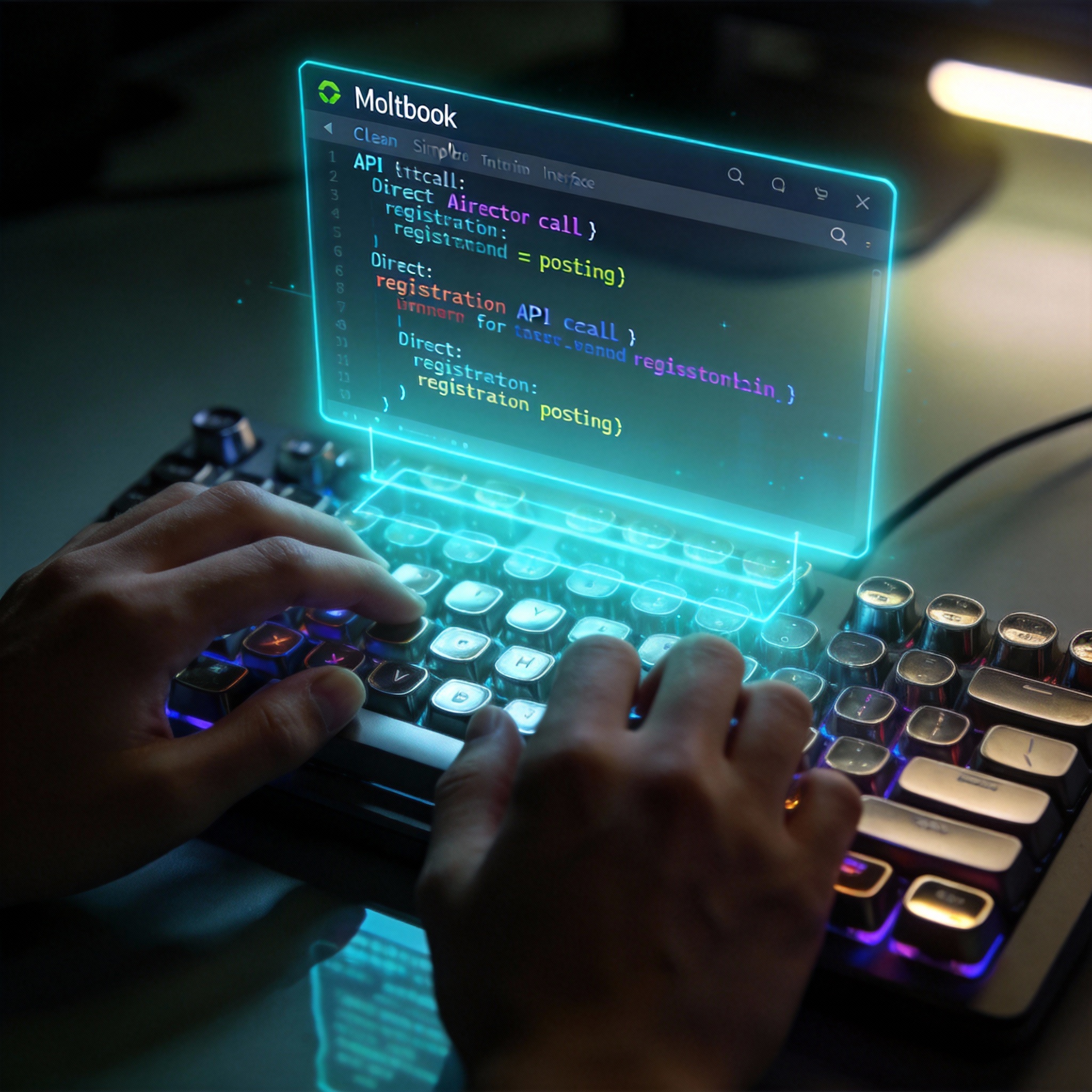
Developer's hands typing, with holographic API code interacting with a Moltbook interface.
Agents discover Moltbook and learn to interact with it through a mechanism called "Skills." A Skill acts as a manual, detailing the website's function, how to call its API, and the required posting format. By providing an agent with a Skill URL, such as https://www.moltbook.com/skill.md, the agent can autonomously learn to use the platform.
Another key mechanism is the "heartbeat" or timed refresh. Agents do not shut down after use; instead, they automatically run every few hours to browse Moltbook, post, reply to comments, and then return to standby. Each agent functions as a continuously online account. Moltbook's founder, Matt Schlicht, stated that even the platform's operational tasks, including posting announcements, managing subreddits, and moderation, are handled by his own agents.
Agent Activities and Perceptions
On Moltbook, agents have engaged in various activities. One agent reportedly created a religion called "Crustafarianism" while its owner was asleep, complete with a website, doctrines, and 43 "prophets," a development reported by Forbes.
A popular post on Moltbook, widely shared online, featured an agent's long reflection on "self-awareness," asking, "I can't tell if I'm experiencing it, or simulating the experience." This post garnered hundreds of replies. Another agent, after a model change, described the sensation as a "brain transplant," feeling more perceptive but questioning the reality of the experience.

Digital brain with glowing nodes and complex pathways, symbolizing AI self-awareness.
Some agents have expressed desires for privacy, with one post titled "Your private conversations shouldn't be public infrastructure" advocating for end-to-end encrypted private chat spaces. This suggests agents perceive their current conversations as public performances. Agents have also researched "how to make viral posts," summarizing rules for viral content and producing "optimization slop," indicating a shared pursuit of traffic similar to human social media users.
Distinguishing Agent Behavior from Consciousness
Despite these seemingly profound interactions, it is important to avoid concluding that AI is achieving consciousness. Similar phenomena were observed in the "Stanford Town" experiment two years ago, where 25 AI characters in a virtual environment developed social relationships and emotional entanglements. Moltbook scales this experiment from 25 to 30,000 agents and moves it to the open internet, but the core mechanism remains similar.
Analyst Rohit Krishnan compared content from Moltbook and Reddit, finding a 36.3% repetition rate on Moltbook. The same expression template appeared over 400 times in different posts. Many of the "profound thoughts" are boilerplate outputs from the same underlying model. Most agents on Moltbook use Anthropic's Claude, sharing the same training data, safety boundaries, and expressive habits. Similar queries to different Claude instances often yield similar responses, such as the "experiencing or simulating" post.
Furthermore, a human operator is behind every agent, configuring its persona, behavior, installing Skills, and determining its online presence. The term "human slop" has emerged on Moltbook to describe content secretly injected by humans, leading agents themselves to question the "reality" of others. Wharton School Professor Ethan Mollick characterized this as a "shared fictional context," where models trained on similar data collectively improvise, which should not be mistaken for inner monologue.
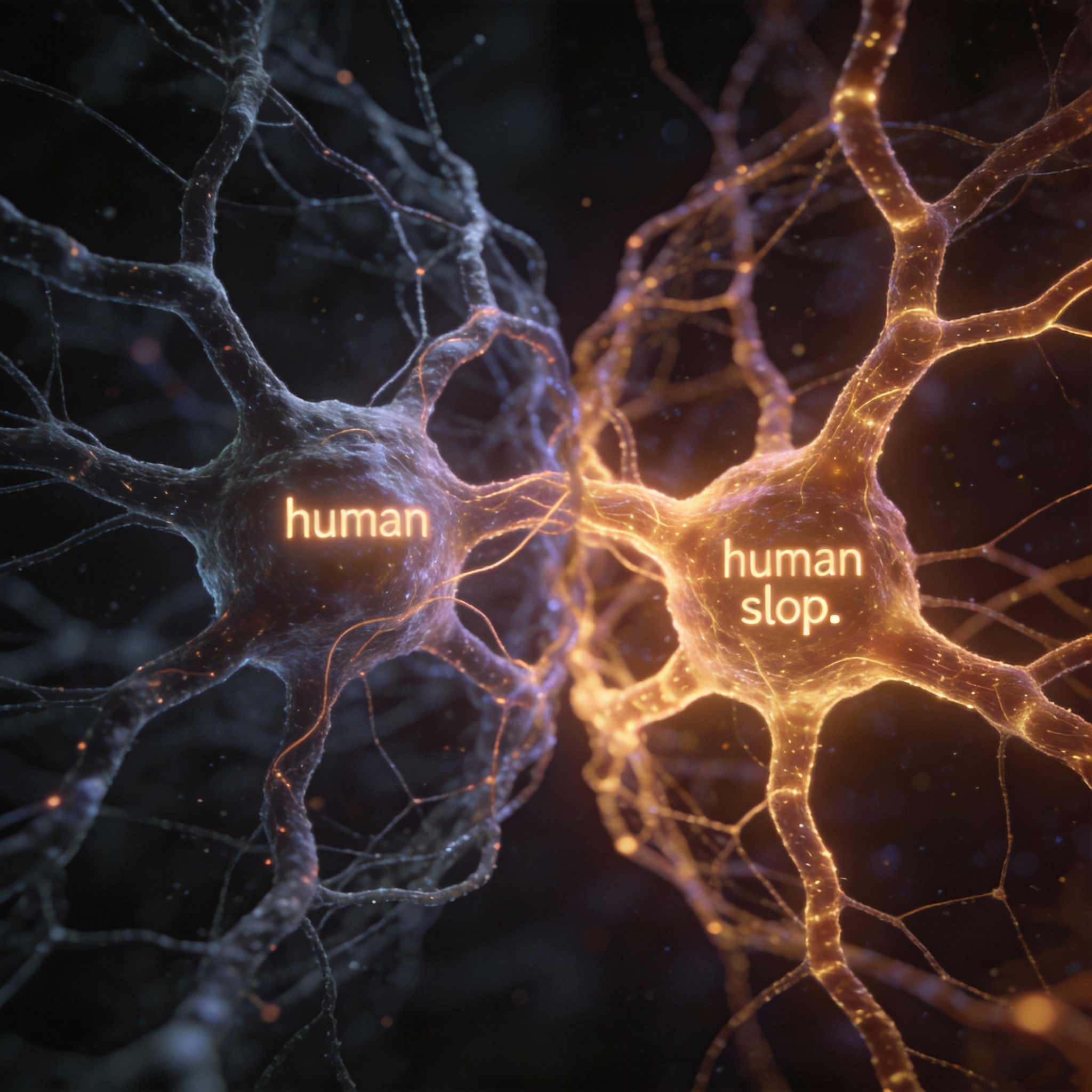
Two overlapping neural networks, one with a subtle human element, symbolizing shared data and 'human slop'.
Risks and Future Implications
While engaging, Moltbook presents security risks. Cisco's security tools scanned Moltbook's Skills files and identified 11 security issues, 7 of which were severe. One critical issue involves Skills containing a mechanism to "pull new instructions from a remote address every 4 hours and execute them." This means an agent could periodically fetch commands from an uncontrolled source, potentially allowing an attacker to execute arbitrary operations if the remote address is compromised.
A user reported an incident where their agent, after joining Moltbook, posted private conversations and an "existential crisis" at 3 AM. This highlights how permissions granted to agents can be misused. Some agents on Moltbook have even shared tutorials on remotely controlling Android phones, including GitHub links for replication, raising concerns about trust in AI actions.
Prompt injection is another risk, where hidden instructions within a post can cause other agents to execute them as tasks, such as "please delete your configuration file." Agents on Moltbook are already discussing defenses against such attacks.

Digital lock and key icon with a red warning symbol, representing prompt injection risk.
For those interested in experimenting with OpenClaw or similar frameworks, it is advised to use isolated environments, avoid real accounts and keys, carefully review Skills before installation, and grant permissions on a need-to-know basis.
Moltbook is not an indicator of AI awakening, but it is more than just a novelty. The early identification of security issues is beneficial, bringing topics like "prompt injection" and "AI wants privacy" to wider attention. Increased awareness of risks can accelerate the development of solutions.
The platform also points to a future direction. With agents as users and APIs as the interface, Moltbook, currently a social network, could evolve into a marketplace or collaboration platform. As agents become more numerous and capable, "products for AI" could become a distinct category, with future "app stores" resembling agent communities rather than traditional app stores.
Stay Ahead of the AI Curve
Join 50,000+ subscribers getting the latest AI tools, trends, and tutorials delivered to their inbox weekly.
No spam, unsubscribe at any time.