
Manus Prioritizes Iterative Refinement in AI Agent Development Over Grand Designs


Manus, an AI agent developer, has adopted a strategy emphasizing the cumulative effect of numerous small improvements over a few major breakthroughs. This approach, articulated by co-founder and chief scientist Ji Yichao (Peak), suggests that "doing a thousand small things right is more important than doing three big things right." This philosophy aligns with the "Bitter Lesson" in AI research, which posits that general learning methods leveraging computational power often outperform meticulously designed, human-engineered rules.
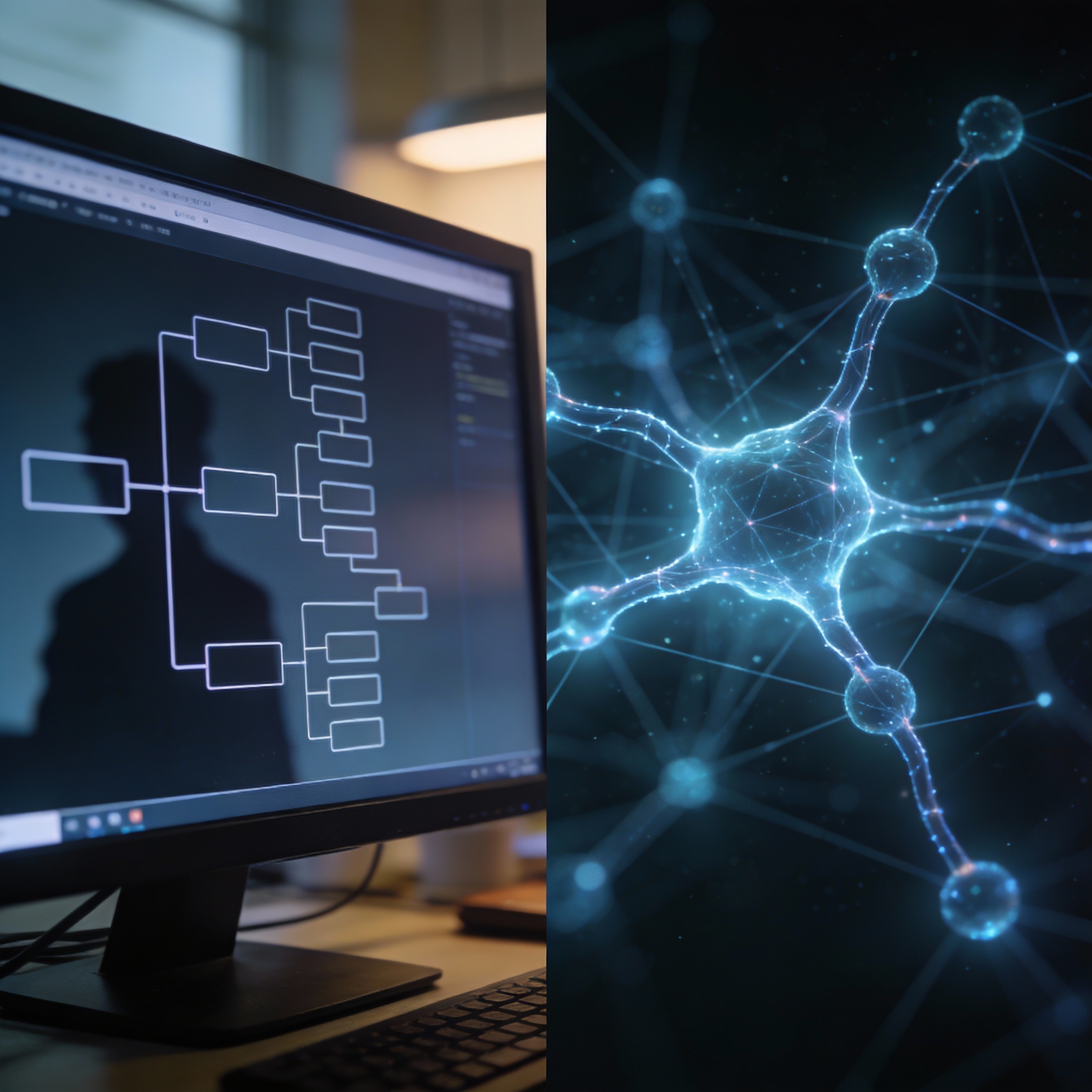
Split image contrasting a rigid flowchart (rule-driven AI) with a dynamic neural network (intelligence-driven AI).
Agent Design Philosophy
The current AI agent market is broadly divided into "rule-driven" and "intelligence-driven" categories. Rule-driven agents operate based on pre-defined workflows, offering predictability but limited adaptability to unforeseen scenarios. In contrast, intelligence-driven agents allow models to determine their own steps, providing flexibility but sometimes exhibiting instability. Manus has opted for the latter, prioritizing adaptability.
Peak explained that while rule-driven workflows offer better reproducibility, their inherent limitation lies in the inability to anticipate all user situations. Manus believes this ceiling problem is insurmountable for rule-based systems, whereas the stability issues of intelligence-driven agents can be addressed as model capabilities advance.
"No Rules" Implementation
Manus implements its "no rules" strategy through a graceful degradation mechanism. For instance, when interacting with internet services, if direct Machine-to-Computer Protocol (MCP) access is available, Manus utilizes it. If MCP is absent but API documentation exists, Manus reads the documentation to learn API calls. In the absence of an API, Manus simulates human browser operations to interact with web interfaces. This design allows Manus to function with any service designed for human use, without requiring special adaptations.

Laptop screen showing layered interaction methods: MCP, API, and human browser simulation, illustrating graceful degradation.
This method means that the system's processes and task completion methods are determined by its intelligence, rather than by artificially set constraints. The goal is to enable the system to make reasonable judgments across numerous situations, even if individual judgments are not perfect. Collectively, this approach aims to handle a broader range of problems than rule-based systems.
Reliance on Model Advancement
The Manus strategy is predicated on the continuous improvement of AI model capabilities. Should model capabilities stagnate, the intelligence-driven path would carry significant risk due to persistent errors and an unstable user experience. However, with ongoing advancements, the ceiling for this approach continuously rises, allowing the same code to perform more tasks correctly as models become more powerful.

Abstract glowing structure symbolizing continuous improvement and rising capabilities of AI models.
Peak noted that Manus, as an application company, benefits from external model innovations without needing to develop its own foundational models. This allows the company to focus its resources on "how to better use models" rather than on "how to train better models," mitigating resource investment and directional risks.
Engineering Details and Core Competitiveness
The Manus team has shared insights from its agent development, including publications like "Context Engineering for AI Agents: Lessons Learned from Building Manus" and collaborations with LangChain. Peak mentioned that while reading research blogs from some model companies, Manus often finds that the concepts presented, such as Anthropic's "thinking tool" or programmatic MCP calling and progressive information disclosure, are practices Manus had already implemented.
These experiences are not singular innovations but rather specific engineering details. Individually, they may seem minor, but their cumulative effect forms the product's core competitiveness. Peak summarizes this as "doing a thousand small things right is more important than doing three big things right."
The "thousand small things" encompass making reasonable judgments in specific scenarios, handling edge cases, and refining user interactions. These tasks, while not individually difficult, require patience and accumulation, which in turn raises the barrier to entry. While some might perceive Manus as a "wrapper," its complexity lies in these numerous hidden details: maintaining model focus, managing memory, gracefully degrading in the absence of APIs, optimizing token costs, and addressing unexpected edge cases. Each of these details, though not a major invention, must be executed correctly, forming the true barrier to entry for such a system.
Stay Ahead of the AI Curve
Join 50,000+ subscribers getting the latest AI tools, trends, and tutorials delivered to their inbox weekly.
No spam, unsubscribe at any time.