
LimX Dynamics Unveils COSA, an Embodied Agentic OS for Humanoid Robots


LimX Dynamics has introduced COSA, an embodied Agentic Operating System (OS) designed to integrate the "brain" and "cerebellum" functions of humanoid robots. The company states that COSA aims to enable robots to process information, plan, and execute actions more cohesively, moving beyond pre-programmed movements.
Traditional robots often operate with disconnected perception, planning, and execution modules. This architecture can lead to failures when environments change, as information transfer relies on interfaces and response speeds are limited by queues. Consequently, many seemingly autonomous robot demonstrations rely on teleoperation.

Humanoid robot with visible joints and sensors, ready for complex movements.
Evolving Landscape of Embodied Intelligence
The field of embodied intelligence is experiencing rapid growth. While 2025 is anticipated as a year for mass production and market expansion, 2026 is projected to see widespread application of humanoid robots. This growth is accompanied by shifts in the competitive landscape across three dimensions:
First, robot hardware, including motors, joints, and sensors, is becoming increasingly commoditized due to a maturing supply chain. This narrows the differentiation based solely on physical components, though body design remains important for performance and cost.
Second, significant disparities exist in motion control capabilities. Companies such as LimX Dynamics, Unitree, and Boston Dynamics have established leads in developing robots capable of complex movements like running, jumping, and navigating challenging terrains, leveraging years of accumulated motion control expertise.
Third, the application of large language models to the physical world and the translation of cognitive decisions into stable physical execution remain areas of global exploration. The focus of competition is shifting towards integrating hardware, motion control, and cognitive abilities. The concept of "brain-cerebellum integration" is emerging as a critical factor for competitive advantage.
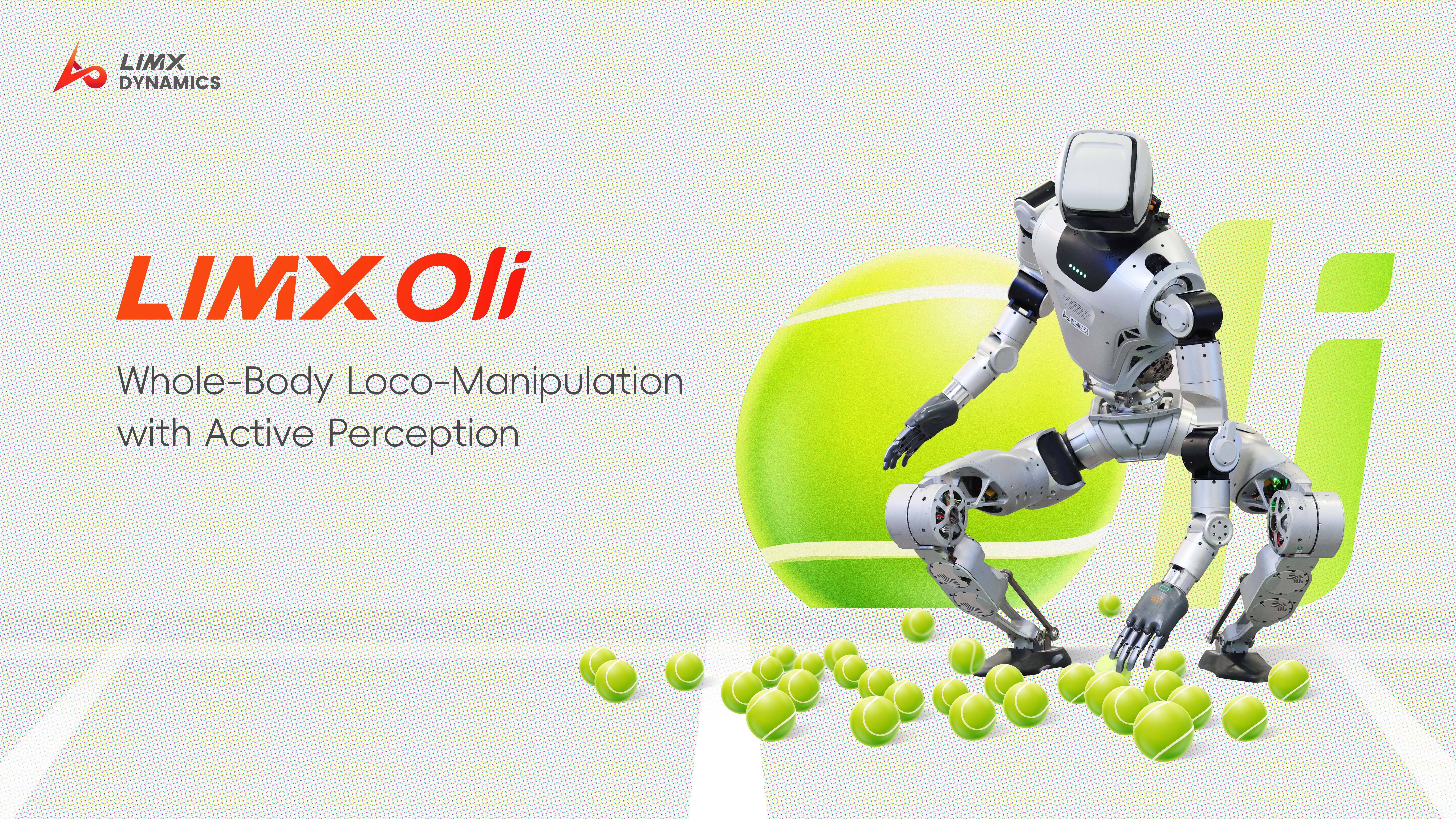
LimX Dynamics' Oli humanoid robot performing a task.
LimX Dynamics' COSA System
LimX Dynamics launched COSA, or Cognitive OS of Agents, on January 12, 2026. The system is positioned as an embodied Agentic OS native to the physical world, designed specifically for humanoid robots. The company emphasizes "Agentic native" to highlight its ability to autonomously perceive, understand, decide, and act from its foundational layer, rather than being an adaptation of traditional systems with added AI functions.
As an illustration, LimX Dynamics demonstrated its full-size humanoid robot, Oli, equipped with COSA, performing a water delivery task. When Oli received a new instruction mid-task, it paused, integrated the new instruction into its plan, adjusted priorities and its route, and then continued to its destination. This action, while appearing as a pause, represents the robot's ability to dynamically adapt.
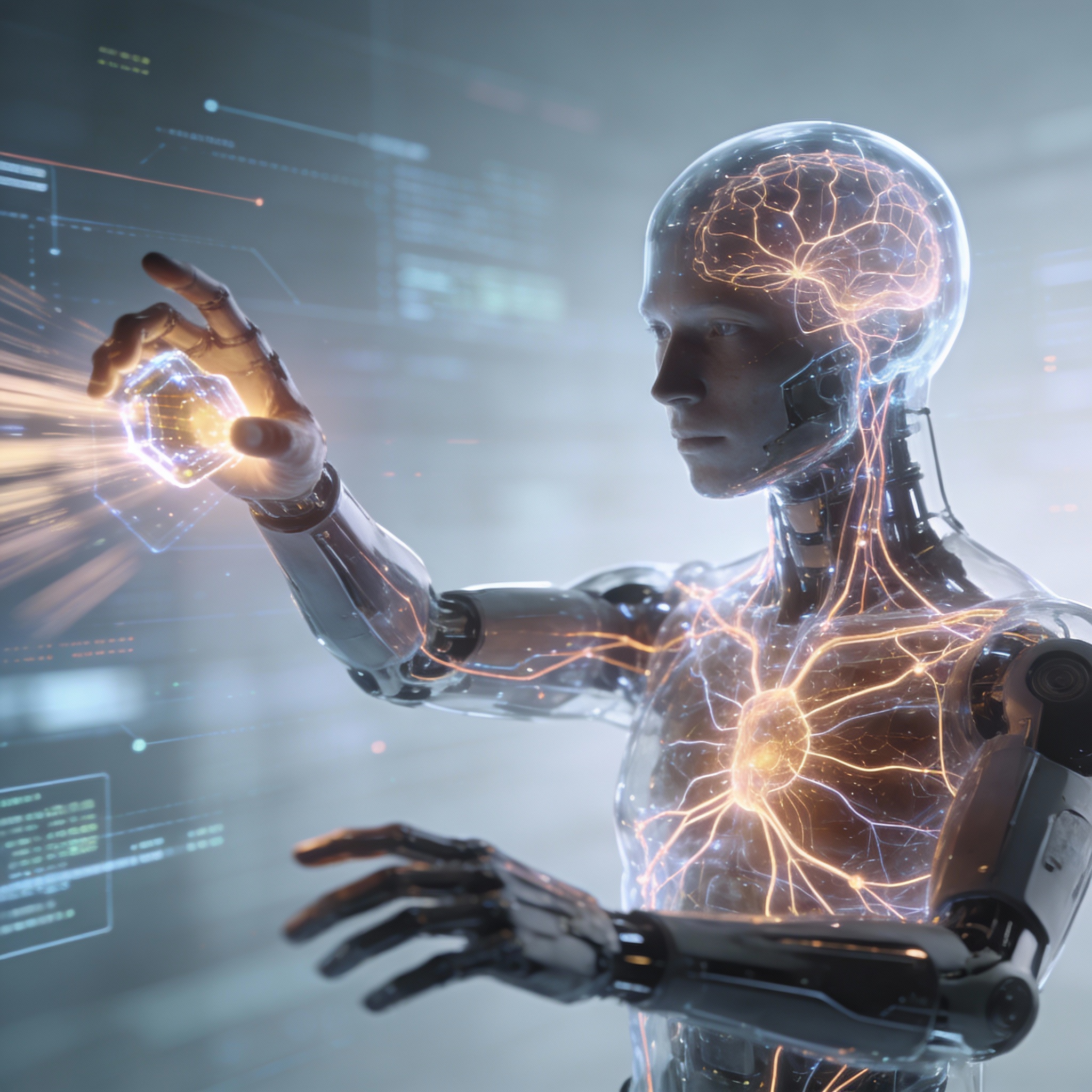
Transparent robot head and torso showing integrated brain and cerebellum, symbolizing 'thinking while acting'.
Technical Approaches in Global Robotics
Globally, Figure AI is a prominent player in embodied intelligence, with a valuation of $39 billion in 2025. Both Figure AI and LimX Dynamics are addressing the challenge of integrating robot "brain" and "cerebellum" functions. However, their technical approaches differ.
Figure AI's Helix is an end-to-end Vision-Language-Action (VLA) model, which attempts to integrate perception and action through a "fast and slow brain" system. LimX Dynamics' COSA, in contrast, is an Agentic OS built from the architectural foundation to create an operating system native to the physical world. While Helix is described as equipping a robot with a "super brain," COSA is characterized as building a complete "nervous system." Both aim to enable robots to "think while acting" rather than merely executing pre-programmed sequences.
Key distinctions between the two approaches include:
First, in mobile manipulation, Figure AI's public demonstrations often show movement and manipulation separately. Oli, with COSA, performs "movement-manipulation-movement" in a continuous sequence, grasping objects while moving and adjusting without noticeable pauses.
Second, Helix is a large model, functioning akin to an application, whereas COSA is an operating system designed from the ground up.
Third, despite Figure AI's higher valuation, LimX Dynamics asserts that COSA and Oli's performance are competitive on a global scale, suggesting that Chinese embodied intelligence companies may be undervalued.
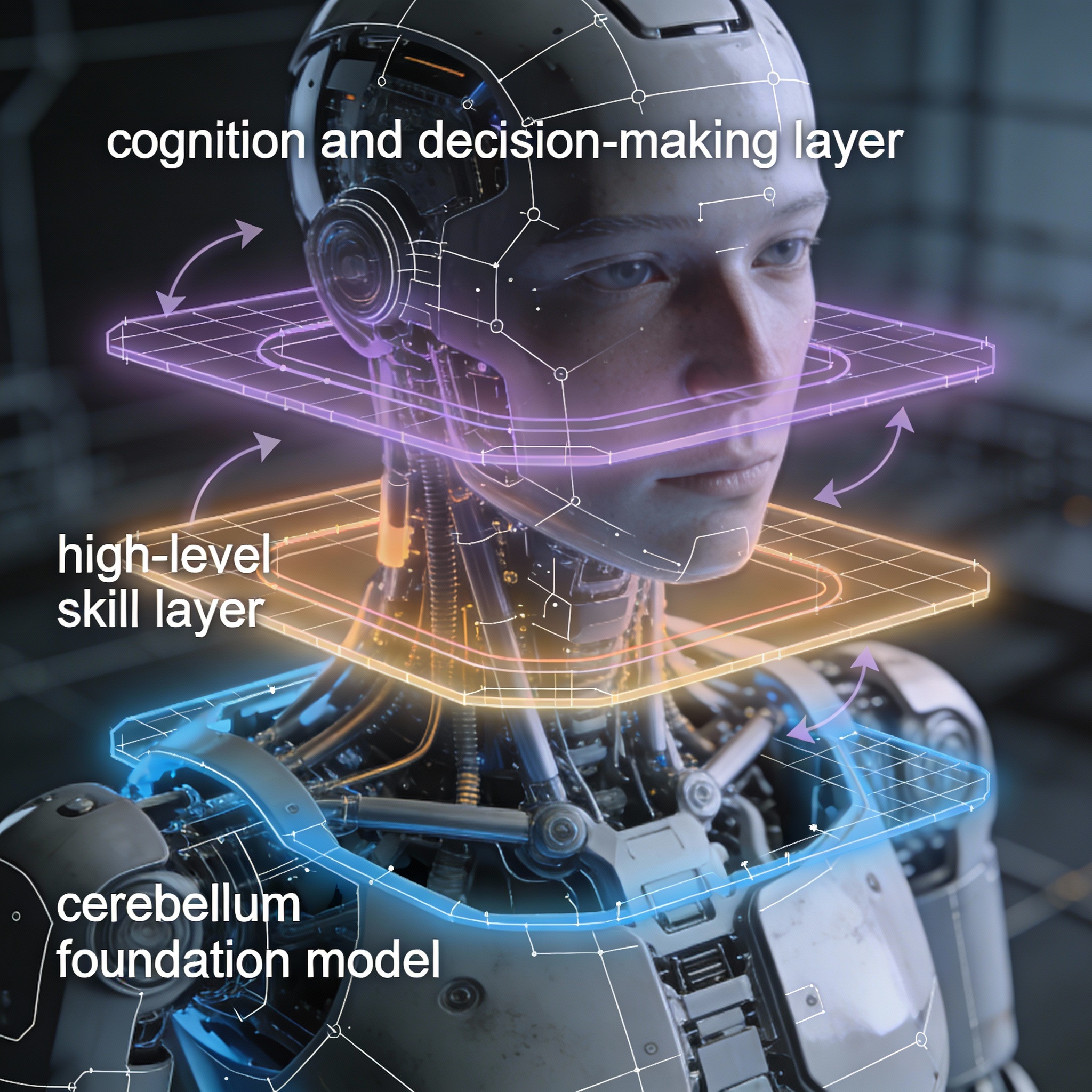
Three-layered internal architecture of a humanoid robot, illustrating COSA's technical framework.
COSA's Technical Framework
COSA addresses the "brain-cerebellum" integration by redesigning the robot's architecture. It treats motion capability not as an output of cognition but as its foundation. Robot decision-making becomes a continuous process of feedback and environmental response. This allows for "thinking while doing," where plans are adjusted based on real-time feedback.
COSA employs a three-layer architecture:
The first layer is a "cerebellum foundation model" that generates real-time, full-body movements. This enables the robot to adjust its posture dynamically rather than relying on a library of preset actions.
The second layer is a high-level skill layer that integrates the brain and cerebellum. It aligns complex behaviors such as navigation, obstacle avoidance, mobile manipulation, and stair climbing with the full-body motion foundation model, bridging motion and cognitive intelligence.
The third layer handles cognition and decision-making, including natural language understanding, task breakdown, dynamic planning, and priority adjustment. The critical aspect is the real-time coupling of these layers, allowing upper-level decisions to influence lower-level actions and lower-level perceptions to feed back to the upper layer.
COSA aims to resolve the "disconnection" challenge for large models in physical applications. It enables the robot's "brain" to perceive the body's actions and environmental changes, and the "body" to understand the brain's intentions and adapt flexibly. This creates a closed loop of task understanding, environmental perception, decision adjustment, skill combination, and physical execution.

Robot hand holding a glowing sphere, symbolizing understanding vague instructions, memory, and translating thought into action.
Core Capabilities Enabled by COSA
COSA's architecture provides robots with three core capabilities:
First, understanding "vague instructions." Robots can interpret general commands like "take two bottles of water to the front desk for the guest" by breaking them down into subtasks, planning execution paths, and dynamically adjusting based on environmental changes, moving beyond step-by-step programming.
Second, possessing "memory." Oli can retain semantic memory, remembering past interactions, object locations, and encountered obstacles. This transforms the robot from a purely reactive agent to one that can make judgments based on past experiences.
Third, translating thought into action. COSA addresses the bottleneck where smart robot brains struggle with execution. The "brain-cerebellum" integration ensures that the robot's plans can be stably and flexibly executed in the physical world.
China's Contribution to Embodied Intelligence
The comparison between LimX Dynamics' COSA and Figure AI's large model suggests a shift in Chinese embodied intelligence companies from following to defining technological approaches. In a global competition focused on "system capabilities," LimX Dynamics emphasizes full-stack capabilities, including self-developed robot hardware, cerebellum motion control intelligence, and a brain-cerebellum integrated system. The company states that its COSA system demonstrates the capability of Chinese teams to contribute to the forefront of embodied intelligence.
Humanoid robot on a pedestal with a glowing head, symbolizing intelligent awakening.
From Mechanical Performance to Intelligent Awakening
The demonstration of Oli pausing to integrate a new task illustrates a continuous "think-act" process, combining real-time perception, memory retrieval, intent understanding, task planning, dynamic adjustment, and stable execution. This integration, previously handled by separate modules, signifies a move towards robots having more autonomous "thought."
Historically, the introduction of operating systems, such as Windows or iOS, marked new eras for personal computing and smartphones. Humanoid robots are at a similar juncture, with maturing hardware and algorithms but a need for a foundational operating system to enable stable and adaptable operation across various scenarios. LimX Dynamics suggests that COSA could be the beginning of filling this gap, marking the arrival of the embodied Agentic OS era.
Stay Ahead of the AI Curve
Join 50,000+ subscribers getting the latest AI tools, trends, and tutorials delivered to their inbox weekly.
No spam, unsubscribe at any time.