
Lightyear Beyond Introduces Tabbit AI Browser with "Miao Zhao" Skill Integration

Lightyear Beyond has launched Tabbit, an AI-powered browser designed for the Chinese market, featuring a "Miao Zhao" (clever tricks) capability that allows users to automate complex tasks. The browser aims to integrate artificial intelligence directly into web browsing, addressing a gap in the domestic market for native AI browser solutions.

Close-up of a laptop screen showing the Tabbit AI browser interface with hands on keyboard.
According to information reviewed by toolmesh.ai, Tabbit is presented as a ground-up redesign, distinguishing itself from previous attempts that were often slow or merely Chrome extensions. The browser is currently available for free and supports various mainstream domestic AI models.
Core Functionality and Use Cases
Tabbit incorporates five primary functions:
Chat: Enables AI interaction during browsing, supporting contextual queries across web pages, tab groups, and favorites.
Miao Zhao (Skills): Converts repetitive actions into one-click operations, with support for variables and web page content modification.
Smart Agent: Automates complex tasks with AI, providing transparency into its operations.
Favorites: Offers semantic search and fragmented content collection.
Tab Management: Provides automatic grouping and cloud synchronization for tabs.
These features are intended to enhance efficiency in information gathering and content creation. Early users have highlighted several practical applications.

Professional user managing multiple browser tabs with AI chat summarizing content on a large monitor.
One use case involves managing information overload. For instance, a user tracking a dispute between Anthropic and the U.S. Department of Defense could open numerous related links. Tabbit's tab management can automatically group these pages based on content, allowing the user to then employ the AI chat function to summarize timelines and perspectives from the grouped sources. This process, which previously took significant time, can be completed rapidly, with the AI drawing directly from the browsed content without issues related to external link reading.
Another application is in travel planning. Tabbit's Smart Agent mode can automate searches on travel websites. Users can verbally input complex requests, such as finding flights with specific aircraft size requirements or booking hotels near popular attractions. The Smart Agent operates by controlling web tabs, displaying its actions, and allowing users to continue browsing other pages simultaneously. While effective for less urgent tasks, the Smart Agent's reliance on multimodal large language models can make it slower than manual operation for time-sensitive needs.

User verbally interacting with Tabbit Smart Agent for travel planning on a laptop, showing automated search.
Advanced Automation with Miao Zhao
The "Miao Zhao" feature extends automation by allowing users to save frequently used instructions as reusable templates. For example, a complex travel planning request, including flight and hotel preferences, can be configured with variables for time and location. This allows users to execute the task with minimal input by simply updating the variables. Miao Zhao also supports smart agent functions, enabling one-click execution of tasks like multi-city price comparisons or round-trip itinerary planning.
Tips for creating Miao Zhao prompts include using clear variable names, setting reasonable default values, and regularly updating scripts for accuracy. This functionality aims to transform complex, multi-step processes into streamlined, repeatable actions.

Digital interface showing a 'Miao Zhao' script template with variables, symbolizing advanced automation.
Enhanced Content Management and Customization
Tabbit addresses common challenges in content collection and organization. When a user bookmarks a web page, Tabbit reads and annotates its content, enabling semantic search through the chat function, even if the specific name is forgotten. A notable feature is the ability to bookmark images, with Tabbit providing detailed text annotations of their visual information. This is particularly useful for designers who can semantically search for reference images.
The browser also offers extensive customization through "Scripts" within the Miao Zhao function. Users can write scripts to modify web page content and add new functionalities. Examples include creating a reading enhancement tool that optimizes font, line spacing, and color schemes while removing ads and generating a table of contents. Another script can enhance video websites by adding more playback speed options, a picture-in-picture mode, and a one-click screenshot function. Users can generate these scripts using natural language prompts, with Tabbit's AI assisting in code generation.
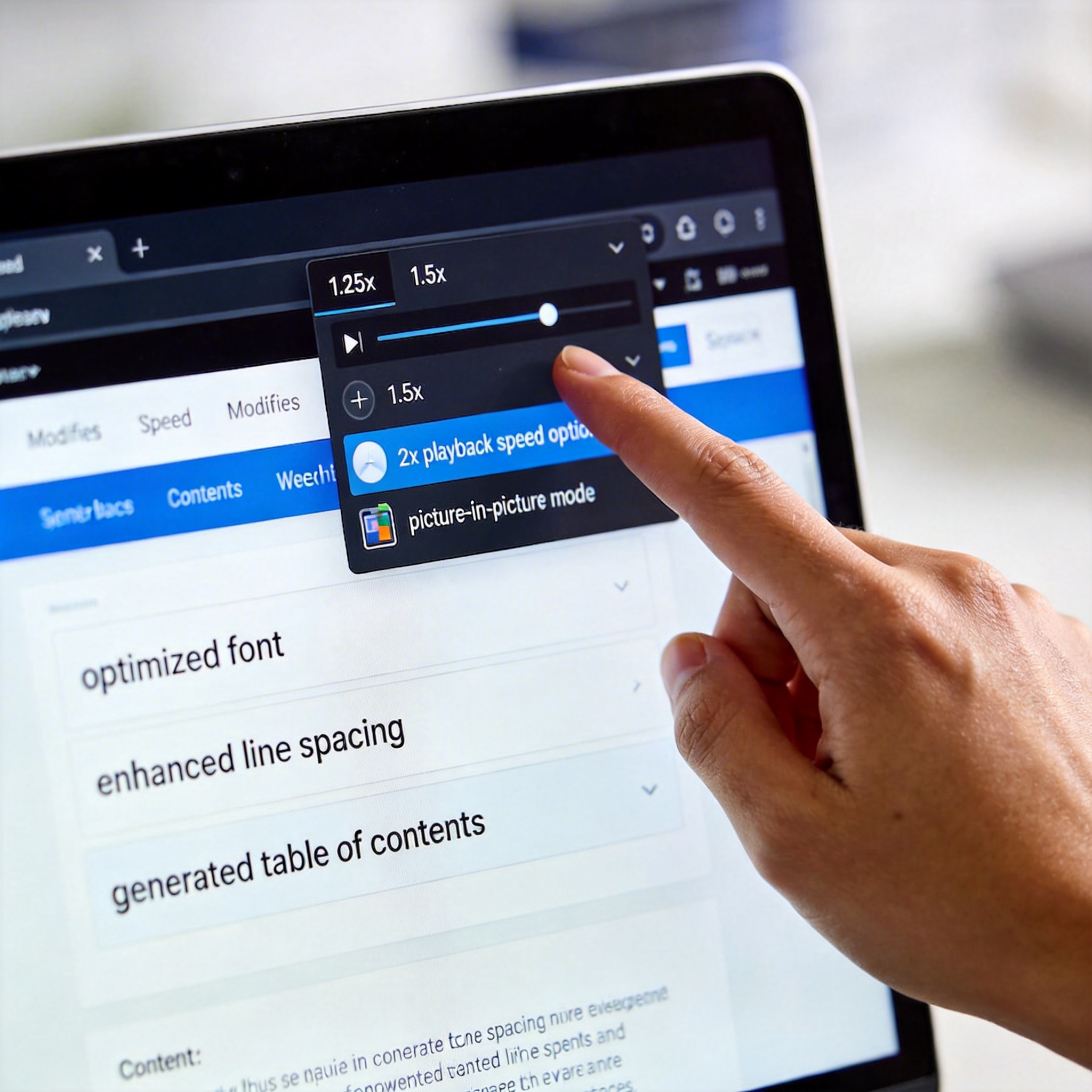
Web browser displaying customized web pages with enhanced readability and video playback features.
Market Positioning
While numerous AI browsers exist internationally, Lightyear Beyond emphasizes Tabbit's deep adaptation for domestic Chinese websites, including support for platforms like WeChat official accounts and Bilibili. The browser also features multi-model switching and local data storage, catering to the specific needs of Chinese users and enterprises. The developers suggest that adopting Tabbit requires a shift in user habits, moving from manual operations to directing AI, which is expected to significantly improve efficiency over time.
Stay Ahead of the AI Curve
Join 50,000+ subscribers getting the latest AI tools, trends, and tutorials delivered to their inbox weekly.
No spam, unsubscribe at any time.