Harvard Poll: 59% of Young Adults See AI as Job Threat, Yet Over Half Rely On It

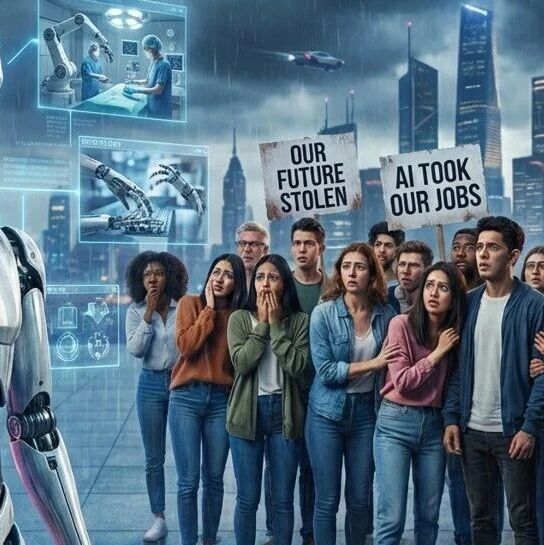
A recent Harvard Youth Poll indicates that 59% of Americans aged 18-29 perceive artificial intelligence as a threat to their future job prospects. This sentiment emerges even as a significant portion of this demographic relies on AI for daily tasks.
The survey findings highlight a complex relationship between young people and AI, characterized by both dependence and apprehension.
Conflicting Views on AI Adoption and Impact
The poll, which surveyed young adults, revealed that 35% regularly use large language models such as ChatGPT or Claude. Furthermore, 52% reported trusting AI to assist with work or school assignments. Daily AI usage is particularly high among this age group, with 53% using it more than once a day, compared to 30% for those aged 65 and over.
Despite this high rate of adoption and integration into daily routines, a substantial majority expressed concerns about AI's impact on their careers. Among those who view AI as a threat, 26% described the threat as "very significant," and 33% as "somewhat threatening." Only 23% felt that AI would not affect their future.
Beyond job security, young people also voiced concerns about the nature of future work. The poll found that 44% believe AI will diminish the meaningfulness of future jobs, and another 44% feel it will reduce, rather than create, opportunities.
Erosion of Perceived Value and Differentiation
The anxiety among young adults is not solely about job displacement but also about the weakening of their perceived irreplaceability in the workforce. Tasks that once required time and skill, such as report writing, information research, and data summarization, are now rapidly handled by AI. This automation leads to a sense that their professional processes are being absorbed by tools.
This shift raises questions about individual value. If AI can easily perform many tasks, the unique contribution of human effort becomes less clear. The increasing use of AI also contributes to homogenization in outputs, such as writing styles and analytical approaches. For young professionals seeking to establish differentiation, this convergence can be unsettling, as their competitive advantages appear to be averaged out.
The poll suggests that while young people use AI extensively, they often feel that the technology reduces their opportunities and the intrinsic meaning of their work. This dynamic of dependence coupled with a sense of being threatened leads to a realization that AI is not merely a tool but a force that redefines how they measure their own worth. The standard shifts from "can it be done well" to "is it necessary for me to do it."
Redefining the Future of Work
The data implies that the future value structure of the workplace is undergoing adjustment. Historically, young professionals gained advantages through quantifiable abilities like speed, diligence, and meticulousness. However, as AI replicates these "repeatable abilities," the starting point for young people becomes less distinct, and effort may no longer guarantee value in the same way.
AI is increasingly handling "first-layer work"—tasks that provide immediate output, such as drafting documents or compiling information. While these tasks once demonstrated capability, their automation by AI means they no longer represent significant value. This can lead to frustration, as efforts to master skills easily replicated by AI may dilute one's sense of value.
The poll's findings suggest a future where jobs may not disappear entirely, but the number of people required for specific roles could decrease. As basic output becomes automated, work is expected to shift towards judgment, selection, creation, and decision-making—roles that are inherently fewer in number. This reordering of the workplace compels a reevaluation of what constitutes valuable skills and effort in an AI-driven environment.