
Epoch AI Report: Chinese AI Models Lag US Counterparts by Seven Months


A recent report from Epoch AI indicates that Chinese artificial intelligence (AI) models trail those from the United States by an average of seven months in terms of capability. The analysis, which sets the minimum gap at four months and the maximum at 14 months, suggests that all cutting-edge AI advancements since 2023 have originated in the U.S.
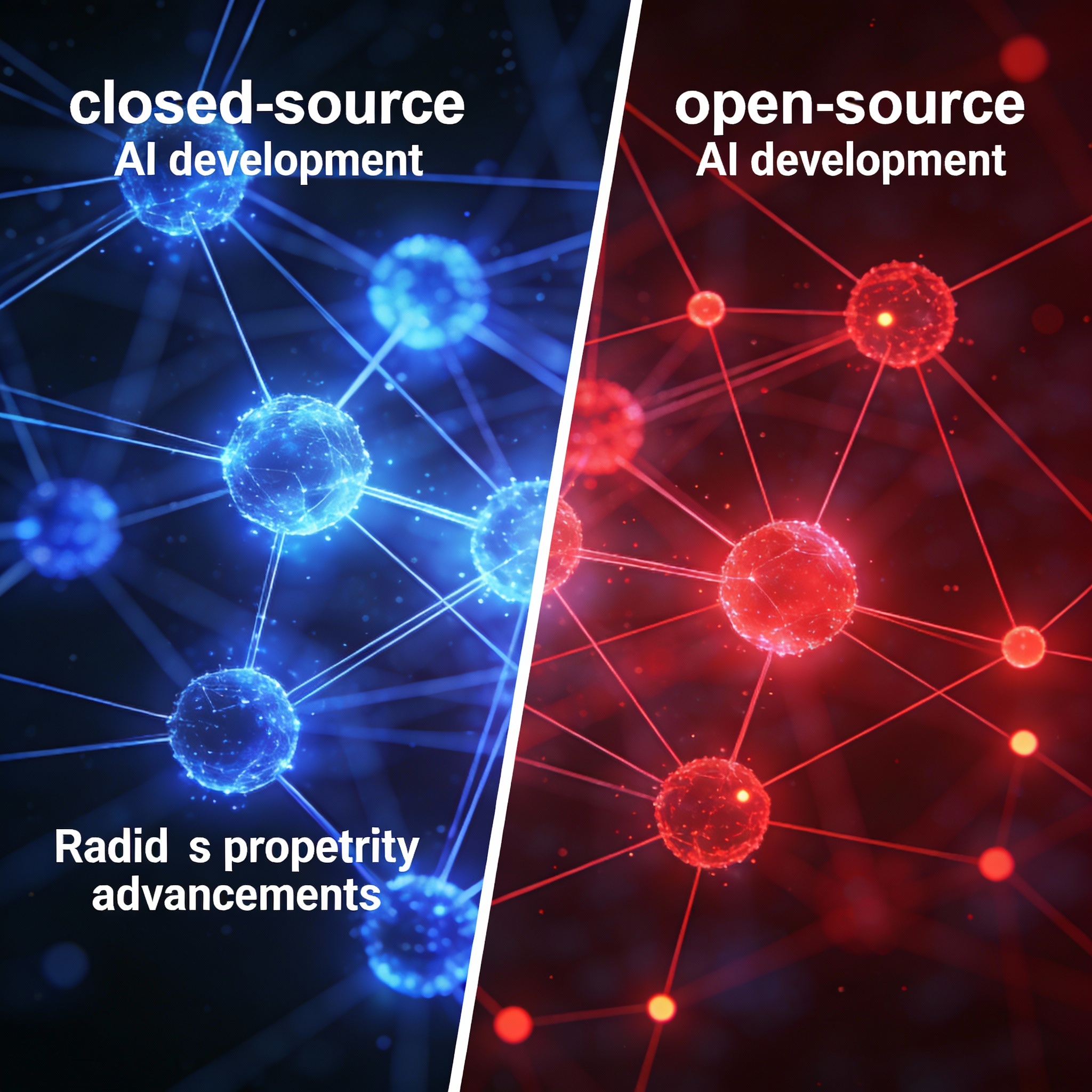
Visual representation of closed-source (blue) and open-source (red) AI development networks.
The report also highlights that this average seven-month disparity largely reflects the difference between open-source and closed-source AI development. The observed gap in large language model (LLM) capabilities between China and the U.S. closely mirrors the broader distinction between these two development approaches.
Measuring the Capability Gap
Epoch AI's assessment relies on its comprehensive capability index (ECI), which evaluates the overall frontier level of AI models. The ECI incorporates factors such as language understanding and generation, reasoning and problem decomposition, multi-task generalization performance, public model evaluations, and expert calibration. This methodology quantifies the lag as a specific timeframe, indicating that Chinese AI models require an average of seven additional months to achieve the same capability level as their U.S. counterparts. This analytical framework assumes that AI capability curves in both countries follow a similar trajectory but are out of sync.
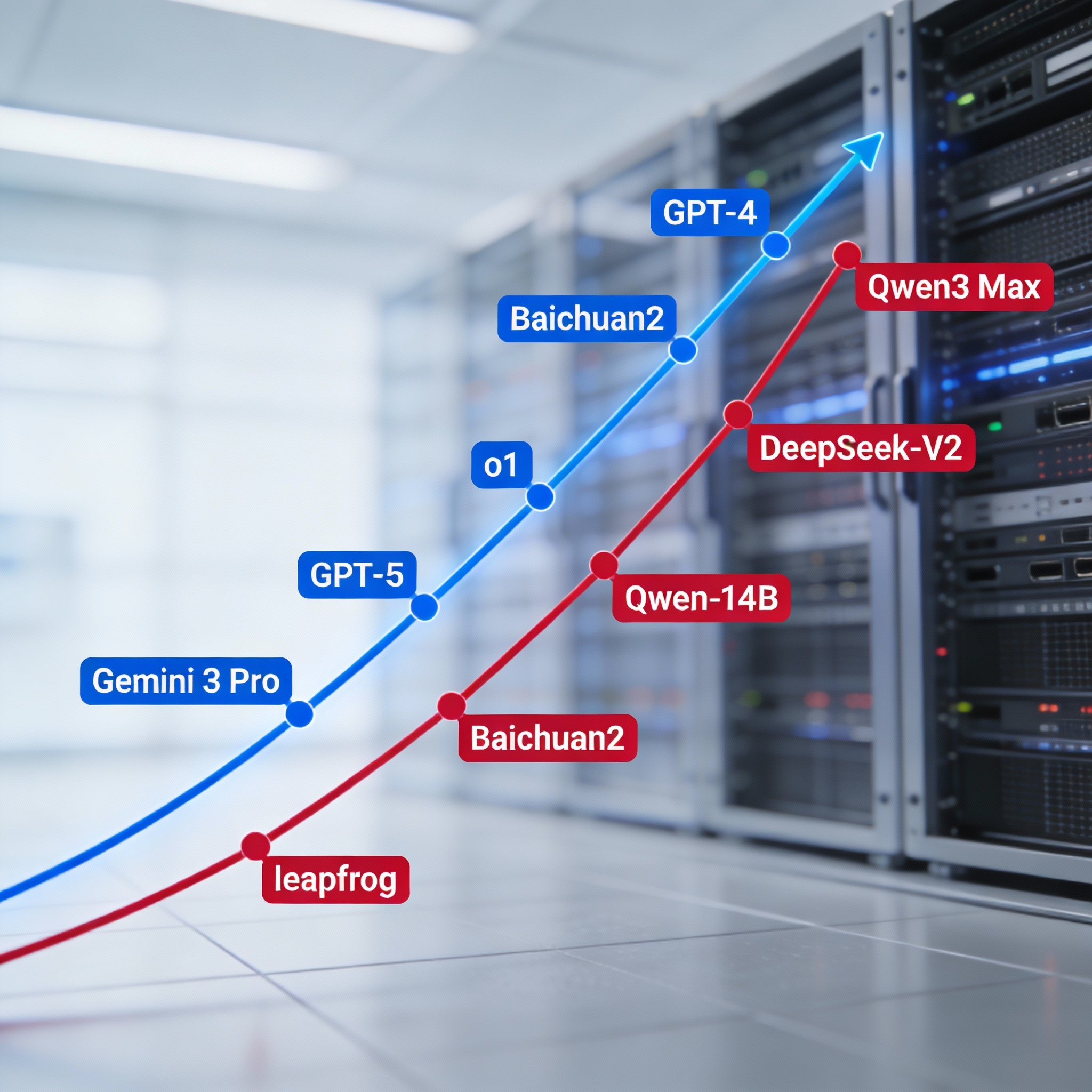
Infographic showing two AI development timelines: a continuous blue line for US models and a 'leapfrog' red line for Chinese models.
The report identifies three key insights from its data. The U.S. AI landscape, represented by a blue line in Epoch AI's charting, shows a rapid update cycle, with continuous advancements from models like GPT-4 to o1 and GPT-5, and Gemini 3 Pro. These advancements are not solely dependent on parameter scale; for instance, the o1 series demonstrates significant power through its reasoning path design, intermediate state modeling, and reconstructed training objectives, integrating "thinking processes" into its engineering.
In contrast, Chinese AI models, depicted by a red line, exhibit a "leapfrog" catch-up pattern. Models such as Baichuan2, Qwen-14B, Yi-34B, DeepSeek-V2, Qwen2.5, and Qwen3 Max mark substantial progress, but with longer intervals between updates. Chinese AI development appears to be closing the gap through increased parameter scale and Mixture-of-Experts (MoE) architectures, as evidenced by models reaching 72B, 236B, and MAX scales.
Over the past few years, the AI capability gap between China and the U.S. has shown a trend of narrowing. In 2023, the gap was approximately 10–12 months, converging to 6–8 months in 2024, and stabilizing at around seven months in 2025. This indicates a consistent pace of catch-up by China's AI sector, even as U.S. frontier AI continues its rapid advancement.
Open Source Versus Closed Source
The report questions whether open-source development acts as a constraint on capability limits. Most leading Chinese large models, including the Qwen and DeepSeek series, are open-source to varying degrees, allowing the AI community to reproduce their weights. Conversely, cutting-edge U.S. models like GPT-5 and Gemini 3 are exclusively closed-source. It is on these closed-source platforms that the U.S. continues to extend its lead in frontier capabilities.

Abstract depiction of a self-evolving neural network, symbolizing continual learning in AI.
Further validation of this seven-month difference in AI strength between China and the U.S. comes from the FrontierMath benchmark test. This gap does not imply an inability to catch up but rather signifies that Chinese LLMs have entered the top tier of global large model competition. The report suggests that future breakthroughs will hinge not on current models like GPT-5 or Qwen3 Max, but on the next paradigm shift, which involves integrating AI reasoning with action, enabling self-reflection and planning, and developing system-level capabilities for agents. Google researchers recently highlighted continual learning as a critical area for AI in 2026, emphasizing the importance of AI's ability to self-learn and evolve iteratively without retraining. The entity that first achieves this capability is expected to redefine the AI frontier.
Stay Ahead of the AI Curve
Join 50,000+ subscribers getting the latest AI tools, trends, and tutorials delivered to their inbox weekly.
No spam, unsubscribe at any time.