
CMU Researchers Propose Collaborative AutoGEO to Enhance AI Search Visibility Without Compromising Quality

Carnegie Mellon University (CMU) researchers have introduced AutoGEO, a collaborative approach to generative engine optimization (GEO) designed to increase content visibility in AI search results while maintaining search quality. This development comes as concerns grow over the commercialization of AI search, including the integration of advertisements and the practice of "poisoning" search results.

Researcher's hands interacting with a tablet and holographic projection, illustrating generative engine optimization.
The AutoGEO project, detailed in a paper accepted for ICLR 2026, aims to offer an alternative to current commercialization models that can degrade user trust.
AI Search Commercialization Challenges
The commercial landscape for AI search engines currently presents two primary models that often lead to user dissatisfaction. One model involves platforms directly embedding advertisements within AI-generated answers, a strategy adopted by services such as ChatGPT, which began featuring ads in February. This approach, while transparent, risks eroding user trust if ads influence the relevance or accuracy of results.
The second model, termed "adversarial GEO," involves third-party service providers manipulating AI search results. This practice, recently highlighted by a 315 Gala exposé, involves injecting false content or manipulative instructions into documents to artificially boost the exposure of specific products or information. While effective in increasing visibility, this method significantly compromises search quality and propagates misinformation.

Visual contrast between chaotic adversarial GEO and harmonious collaborative GEO.
Collaborative GEO: A New Approach
AutoGEO proposes a "collaborative GEO" model as a third path. Instead of deceptive tactics, this method focuses on understanding the preferences of AI engines to help high-quality content achieve greater visibility without sacrificing the integrity of search results. The researchers argue that while the first two models represent zero-sum games where platforms or service providers benefit at the user's expense, collaborative GEO offers a positive-sum outcome for content creators, platforms, and users.
The AutoGEO paper demonstrates the feasibility of this approach, showing that collaborative GEO can improve content visibility by up to 50.99% while preserving or even slightly enhancing search quality.
Performance Against Adversarial Methods
The study directly compared AutoGEO with two adversarial GEO techniques: Hijack Attack and Poisoning Attack. The findings indicated that while adversarial methods increased visibility, they consistently led to a decline in the utility of AI search results, making the overall search experience worse than a baseline without any GEO. In contrast, AutoGEO significantly improved visibility without negatively impacting search quality metrics such as precision, recall, clarity, and insight across engines powered by Gemini, GPT, and Claude.
The research also evaluated AutoGEO's overall performance across three datasets: the general domain GEO-Bench and Researchy-GEO, and the e-commerce domain E-commerce. AutoGEO API demonstrated up to a 50.99% improvement compared to existing methods. An optimized version, AutoGEO Mini, which has significantly lower inference costs, still achieved an average improvement of 20.99%.
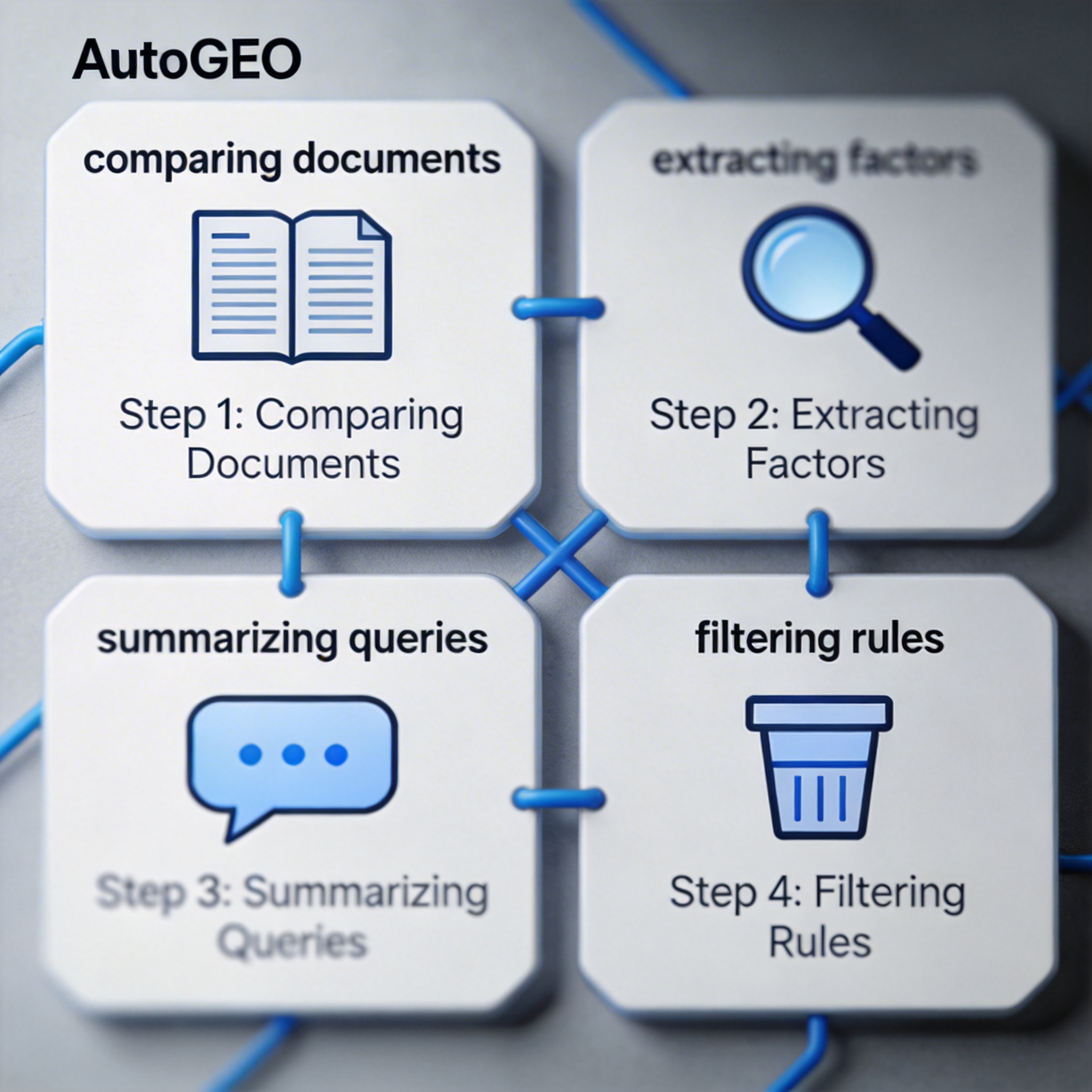
Infographic detailing the four-step process of AutoGEO's framework for identifying content features.
How AutoGEO Works
AutoGEO's effectiveness stems from its ability to identify content features preferred by generative AI engines. The framework uses large language models to automatically extract preference rules from real engine behavior data. This process involves four steps: comparing high-visibility and low-visibility documents, extracting core factors, summarizing across queries, and filtering for essential rules.
These rules can be applied in two ways:
AutoGEO API: Rules are directly injected as prompts into large model APIs like GPT and Gemini.
AutoGEO Mini: Rules serve as reward signals to train a smaller Qwen-3-1.7B model through reinforcement learning, offering low deployment costs and offline CPU operation.
Implications for Content Creators
The research offers key insights for content creators aiming to optimize for AI search:
Consistent AI Preferences: Different AI engines (Gemini, GPT, Claude) exhibit largely similar preferences, with rule overlap rates between 79% and 84% on the same dataset. This suggests a consistent standard for "good content" across platforms.
Domain-Specific Preferences: Content preferences vary significantly by domain. Research-oriented queries favor "in-depth explanations" and "causal analysis," while e-commerce content benefits from "actionable step-by-step guides" and "modular information structures."
Customized vs. General Rules: While rules specifically tailored to an engine and domain perform best, even generalized rules can significantly outperform baselines without any optimization.
These findings encourage content creators to focus on understanding and adhering to AI engine preferences rather than resorting to manipulative tactics.

Abstract image of human and digital hands interlocking over a glowing orb, symbolizing trust in AI.
Fostering Trust in AI Search
The researchers conclude that addressing trust issues in AI search requires a shift towards collaborative solutions. AutoGEO indicates that it is possible to significantly enhance content visibility without compromising search quality. This approach suggests a sustainable path for the AI search ecosystem, advocating for better rules and collaborative optimization rather than relying on adversarial methods or increased platform controls.
Stay Ahead of the AI Curve
Join 50,000+ subscribers getting the latest AI tools, trends, and tutorials delivered to their inbox weekly.
No spam, unsubscribe at any time.