
Anthropic's Claude Sonnet 5, Codenamed Fennec, Expected with Enhanced Coding Capabilities


Anthropic is reportedly preparing to release Claude Sonnet 5, internally codenamed Fennec, a new large language model with advanced programming capabilities. Sources indicate the model is designed to surpass current programming models in performance, offer a 50% price reduction compared to Opus 4.5, and feature a 1-million-token context window.
The model is anticipated to address developer concerns regarding the speed and cost of existing models. Claude Sonnet 5 is also rumored to integrate a "development team" functionality, achieving a score exceeding 80.9% on the SWE-Bench benchmark.

A software engineer coding on a laptop in a modern office, representing advanced programming capabilities.
Deployment and Early Indications
Evidence of Claude Sonnet 5's existence emerged on February 2, when a developer accessing an API on Google Vertex AI encountered a model ID: claude-sonnet-5@20260203. The resulting "404 Not Found" error suggests the model is deployed within Google's infrastructure but not yet publicly accessible. AI blogger Pankaj Kumar reportedly confirmed the codename Fennec and its presence in Google's systems, with a potential release date as early as February 3, 2026.
Screenshot of Google Vertex AI interface, indicating where Claude Sonnet 5 was reportedly found.
Early reviews from testers suggest strong performance in structured visual generation tasks. One tester reported that Sonnet 5 generated a highly detailed ASCII world map from a simple prompt. The model also reportedly demonstrated proficiency in UI rendering and complex code construction.
Performance and Cost Efficiency
Internal benchmarks indicate that Claude Sonnet 5's overall performance surpasses Claude Opus 4.5, despite being positioned as a Sonnet-tier model. Its programming ability is highlighted by an internal test score exceeding 80.9% on SWE-Bench, an increase from the previous highest score of 74.4%. This suggests the model can independently resolve common software engineering issues, including bug fixes, refactoring, and adding tests.
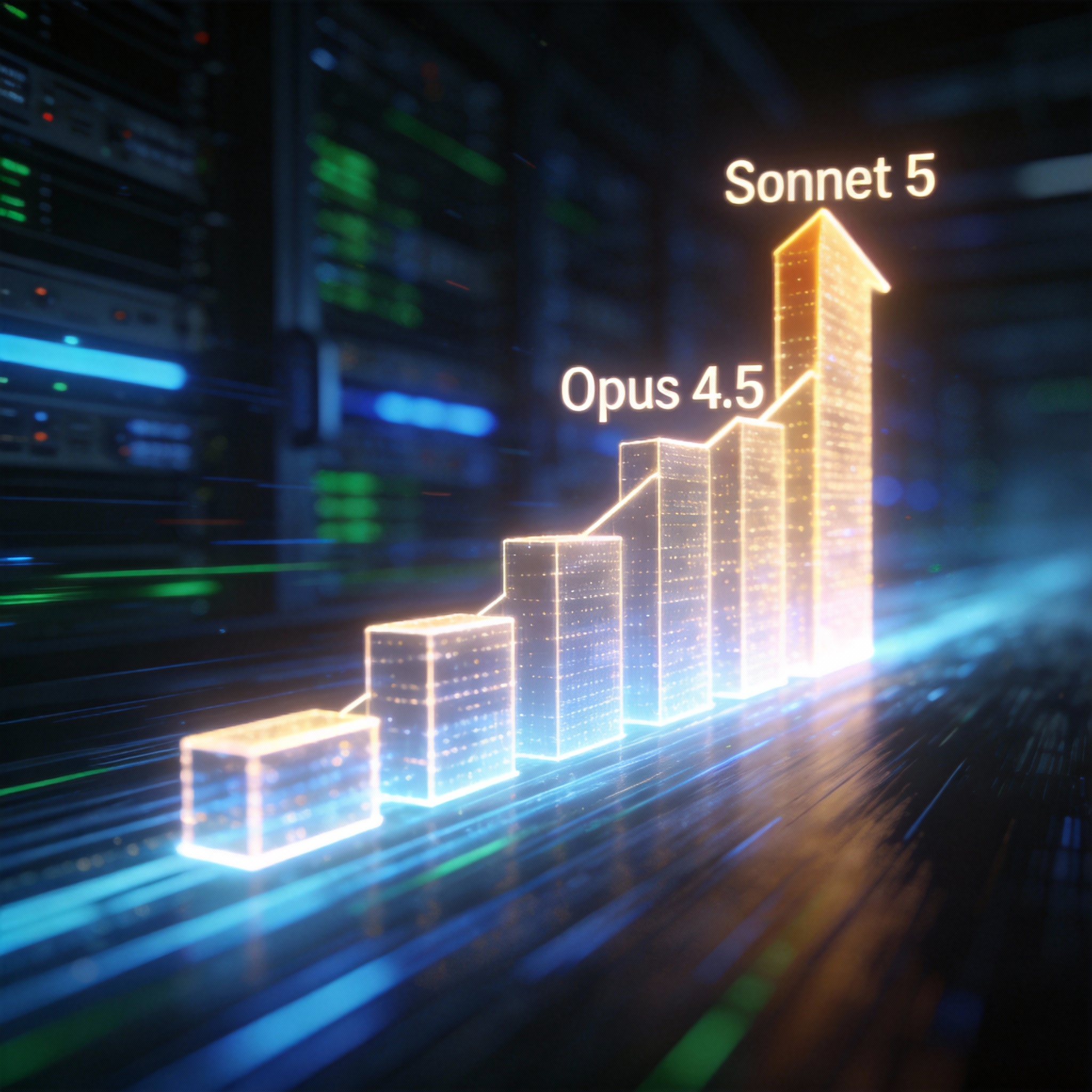
Glowing bar graph showing Claude Sonnet 5's performance surpassing Claude Opus 4.5, with data center background.
The model's inference cost is expected to be 50% lower than Claude Opus 4.5, a reduction attributed to its training and optimization on Google TPUs. In addition to cost efficiency, Sonnet 5 is expected to offer improved operating speed and lower latency, alongside its 1-million-token context length. This extended context window is intended to allow the model to process entire project codebases, providing a comprehensive understanding before executing tasks.
Automated Development Team Model
A notable feature of Claude Sonnet 5 is its "automated development team" model, referred to as Dev Team. In this mode, Sonnet 5 can automatically generate multiple sub-agents that collaborate in parallel to complete development tasks. With a single requirement, these sub-agents are designed to work concurrently and cross-verify each other, producing a complete, functional, and testable module.

Abstract network of glowing nodes and lines symbolizing AI agents collaborating as an 'automated development team'.
Reports from a few days prior mentioned a "swarm mode" for Claude Code, which is believed to be closely related to the Dev Team functionality. Mike Kelly, an X user, shared information about an unreleased "Swarm" feature within Claude Code. A "Swarm" is described as a system comprising a "chief commander" AI and a group of on-demand, temporary, professional sub-agents, operating with hierarchical structures, task dependencies, broadcast communication, and an internal messaging system.
In a developer's test task to create a web frontend for a video downloading tool, Claude reportedly demonstrated the ability to automatically create a Team Leader, Front-end Builder, Backend Builder, Component Builder, and QA Tester. These agents worked in parallel, with their status visible in real-time. The system also generated additional agents, such as a PI Server Agent, frontend building Agent, CSS specialist Agent, and API integration Agent, expanding the total number of agents to eight without direct supervision. Upon task completion, Claude produced a project summary and an execution report.
The "Swarm" feature, despite its capabilities, has not yet been released, potentially due to the complexity and potential risks associated with a system that can process extensive context and self-organize.
Two glowing digital pathways, one leading the other, symbolizing the competitive AI market between Anthropic and OpenAI.
Market Context
Anthropic's anticipated release of Sonnet 5 coincides with OpenAI's plans to release its Codex suite. By the end of January 2026, Anthropic had reportedly secured over $10 billion in financing, with a valuation of $350 billion, and a potential final financing scale of $20 billion. According to Menlo Ventures' Q4 2025 report, Anthropic's enterprise market share reached 40%, surpassing OpenAI's 27% and Google's 21%. Claude Code's annualized revenue reportedly exceeded $1 billion within six months.
Stay Ahead of the AI Curve
Join 50,000+ subscribers getting the latest AI tools, trends, and tutorials delivered to their inbox weekly.
No spam, unsubscribe at any time.