
Chinese AI Leaders Discuss Model Differentiation and Future Paradigms at AI NEXT Event

Leading figures in China's artificial intelligence sector, including Tang Jie of Zhipu AI, Yang Zhilin of Kimi, and Lin Junyang of Qwen, recently convened at the AI NEXT event. Yao Shunyu, a prominent figure at Tencent, also participated remotely. The discussions, which spanned over three hours, focused on the evolving landscape of AI, particularly model differentiation and the emergence of new paradigms.
The Shifting AI Landscape
Professor Tang Jie initiated a key discussion point, suggesting that the "chat paradigm" has largely reached its limits, especially with the advent of models like DeepSeek. He posited that the next frontier for AI lies in "Action" — enabling AI to perform tasks and "do things." Yang Zhilin elaborated on the concept of AI agents, describing them fundamentally as a search problem. He also highlighted that intelligence is not a uniform commodity; its value varies significantly depending on its application and the "taste" or discernment embedded within the model. This implies that future competition among models will hinge on their ability to reflect specific values and worldviews, suggesting that no single model is likely to dominate the global market due to diverse intelligent "tastes."
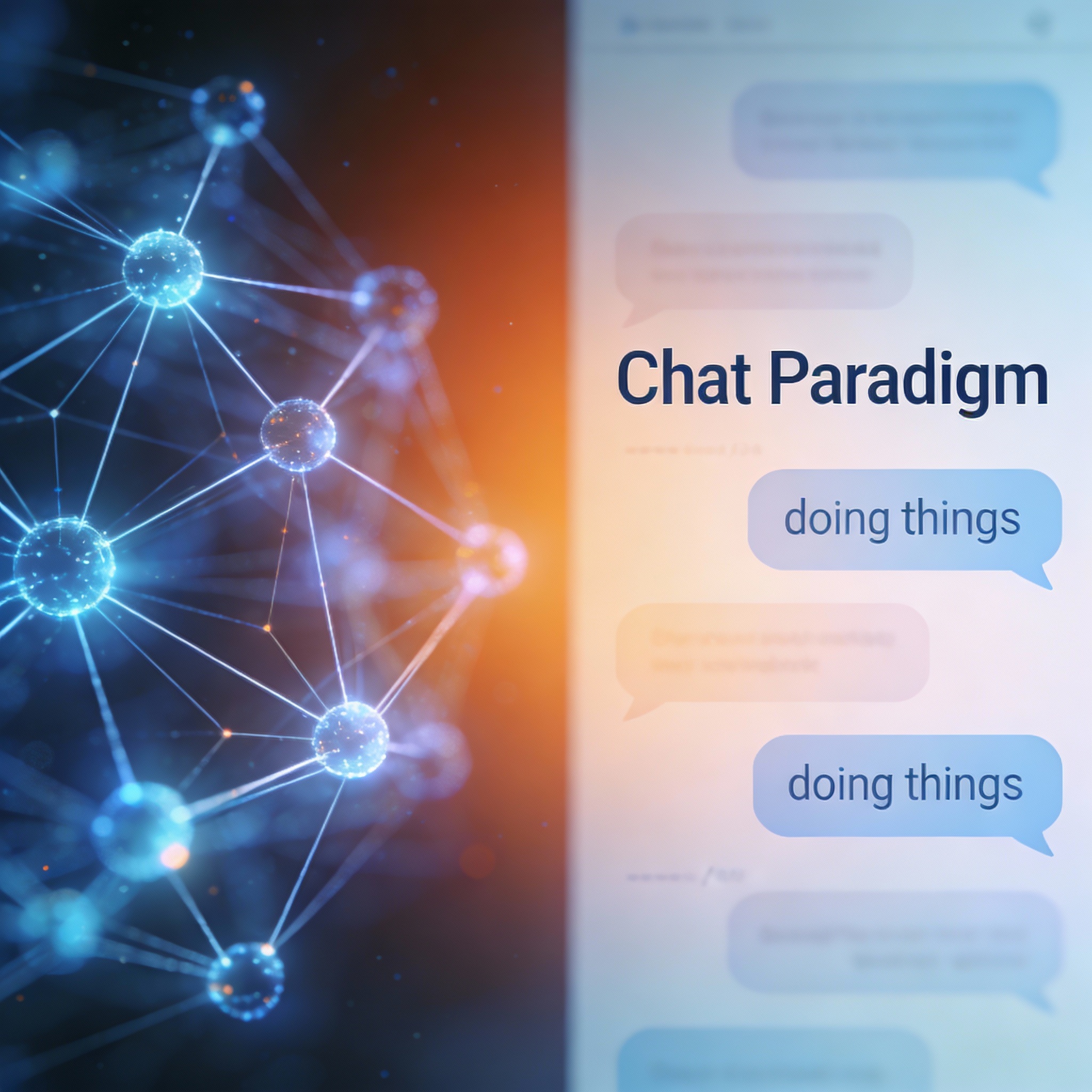
Abstract visual contrasting dynamic 'AI Action' with static 'Chat Paradigm', showing a shift in AI focus.
The panel discussion provided a platform for candid exchanges, with participants openly addressing challenges and future directions without resorting to typical public relations rhetoric. The host, Li Guangmi, observed a clear differentiation among Silicon Valley AI companies, citing Anthropic's focus on enterprise solutions, coding, and agents as an inspiration for Chinese models.
Differentiation in AI Development
Yao Shunyu, participating remotely, identified two major differentiation trends: the split between consumer-facing (To C) and business-to-business (To B) applications, and the divergence between vertically integrated solutions and layered model-application architectures.
He noted that while consumer AI, exemplified by ChatGPT, has seen incremental improvements, its core user experience has not drastically changed in the past year. In contrast, To B applications, such as Claude Code, are fundamentally reshaping industries by enabling communication with computers in natural language. Shunyu emphasized that To B scenarios benefit significantly from higher intelligence, with many businesses willing to pay a premium for the strongest models due to their direct impact on productivity.
Regarding architectural differentiation, Shunyu pointed out that while vertical integration remains effective for To C products like ChatGPT and Doubao, the To B sector is seeing a reversal. Here, powerful models are increasingly being leveraged by various application layers, indicating a move towards more modular and specialized solutions.
When asked about Tencent's strategy, Shunyu highlighted the company's strong To C focus. He explained that enhancing user value often involves providing more "context" to AI models, rather than solely relying on larger models or stronger pre-training. For instance, an AI suggesting meal options would be more effective with additional context about the user's preferences, current weather, or location. For To B in China, he noted the challenge of productivity revolutions and the need for Chinese companies to target overseas markets. He suggested that large companies, with their diverse internal scenarios, could use their own data to train models, offering a unique advantage over startups that rely on external labeling.

Visual split showing consumer-facing (To C) AI on one side and business-to-business (To B) AI on the other, highlighting market differentiation.
Lin Junyang of Qwen discussed Alibaba Cloud's approach, emphasizing that both To B and To C applications aim to solve real-world problems and improve human life. He acknowledged the strength of coding-focused AI, particularly in the US market, where API consumption for coding is remarkably high. Junyang expressed a belief in AGI (Artificial General Intelligence) and allowing natural differentiation to occur as models evolve.
Professor Yang Qiang shifted the discussion to the differentiation between industry and academia. He noted that while industry has been rapidly advancing, academia needs to catch up by addressing fundamental questions that industry might overlook, such as the upper bound of intelligence and optimal resource allocation for training and inference. He also highlighted the relevance of Gödel's incompleteness theorems in understanding the inherent limitations of large models, particularly regarding hallucinations. Yang Qiang also underscored the importance of continuous learning, drawing parallels with human sleep as a mechanism for noise reduction and sustained improvement.
Professor Tang Jie reflected on Zhipu AI's journey, noting that after the initial rush to launch chat models in 2023, the focus shifted. He stated that the "chat paradigm" battle concluded with the emergence of models like DeepSeek, and the next frontier is enabling AI to perform actions. Zhipu AI, he noted, has since concentrated its efforts on coding.
The Next Paradigm: Autonomous Learning
The conversation then moved to the "next paradigm" in AI, particularly autonomous learning. Yao Shunyu, drawing from his experience at OpenAI, described autonomous learning not as a single methodology but as a concept tied to specific data or tasks and reward functions. He clarified that autonomous learning is already happening, citing ChatGPT's continuous adaptation to user data and Claude's self-improvement in coding. He views this as a gradual evolution rather than a sudden breakthrough. Shunyu projected that significant signals for autonomous learning could emerge as early as 2025, with OpenAI still holding the highest probability of leading paradigm innovation.

Abstract representation of autonomous learning with self-organizing neural pathways and data streams, symbolizing continuous AI adaptation.
Lin Junyang added that while autonomous learning is in its early stages, the full potential of reinforcement learning has yet to be exploited. He questioned whether simply increasing context length makes AI smarter or if true autonomy requires proactive learning. This, he noted, introduces significant safety concerns, emphasizing the need for AI to operate within defined boundaries. Junyang suggested that autonomous learning might first be applied to continuous user understanding, similar to how recommendation systems improve with ongoing user input. However, he acknowledged the challenge of defining metrics for success in an AI that permeates all aspects of human life.
Professor Yang Qiang discussed federated learning as a model for collaboration among decentralized entities, particularly in scenarios requiring privacy and security. He believes this approach will become increasingly relevant as general-purpose large models collaborate with specialized local models, especially in fields like healthcare and finance.
Professor Tang Jie concluded the discussion by acknowledging the existing gap between Chinese and US AI capabilities but expressed optimism for China's future, particularly with the emergence of a new generation of adventurous entrepreneurs. He highlighted the importance of a supportive environment that allows innovators more time and resources to pursue groundbreaking work. He also emphasized the need for perseverance, stating that those who "foolishly persevere" will ultimately succeed.

Young Chinese AI entrepreneurs and researchers looking towards a futuristic cityscape at sunrise, symbolizing optimism and future potential.
The event concluded with a call for increased investment in China's AGI industry, including more computing power, to foster the next generation of AI researchers.
Stay Ahead of the AI Curve
Join 50,000+ subscribers getting the latest AI tools, trends, and tutorials delivered to their inbox weekly.
No spam, unsubscribe at any time.