
ByteDance's Volcengine Open-Sources OpenViking Context Database for AI Agents

ByteDance's Volcengine has open-sourced OpenViking, a context database designed to enhance the performance of AI Agents. The project, which recently topped GitHub's trending list, aims to address common challenges in managing and utilizing context within AI Agent systems.
Addressing AI Agent Context Challenges
OpenViking targets several pain points in current AI Agent architectures. One key issue is fragmented context, where memory, resources, and skills are often scattered across different systems, complicating unified management. Another challenge is the continuous growth of context as Agents operate, leading to information loss when context is truncated or compressed. Traditional Retrieval-Augmented Generation (RAG) systems often suffer from poor retrieval effectiveness due to flat storage methods, which can lead to irrelevant information retrieval. The black-box nature of many retrieval processes also makes debugging difficult. Additionally, current memory systems often fail to record the Agent's own actions, limiting self-iteration capabilities.

Holographic projection of a digital file system with 'resources', 'user', and 'agent' directories, representing OpenViking's paradigm.
OpenViking's core approach is to manage context using a file system paradigm. This allows Agents to interact with context as if it were a virtual file system, using commands like ls to list contents, find to search, and tree to view the directory structure. All context is represented by URIs using a viking:// protocol.
The hierarchical structure organizes context into categories such as resources/ (for project documents, code, web pages), user/ (for preferences and habits), and agent/ (for skills, instructions, and task memories).
Core Features and Functionality
OpenViking incorporates several features to improve context management:
Hierarchical Context Loading
To optimize token usage and manage large contexts, OpenViking processes context into three layers:
L0 (Summary): A brief, one-sentence summary for quick identification and retrieval.
L1 (Overview): Contains core information and applicable scenarios, utilized during the Agent's planning phase.
L2 (Details): The complete raw data, loaded only when in-depth reading is required by the Agent.
This layered approach is designed to reduce token costs and is conceptually similar to other context management techniques.
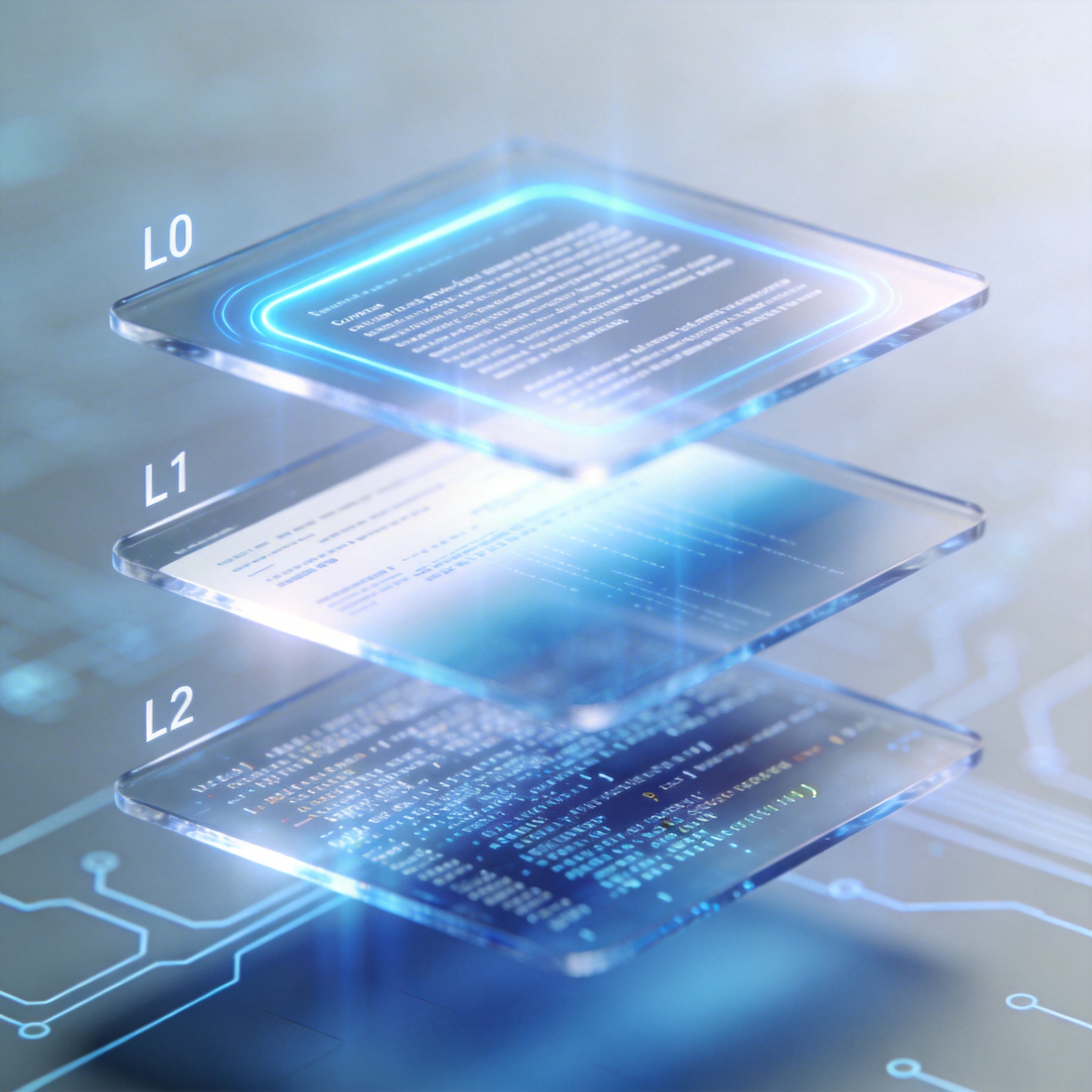
Visual representation of hierarchical context loading with three layers: summary, overview, and detailed data.
Directory Recursive Retrieval
OpenViking employs a directory recursive retrieval strategy to enhance retrieval effectiveness, particularly for complex queries. This process involves intent analysis to generate multiple retrieval conditions, followed by vector retrieval to identify high-scoring directories. The system then performs refined exploration within these directories, recursively drilling down into subdirectories if present, before aggregating and returning the most relevant context. This method aims to locate semantically matching snippets and understand their broader context.
Visualized Retrieval Trace
The system provides a visualized retrieval trace, offering observability into the retrieval process. Users can see which directories were accessed, the rationale behind content retrieval, and identify potential issues, which aids in optimizing retrieval logic.
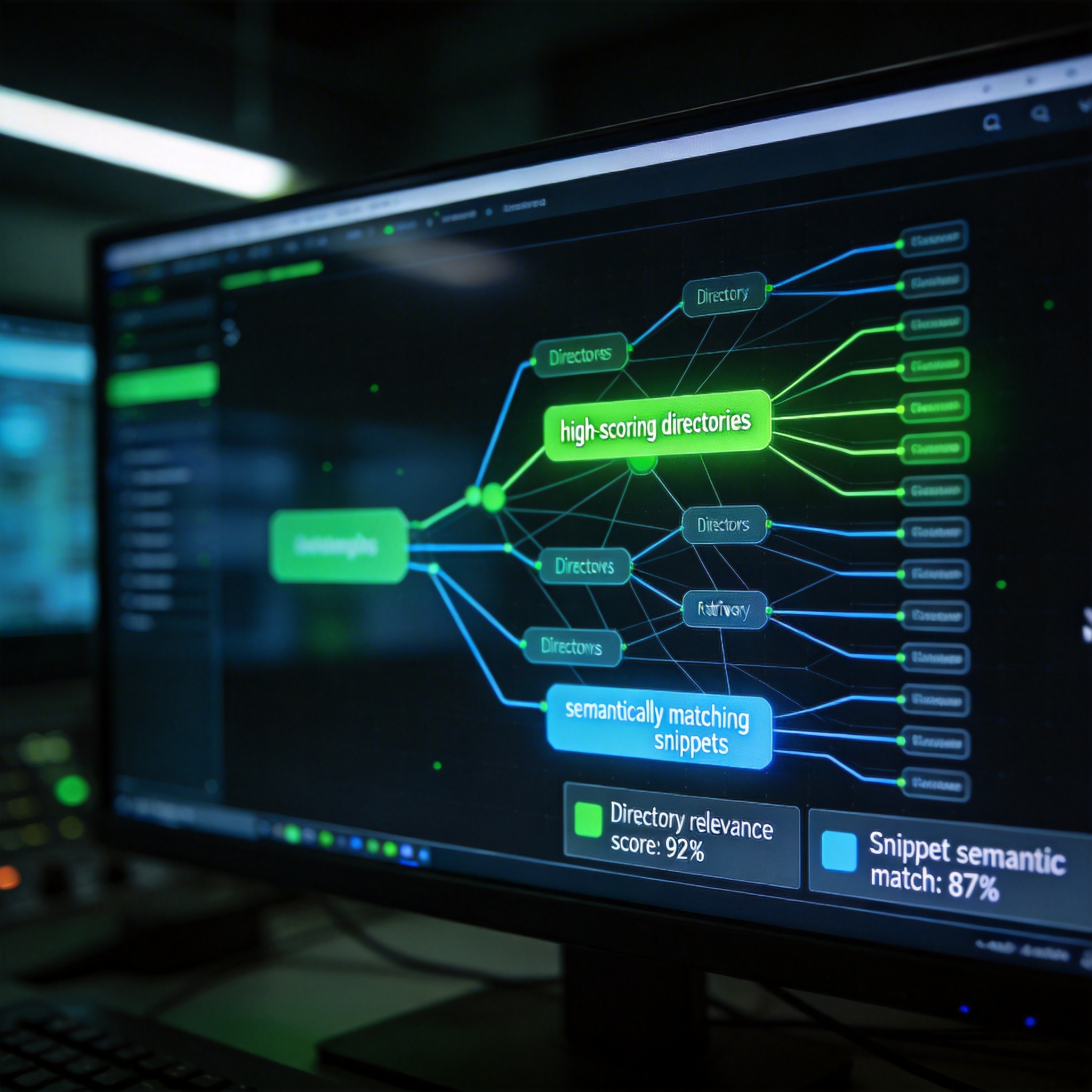
Screenshot of a visualized retrieval trace interface showing directory paths and content retrieval rationale.
Automatic Session Management
OpenViking includes automatic session management capabilities. After a conversation round between an Agent and a user, the system compresses conversation content, extracts resource references, records tool calls, and generates long-term memories. This functionality is intended to enable the Agent to become more intelligent over time through self-iteration.
Supported Models and Performance Benchmarks
OpenViking supports various VLM (Visual Language Model) and embedding models. VLM providers include Volcengine's Doubao model, OpenAI's official API, and LiteLLM for unified access to third-party models like Anthropic, DeepSeek, Gemini, vLLM, and Ollama. Embedding models supported include Volcengine's Doubao embedding, OpenAI's text-embedding-3-large, and Jina AI's jinaembedding.
In benchmarks conducted with OpenClaw test data, OpenViking demonstrated improved performance. Compared to native OpenClaw, the task completion rate increased by 43%, while input token cost decreased by 91%. Against OpenClaw integrated with LanceDB, OpenViking showed a 17% increase in task completion rate and a 92% reduction in token cost.
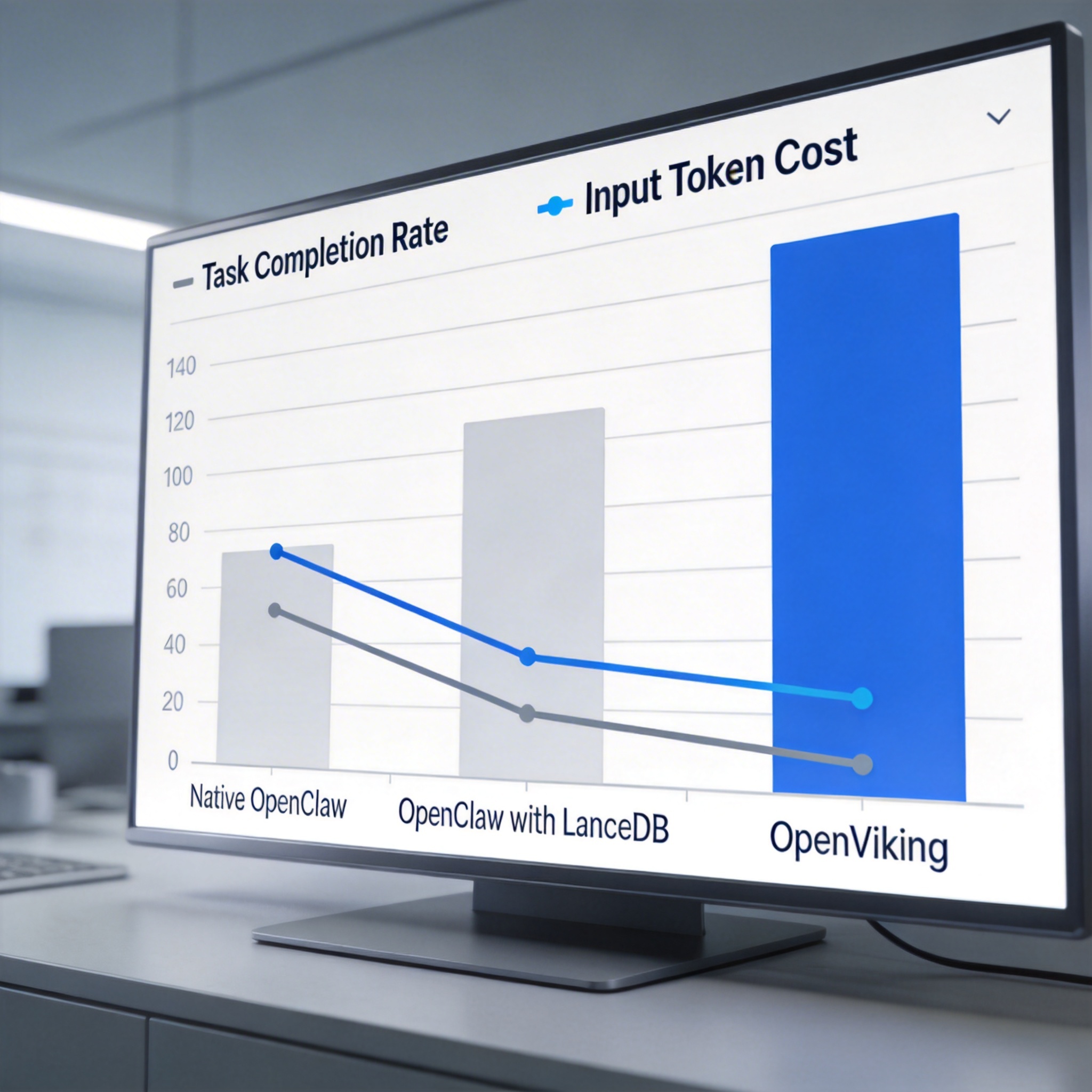
Bar chart comparing OpenViking's performance benchmarks against Native OpenClaw and OpenClaw with LanceDB, showing higher completion rates and lower token costs.
System Requirements and Quick Start
OpenViking requires Python 3.10+, Go 1.22+ (for AGFS components), and a C++ compiler (GCC 9+ or Clang 11+) for core extensions. It is compatible with Linux, macOS, and Windows, and requires a network connection for dependencies and model services.
Installation involves a Python package via pip and an optional Rust CLI. Users configure VLM and embedding models in a ~/.openviking/ov.conf file, which can specify providers like Volcengine, OpenAI, or Claude. After starting the openviking-server, users can interact with the system using CLI commands for tasks such as adding resources, listing contents, viewing directory structures, and searching.
OpenViking also includes VikingBot, an AI Agent framework built on the system, which can be installed and run alongside the server for conversational interactions. The project's source code is available on GitHub, and an official website provides additional information.
Stay Ahead of the AI Curve
Join 50,000+ subscribers getting the latest AI tools, trends, and tutorials delivered to their inbox weekly.
No spam, unsubscribe at any time.