
Berkeley-Led MetaClaw Framework Enables Continuous AI Agent Evolution During User Inactivity

A new open-source framework, MetaClaw, developed by researchers from the University of California, Berkeley, and three other universities, allows AI agents to continuously evolve and improve their capabilities while users are away from their computers. This development challenges the conventional industry practice of "frozen upon deployment" for AI agents.
The MetaClaw framework enables agents to learn from past errors and integrate new rules and optimizations without interrupting their online service. This continuous self-iteration occurs opportunistically, leveraging periods when a user is in meetings, away from their desk, or during scheduled breaks.
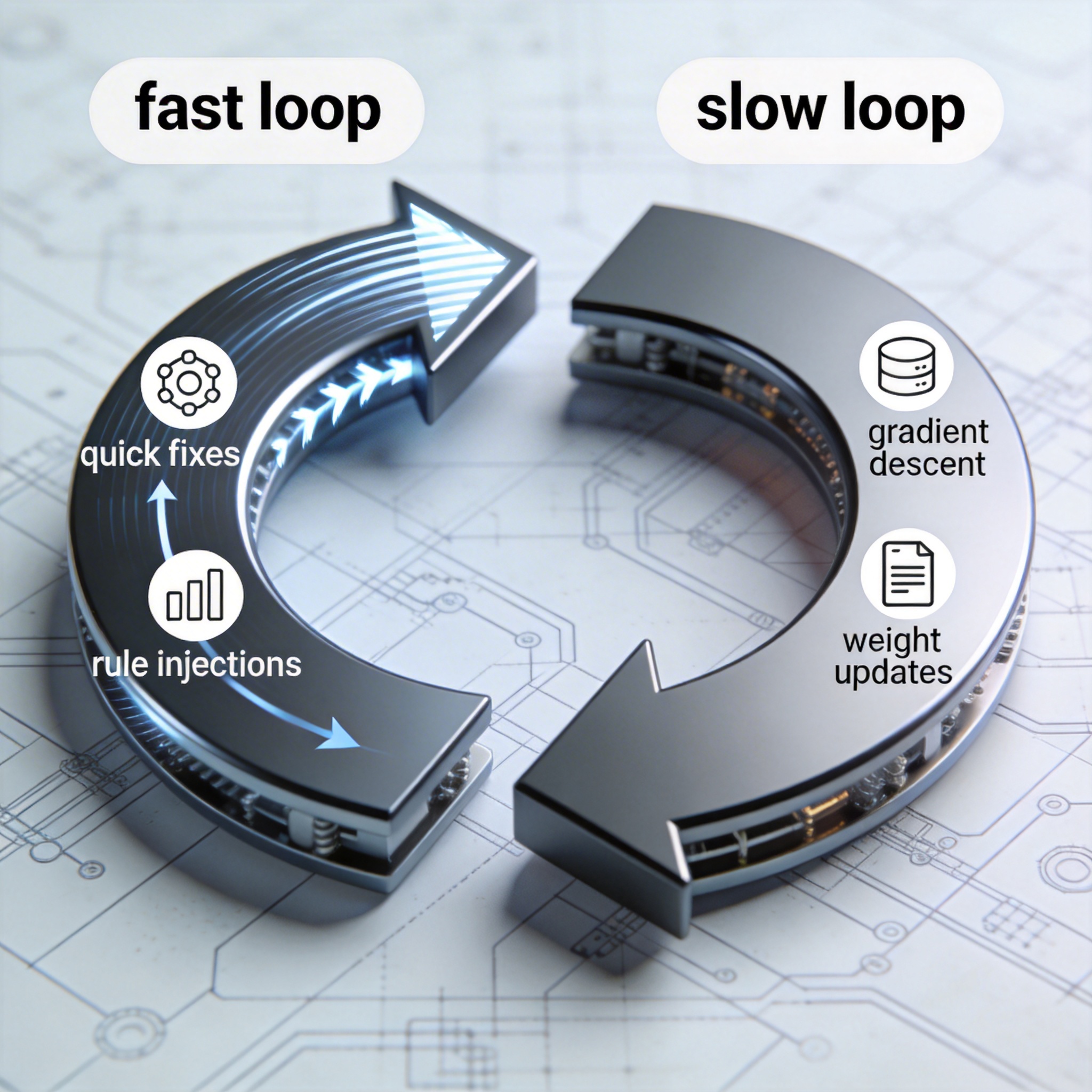
Diagram illustrating a dual-loop learning mechanism with fast and slow adaptation cycles.
Dual-Loop Evolution Mechanism
MetaClaw's architecture incorporates a "fast and slow dual-loop" learning mechanism to manage continuous evolution. The fast loop focuses on skill-driven adaptation, while the slow loop handles opportunistic policy optimization.
When an agent encounters a failure, the system analyzes the failure trajectory and extracts reusable behavioral rules. These rules are then immediately injected into the system prompt, allowing for rapid adaptation without modifying the model's core weights or interrupting service. Examples of such rules include standardizing time formats or ensuring backups before high-risk file operations. These are transferable knowledge points, not task-specific patches.
The slow loop involves gradient-based reinforcement learning (RL) weight updates using a process reward model (PRM) and LoRA (Low-Rank Adaptation) when the user is inactive. To prevent "stale reward contamination"—where the model is penalized for issues already resolved by new rules—MetaClaw employs skill version control. Trajectories are tagged with skill version numbers, and invalid samples from older versions are cleared before RL training, ensuring that only data effective after new skills are applied is used.

Computer screen showing an idle calendar and AI training in progress, symbolizing opportunistic scheduling.
Opportunistic Scheduling for Training
To facilitate training without user disruption, MetaClaw utilizes an opportunistic meta-learning scheduler (OMLS). This scheduler monitors signals such as preset sleep periods, system-level keyboard and mouse idle status, and Google Calendar schedule occupancy. Upon detecting any signal indicating user absence, the training window automatically activates. The trainer supports pausing and resuming, allowing even brief periods of user inactivity to be used for continuous AI training.
The framework uses a proxy architecture and cloud training interface, eliminating the need for local GPU resources. It can connect to existing personal agents and various model platforms, supporting one-click deployment and continuous meta-learning.
Performance and Impact on Weaker Models
The effectiveness of MetaClaw was evaluated using MetaClaw-Bench, a benchmark comprising 934 problems simulating 44 working days of task flows. Results showed that injecting behavioral rules alone could increase the relative accuracy of evaluated models by up to 32.2%. The end-to-end task completion rate, a measure of actual execution capability, saw an 8.25-fold increase, rising from 2.0% to 16.5%.
In an autonomous research pipeline, AutoResearchClaw, which involves 23 stages from literature review to paper writing, skill injection alone improved overall system robustness by 18.3%, reduced the stage retry rate by 24.8%, and decreased the number of iteration optimization rounds by 40%.
The research indicates that MetaClaw's benefits are particularly significant for agents driven by weaker base models. These models often lack implicit procedural knowledge, which the skill library explicitly addresses. While stronger models like GPT-5.2 show less room for improvement due to their higher starting point, the complete MetaClaw framework, combining skill injection with weight-level policy optimization, is crucial for achieving substantial gains in end-to-end task completion rates.

Abstract representation of evolving AI models, symbolizing a paradigm shift in development.
Shifting Agent Development Paradigm
While current benchmarks are in simulated environments, MetaClaw signals a paradigm shift in the lifecycle of AI agents. Instead of being static after deployment, agents can continuously evolve and improve through real-world usage. The ongoing updates to its GitHub repository, including features like proxy access and multi-client support, suggest its rapid development into a practical toolchain.
MetaClaw's layered strategy of "fast rules plus slow weights" offers a distinct approach compared to other methods, such as Princeton's OpenClaw-RL, which directly uses all interaction signals for training. This framework suggests that the future capabilities of AI models will depend not only on their initial parameter scale but also on their ability to continuously transform experience and self-iterate in operational environments.
Stay Ahead of the AI Curve
Join 50,000+ subscribers getting the latest AI tools, trends, and tutorials delivered to their inbox weekly.
No spam, unsubscribe at any time.