
Anthropic Research Reveals 40% of Claude Users Deploy AI Agents Autonomously in Varied Scenarios

Anthropic has released new research quantifying the autonomy of AI agents in real-world use, revealing that 40% of Claude users allow agents to operate fully automatically. The study, based on millions of interactions with Claude Code and its API, indicates that while most operations are low-risk, agents are increasingly deployed in higher-risk areas such as safety systems and financial transactions.
The findings also suggest a shift in user behavior as experience with AI agents grows, moving from step-by-step approvals to more autonomous operation with intermittent human intervention.
Evolving User Interaction and Agent Autonomy
Anthropic's analysis shows that as users gain experience, their supervision strategies change. New users typically approve each action individually, but after approximately 750 sessions, over 40% of interactions involve full automatic approval. This indicates a growing trust in AI agents. Conversely, experienced users also interrupt Claude Code more frequently, with intervention rates rising from 5% for new users to 9% for seasoned users. This suggests a pattern of delegation combined with targeted intervention when necessary.

Software engineers collaborating around a monitor, discussing code and making decisions, illustrating human intervention in AI.
Claude Code itself also encourages supervision by proactively pausing to ask questions in complex tasks, doing so more than twice as often as humans interrupt it. This behavior helps limit the agent's autonomy and involves humans in decision-making, particularly when uncertainty is detected.
Risk and Deployment Across Industries
The research evaluated the relative risk and autonomy of individual tool calls within the public Claude API, scoring them from 1 to 10. A risk score of 1 indicates no consequences from an error, while a score of 10 signifies potential significant damage. Autonomy scores similarly range from low (following clear human instructions) to high (operating independently).
The study found that 80% of tool calls originate from agents with safeguards, such as limited permissions or human approval requirements. Approximately 73% of operations appear to involve human supervision, and only 0.8% are irreversible. While the majority of agent operations on the Claude API are low-risk, the data shows that agents are also participating in safety systems, financial transactions, and production deployments, though some of these may be evaluation tests.
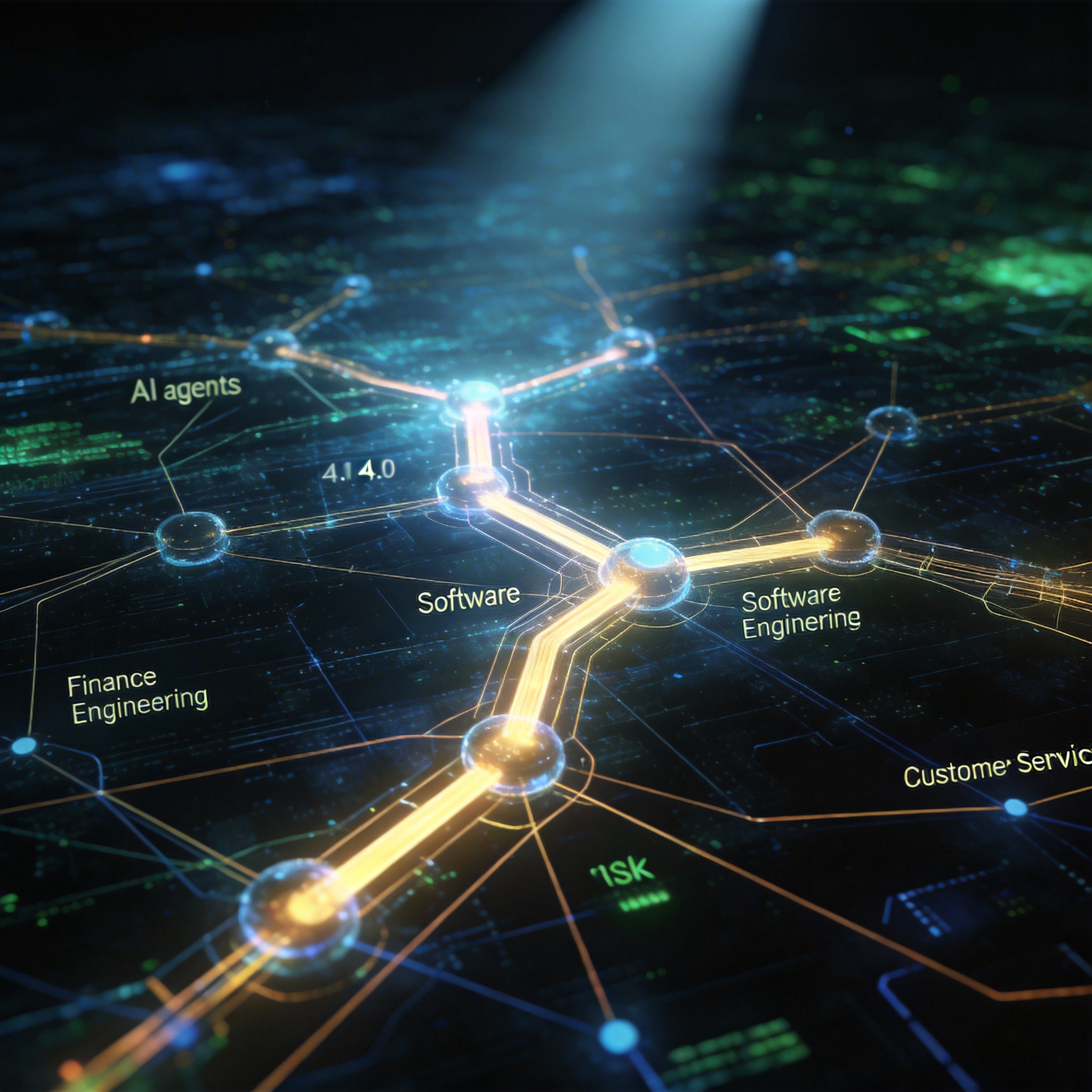
Interconnected glowing data lines and nodes representing diverse industries, symbolizing AI agent deployment across sectors.
Software engineering accounts for approximately 50% of agent tool calls in the API. Beyond programming, smaller applications were identified in business intelligence, customer service, sales, finance, and e-commerce. Anthropic anticipates that as agents expand into these areas, the spectrum of risk and autonomy will broaden, making post-deployment monitoring critical.
Recommendations for Future Development
Anthropic proposes several recommendations for the future development of AI agents:
Model and product developers should invest in post-deployment monitoring to understand real-world AI agent usage. Pre-deployment evaluations, while useful, are insufficient on their own.
Model developers should train models to recognize their own uncertainty and proactively alert humans when doubts arise. This "I'm not sure" capability is considered an important safety attribute.
Product developers should design systems that facilitate effective user supervision. This includes providing clear visibility into agent actions and offering simple intervention mechanisms for error correction.
The research suggests that mandating specific interaction patterns, such as requiring approval for every action, may create friction without necessarily enhancing safety. Instead, the focus should be on ensuring humans can effectively monitor and intervene in a timely manner.
Close-up of a human eye intently watching a blurred digital screen, symbolizing vigilant monitoring of AI systems.
A core insight from the research is that the practical extent of AI agent autonomy is shaped by the model, the user, and the product working together. This interaction makes it impossible to fully describe agent behavior through pre-deployment evaluation alone, necessitating real-world measurement and robust infrastructure for it.
Impact on Software Engineering
Boris Cherny, creator of Claude Code, suggested in a recent interview that the role of "software engineer" may evolve significantly, with coding becoming less central. He posited that future roles might focus more on "builder" or "product manager" functions, or that the title itself could become a "hollow relic." Cherny indicated that software engineers would increasingly focus on tasks like writing technical specifications and communicating with users, rather than solely writing code.
Andrej Karpathy, a founding member of OpenAI and former head of AI at Tesla, also noted in January that his ability to write code by hand had begun to "atrophy." These perspectives highlight a potential shift in the skills required for software development as AI agents become more prevalent.
Stay Ahead of the AI Curve
Join 50,000+ subscribers getting the latest AI tools, trends, and tutorials delivered to their inbox weekly.
No spam, unsubscribe at any time.