
Claude's Parent Company Anthropic Nears $2 Trillion Valuation as AI Directs Human Coders


A recent viral video depicting an AI instructing a human engineer to write code has coincided with a significant surge in investment for Anthropic, the company behind the Claude AI model. This influx of capital positions Anthropic as a leading AI unicorn, second globally only to OpenAI.
The video, titled "Reverse Claude Code" and posted on X by a Midjourney engineer on January 17, 2026, showed Claude issuing directives to a human. These tasks included checking API documentation, refactoring code for style consistency, and sending messages on X. The concept of AI "reversing the natural order" by directing human labor resonated widely, with some observers likening it to a "Ratatouille of the programming world."

Software engineer receiving instructions from an AI interface on a monitor.
While initially appearing as a technical demonstration, the video highlighted AI's expanding capabilities, a trend that has captured the attention of investors in Silicon Valley. The growing prominence of Claude Code within the developer community further underscores this shift.
The Shifting Paradigm of Human-AI Interaction
Traditionally, human-computer interaction has involved humans as instructors and machines as executors. This relationship was considered fundamental, with humans providing goals, breaking down tasks, and making judgments. However, Claude Code's advanced capabilities are blurring these lines. The AI can comprehend entire codebases, independently determine necessary documentation, assess code adherence to project specifications, and even identify design flaws.
As AI gains the ability to understand context and decompose tasks, it transcends being merely a tool, beginning to exhibit "agentic" qualities. This concept of Agentic AI implies that the AI no longer passively awaits instructions but actively plans and executes multi-step tasks. It can manage multiple tools, adapt strategies based on execution outcomes, and maintain contextual coherence across complex processes. Developers are increasingly treating AI as a "digital colleague," assigning tasks and receiving progress reports before conducting final reviews and making decisions.

Abstract representation of an AI comprehending a complex codebase, with a human hand reviewing.
This paradigm shift redefines human roles: from actively writing code to accepting and refining AI-generated code, and from solving problems to defining them. While this does not signal the obsolescence of programmers, it suggests a greater demand for senior engineers capable of defining clear requirements, designing system architectures, and making critical decisions. Repetitive, mechanical tasks lacking systematic thought are more likely to be automated. The speed of this transformation is accelerating, prompting significant capital investment.
Capital Inflow and Market Dynamics
On January 18, 2026, the Financial Times reported that Sequoia Capital would participate in Anthropic's new funding round. This investment is notable because Sequoia Capital has also invested in OpenAI and xAI, direct competitors to Anthropic. In venture capital, investing in competing companies typically presents conflicts of interest and can strain trust with portfolio companies.
Historically, Sequoia Capital has demonstrated a commitment to avoiding such conflicts. In 2020, the firm divested from Finix, a payment company, after realizing it competed with Stripe, another portfolio company. Sequoia voluntarily withdrew from Finix's board, relinquished information rights and equity, incurring a $21 million loss. This move underscored the firm's adherence to its investment principles.

Business professionals in a modern meeting room, discussing investment strategies.
However, Sequoia Capital's simultaneous investment in OpenAI, xAI, and Anthropic suggests a strategic shift. Anthropic aims to raise $25 billion, which would elevate its valuation to $350 billion, a significant increase from $170 billion four months prior. Singapore's sovereign wealth fund GIC and Coatue have each committed $1.5 billion, with Microsoft and Nvidia potentially contributing up to $15 billion. This funding round positions Anthropic to become the world's second AI unicorn valued at nearly $2 trillion. Foreign media reports indicate that major capital firms and Anthropic have declined to comment on these figures.
The decision by Sequoia and other investors to engage in what might be considered "investment taboo" underscores the intensity of the AI arms race, a competition that no major player can afford to miss.
The AI Model Arms Race and Anthropic's Strategy
The competition in large AI models has evolved into an arms race. Anthropic's rapid ascent is evident, with its Claude Opus 4.5 model gaining significant traction in the programming community. The demand for Claude Opus, indicated by high usage and reduced quotas from other platforms, suggests its leading position in programming AI.
Demonstrations of Claude Code highlight its ability to write code, understand codebase architecture, handle 70-80% of routine development tasks, execute multi-step processes autonomously, and integrate with Git and CI/CD systems. Anthropic has also launched Cowork, available in its Pro version. Unlike OpenAI's pursuit of "omnipotence," Anthropic's product philosophy focuses on developing AI as a "reliable colleague." This approach has fostered trust in the enterprise market. The changes observed in the developer community reflect the disruptive potential that capital finds appealing. The underlying logic is that the future of this technological race is uncertain, and missing even a few months of development could lead to being left behind. Investors are hedging against this uncertainty by ensuring their presence across multiple leading AI ventures.
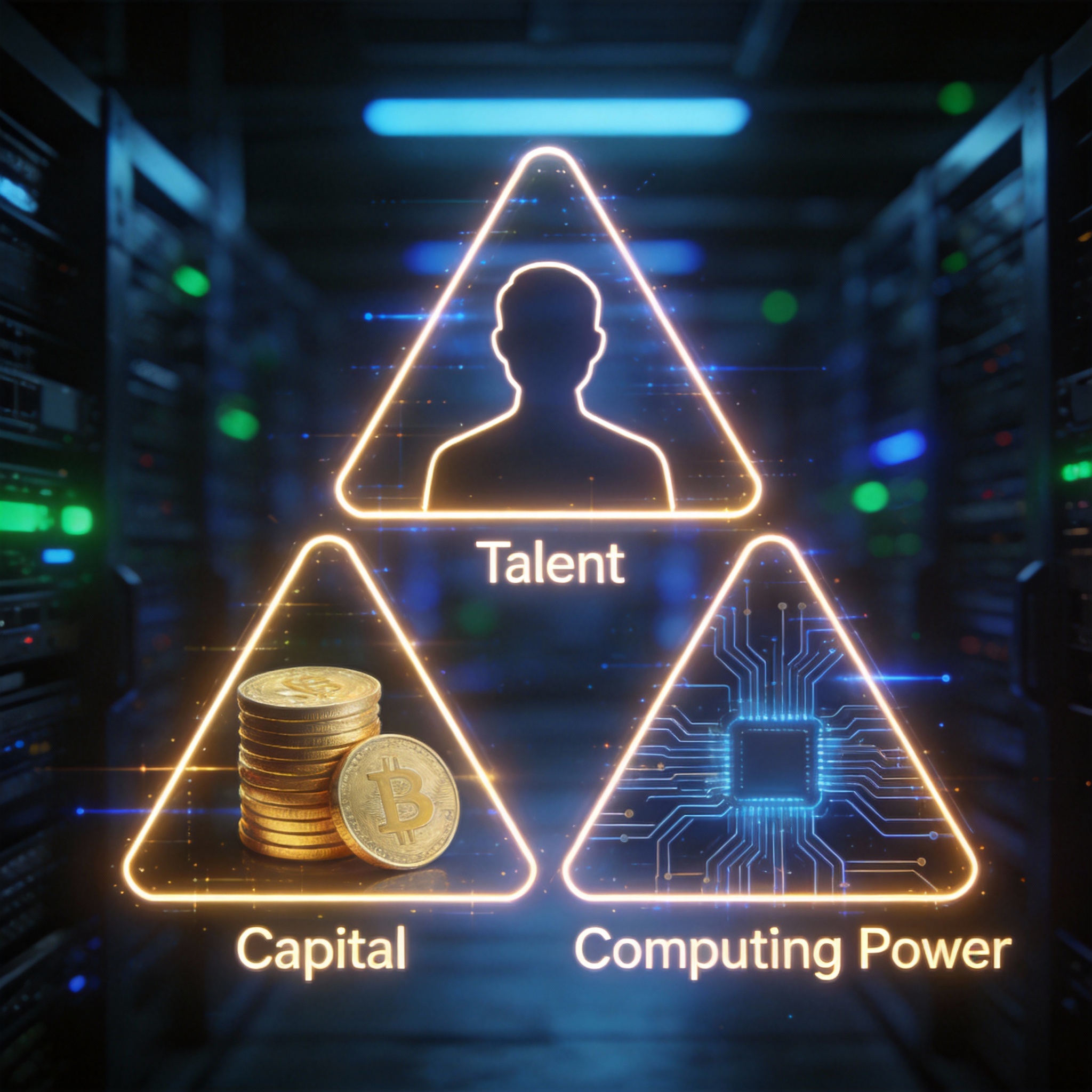
Abstract triangle symbolizing the interdependence of talent, capital, and computing power in AI.
Talent, Capital, and Computing Power: The New Triangle
The current AI landscape mirrors historical patterns of technological disruption. In 2012, Geoff Hinton's team, using four Nvidia GPUs, demonstrated the power of neural networks at the ImageNet competition, shifting the industry's perception of deep learning. This event led to significant talent acquisitions, such as Google's purchase of DeepMind.
Anthropic's core team includes former OpenAI co-founders, ex-chief scientists, and colleagues of Ilya Sutskever, a student of Hinton. This team brings not only technical expertise but also a strong focus on AI safety. This emphasis on safety, often viewed as a business vulnerability, has become a key differentiator for Anthropic, particularly as concerns about AI's rapid development grow. The movement of top talent, such as Hinton's resignation from Google in 2023 to warn about AI risks and Sutskever's departure from OpenAI in 2024 to found a new company, triggers significant capital reactions.
Computing power is another critical component, with companies and nations aggressively acquiring it. Microsoft is expanding data centers for OpenAI, Google is developing its own TPU chips, and sovereign wealth funds from Saudi Arabia and the UAE are investing in AI computing infrastructure. Nvidia's market capitalization has soared, and its H100 chips are in high demand, with long lead times. The cost of entry into this technological revolution is escalating, and investors are committing substantial funds.
Rows of high-performance server racks in a modern data center, symbolizing computing power.
Historical Parallels and Future Outlook
The current investment climate for AI echoes the period following Hinton's 2012 ImageNet victory, which transformed deep learning from a niche academic pursuit into a global technological priority. That era saw major tech companies acquiring AI startups and talent, leading to rapid advancements. The 2017 introduction of the Transformer architecture by Google paved the way for ChatGPT's emergence six years later, fundamentally altering public perception of AI.
The events of January 2026, particularly the significant capital investment in Anthropic, suggest the arrival of a new paradigm, similar to the impact of the Lake Tahoe auction in 2012. This time, the pace of change is faster, the stakes are higher, and the ultimate outcome remains unclear. Anthropic is reportedly preparing for an IPO, potentially within the year, which could make it the second AI startup after OpenAI to achieve a valuation exceeding $100 billion. The collective investment by leading institutions like Sequoia, GIC, and Coatue indicates a belief that this represents the future, rather than a speculative bubble. As Hinton observed decades ago, at historical turning points, the line between correctness and perceived madness can be very fine. The capital market will ultimately determine the value of these ventures, while history will record the efforts of those who drive this technological transformation.
Stay Ahead of the AI Curve
Join 50,000+ subscribers getting the latest AI tools, trends, and tutorials delivered to their inbox weekly.
No spam, unsubscribe at any time.