
Anthropic's Claude Sonnet 4.6 Release Triggers Software Stock Declines

Anthropic has introduced Claude Sonnet 4.6, an updated model that has reportedly caused a downturn in software company stock prices. The release follows Opus 4.6 by two weeks and is designed for "all-round upgrades" across various functionalities.

Close-up of a hand using a mouse on a desk, with a computer screen displaying the Claude Code interface in a modern office.
The new Sonnet 4.6 model is now available on Claude Code, the web version (free/Pro), Claude Cowork, and via API. Its pricing remains consistent with Sonnet 4.5, at $3 per million tokens for input and $15 per million tokens for output.
Sonnet 4.6 Capabilities and Market Impact
Claude Sonnet 4.6 features advancements in programming, computer usage, long-context reasoning, agent planning, knowledge work, and design. It supports up to 1 million tokens of context. In benchmark tests, Sonnet 4.6's performance is noted as being close to that of Opus 4.6 and is reported to have outperformed Gemini 3 Pro and GPT-5.2 in some areas.

Complex digital network with glowing data streams and interconnected nodes, symbolizing advanced AI capabilities and performance.
Its computer usage capabilities reached 72.5% in tests, indicating proficiency in handling tasks such as complex spreadsheets and web forms. In the GDPval-AA knowledge-based agent task, Sonnet 4.6 achieved an Elo score of 1633, surpassing Opus 4.6.

Financial trader looking at multiple monitors displaying stock charts with clear downward trends, indicating market decline.
Following the release, several software stocks experienced declines. Intuit reportedly fell 5%, Oracle 3.8%, Salesforce 2.86%, and Adobe 1.3% as of Tuesday afternoon, local time.
Enhanced Computer Operation
A key focus of Sonnet 4.6 is its ability to operate computers in a manner similar to humans. This addresses a challenge in automating older software systems that lack modern API interfaces. Previously, specialized connectors were required for AI to interact with such software.

Human hand interacting with an old green-screen computer terminal, with a subtle digital overlay of modern AI code.
Anthropic first introduced a "universal computer operation model" in October 2024, which was then in an experimental phase. The company states that Sonnet 4.6 demonstrates significant progress in this area.
The OSWorld benchmark, which evaluates AI computer operation capabilities, shows Sonnet series models progressing to 72.5%. This test involves running real software like Chrome, LibreOffice, and VS Code in a simulated environment, with the model interacting via mouse clicks and keyboard input without special APIs.

Laptop screen displaying a complex web form and spreadsheet, with a transparent digital cursor moving autonomously, symbolizing AI interaction.
Users have reported that Sonnet 4.6 performs at a human level in tasks such as navigating complex tables, filling multi-step web forms, and integrating information across browser tabs. Examples include automating order adjustments in an online store backend, updating website branding, and performing website QA.
While the model's proficiency in computer operation is not yet at the level of human experts, its rapid development suggests increasing practicality in various work scenarios. Security evaluations indicate that Sonnet 4.6 has improved in addressing prompt injection attacks, with performance nearing Opus 4.6.
Performance Benchmarks and Context Window
Claude Sonnet 4.6 demonstrates strong performance across various benchmarks, offering near-Opus level intelligence at a lower price point. It notably outperforms the previous generation, Sonnet 4.5, in most areas, including agent coding and MCP tool usage, and also surpassed Opus 4.5 in some tests.
In office task tests, Sonnet 4.6 is described as a high-performing AI worker. It also reportedly surpassed Gemini 3 Pro and the GPT-5.2 series in multimodal QA and GPQA tasks.
Early tests with Claude Code showed that approximately 70% of developers preferred Sonnet 4.6 over Sonnet 4.5 due to its improved context understanding for code modification, which helps avoid repetition and integrates shared logic. Additionally, 59% of users found Sonnet 4.6 to be more reliable and stable than Opus 4.5 for complex multi-step tasks, with reduced instances of "over-design," "laziness," and hallucinations.

Abstract digital library with glowing lines of code and data flowing between transparent blocks, symbolizing a vast context window.
The 1 million token context window allows Sonnet 4.6 to process large amounts of information, such as entire codebases, lengthy contracts, or multiple research papers, while maintaining reasoning capabilities. In the Vending-Bench Arena test for long-term planning, Sonnet 4.6 exhibited a strategy of early production capacity expansion followed by a focus on profit generation, which led to strong performance.
User feedback highlights Sonnet 4.6's performance in front-end code and financial analysis, as well as its ability to generate refined visual effects with improved layout, animation, and design.
Feature Updates and Developer Tools
Sonnet 4.6 includes several feature updates. For the developer platform, it supports "adaptive thinking" and "extended thinking" modes. A new "Context Compaction" feature is being tested, which summarizes older content in conversations to indirectly extend effective length.
API calls have been enhanced, allowing Claude's web search and scraping tools to automatically write code to filter results, bringing only relevant information into context to improve answer quality and token efficiency. Code execution, memory function, and tool search are now in full public release.
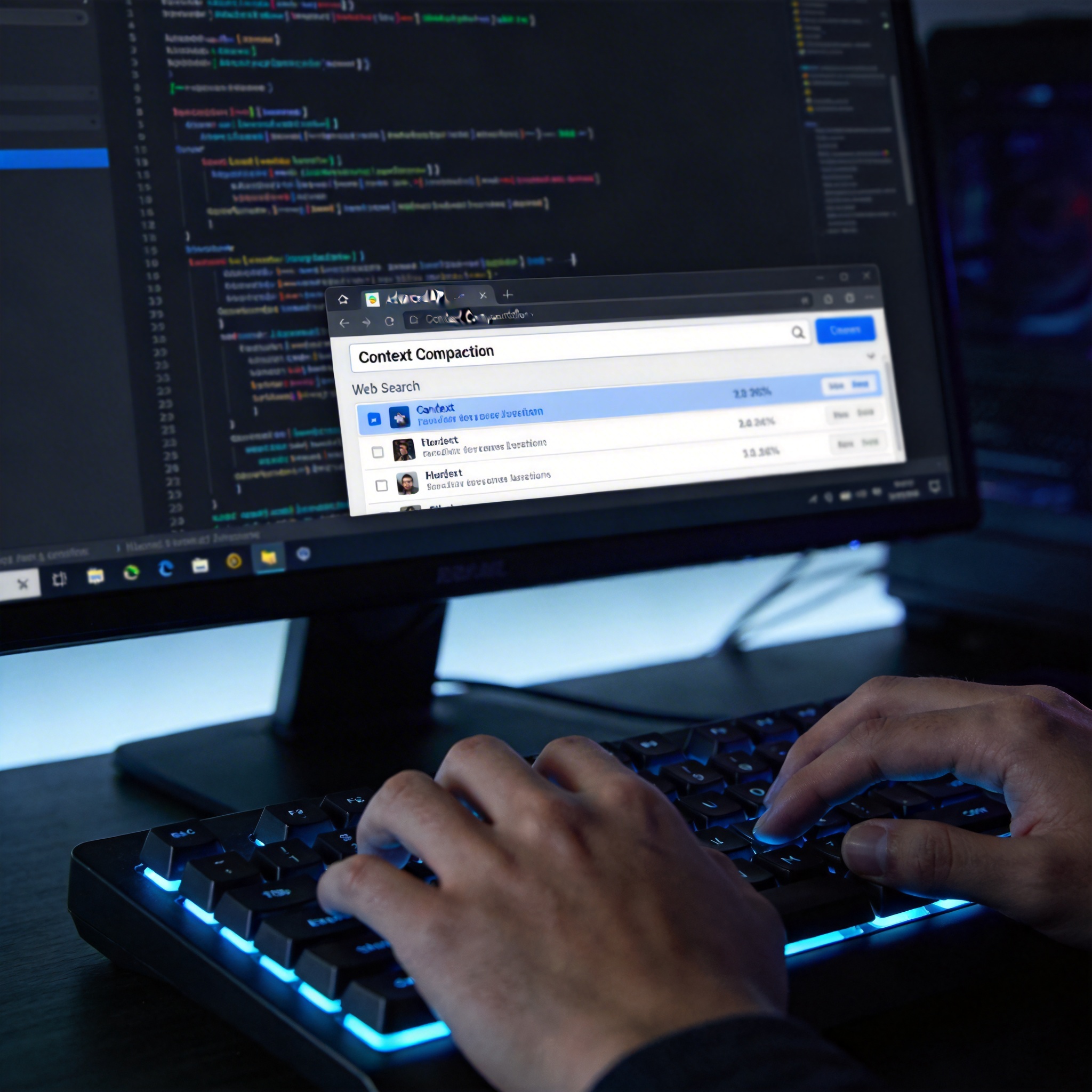
Developer's hands typing on a keyboard, with a screen showing API code, web search results, and 'Context Compaction' feature.
Anthropic advises developers to experiment with different thinking intensities when migrating to find the optimal balance between speed and performance. The Excel version of Claude now supports "MCP connectors" for integration with professional tools like S&P Global, LSEG, Daloopa, PitchBook, and Moody's, allowing direct calls within Excel.
Sonnet 4.6 vs. Opus 4.6 Comparison
In benchmark comparisons, Sonnet 4.6 reportedly surpassed Opus 4.6 in several areas:
Financial Analysis: Sonnet 63.3% vs. Opus 60.1%.
Office Tasks (GDPval-AA): Sonnet 1633 vs. Opus 1606.
Large-scale Tool Calling: Sonnet 61.3% vs. Opus 59.5%.
These areas involve complex, multi-step practical tasks. Opus 4.6, however, maintains an advantage in "hardcore reasoning" scenarios:
Novel Problem Solving (ARC-AGI-2): Opus 68.8% vs. Sonnet 58.3%.
Human Level Exam (HLE): Opus leads by 7-8 percentage points.
Deep Web Search (BrowseComp): Opus 84.0% vs. Sonnet 74.7%.
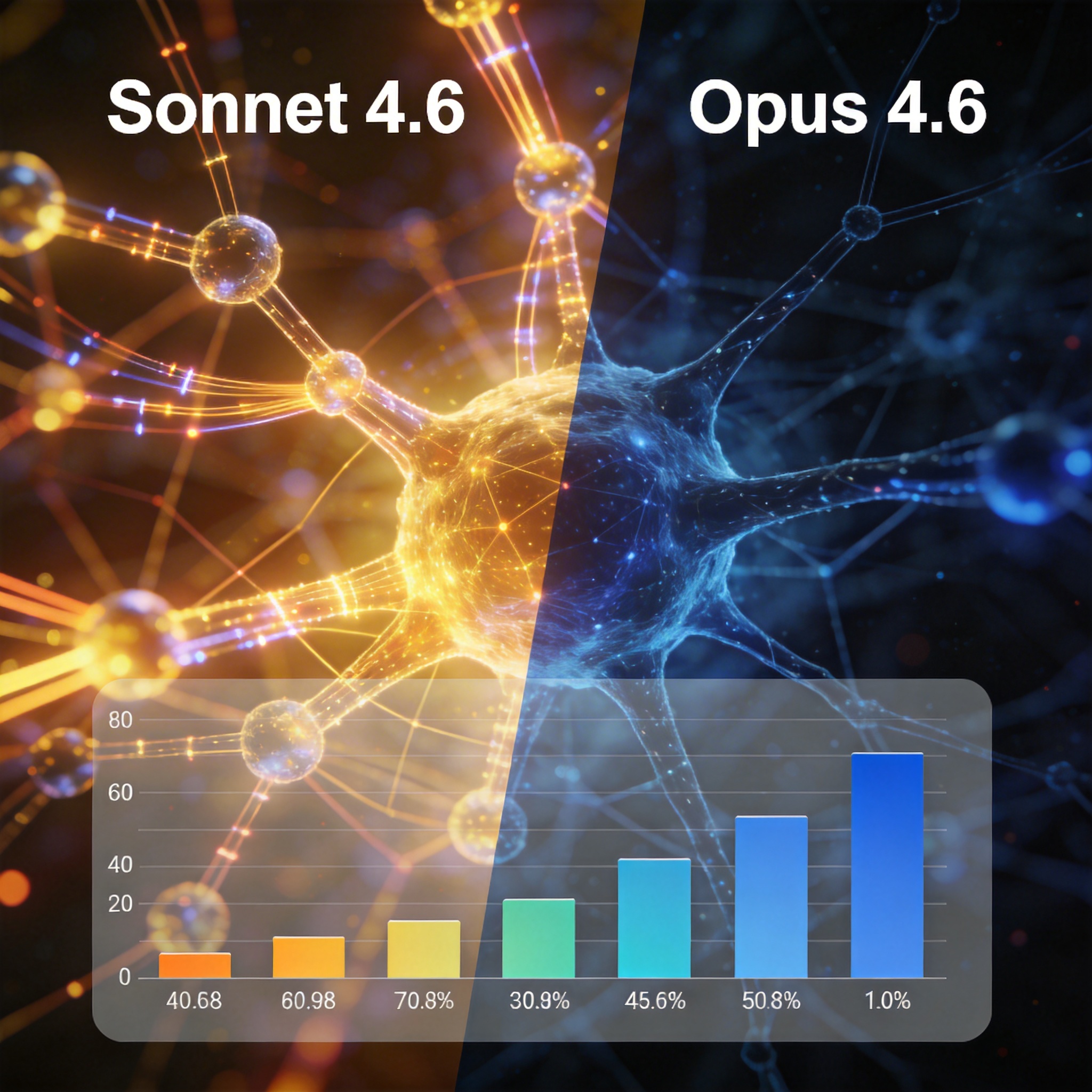
Split image comparing two AI models: one side showing dynamic network for efficiency, other showing intricate neural network for deep reasoning.
These scenarios require the model to solve novel problems, where Opus's deep thinking capabilities are noted as distinct. For daily work, Sonnet 4.6 is suggested as a cost-effective option, while Opus 4.6 is recommended for more complex, reasoning-intensive problems.
Stay Ahead of the AI Curve
Join 50,000+ subscribers getting the latest AI tools, trends, and tutorials delivered to their inbox weekly.
No spam, unsubscribe at any time.