
Anthropic's Claude Opus 4.6 Fast Mode Launches with Six-Fold Price Increase


Anthropic has introduced a "Fast Mode" for its Claude Opus 4.6 large language model, which increases processing speed by 2.5 times but raises the output token price by 600%. This pricing strategy has generated significant discussion among developers.

Developer typing '/fast' command in a code editor with a lightning icon visible.
The new Fast Mode is available in Claude Code and via API. Users can activate it by typing /fast in the Claude Code command line or within the VS Code extension, with a lightning icon indicating its activation. Deactivation is achieved by typing /fast again.
Pricing Structure and Community Reaction
While the standard output pricing for Opus 4.6 is $25 per million tokens, the Fast Mode increases this to $150 per million tokens. Input pricing also sees a six-fold increase, from $5 to $30 per million tokens. Fast Mode charges are separate from subscription quotas, meaning all usage is billed additionally at the higher rate.

Six glowing digital tokens stacked, symbolizing a six-fold price increase against a financial graph.
Anthropic has stated that Fast Mode utilizes the same Opus 4.6 model, maintaining identical model weights, intelligence levels, and answer quality. This has led to criticism from some users, who question the value proposition of paying significantly more for speed without an increase in model capability. Some online comments suggest the pricing is excessive and could deter users.
For long-context scenarios, where input exceeds 200,000 tokens, standard Opus 4.6 pricing almost doubles. Fast Mode pricing in these situations also nearly doubles, reaching $60 per million input tokens and $225 per million output tokens.
Opus 4.6 Capabilities
Despite the pricing controversy, the underlying Opus 4.6 model has demonstrated strong performance in various benchmarks. It scored 53 points on Artificial Analysis's Intelligence Index v4.0, placing it first overall, ahead of OpenAI's GPT-5.2 (xhigh).
On the Arena.ai "Large Model Arena" platform, which uses human blind tests for ranking, Opus 4.6 topped the code, text, and expert categories. Its score in the code arena increased by 106 points compared to the previous Opus 4.5. In the text arena, it scored 1496, surpassing Google's Gemini 3 Pro. In the expert arena, it maintained a significant lead over its closest competitor.
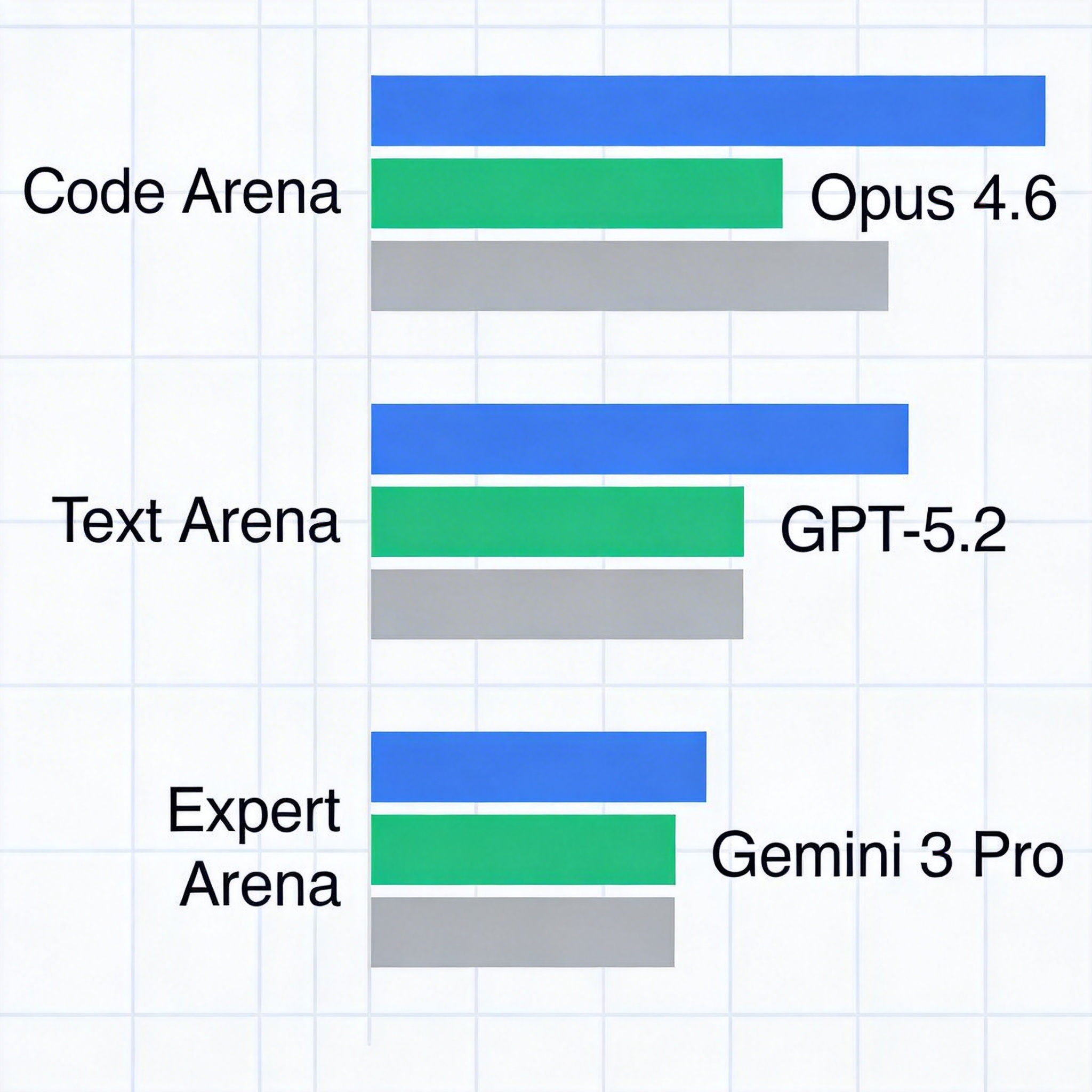
Infographic showing Claude Opus 4.6 outperforming GPT-5.2 and Gemini 3 Pro in AI benchmarks.
In the GDPval-AA knowledge work performance evaluation, Opus 4.6 achieved an Elo score of 1606, outperforming GPT-5.2 by approximately 144 points and Opus 4.5 by 190 points. In the Terminal-Bench 2.0 agent programming evaluation, Opus 4.6 scored 65.4%, ranking first. Its performance in the ARC-AGI-2 abstract reasoning test nearly doubled from the previous generation, reaching 68.8%.
Engineering Breakthroughs
Two key engineering advancements in Opus 4.6 include an expanded context window and enhanced self-correction capabilities. Opus 4.6 is the first Opus-level model from Anthropic to support a 1 million-token context window in beta, a substantial increase from Opus 4.5's 200,000-token limit. This allows for processing larger codebases or extensive documents without loss of context. In the MRCR v2 long-context "needle in a haystack" test, Opus 4.6 achieved a 76% score, significantly higher than its sibling Sonnet 4.5's 18.5%.

Abstract depiction of expanded context window and self-correcting algorithms in a digital network.
The model's self-correction ability allows it to autonomously assess task difficulty, prioritize complex sections, and re-evaluate its reasoning to correct errors, particularly in code review and debugging. Anthropic demonstrated this by using 16 Opus 4.6 models to autonomously write a 100,000-line C compiler in Rust, which successfully compiled the Linux 6.9 kernel and ran applications like Doom and PostgreSQL. This process consumed nearly 2 billion input tokens, costing approximately $20,000 in API fees.
Market Strategy
Anthropic views Fast Mode as a market test to understand the commercial demand for speed in AI applications. While the 6x price for 2.5x speed may not appear cost-effective mathematically, the company suggests that for scenarios requiring immediate resolution, such as fixing online incidents or rapidly prototyping products, the value of speed can outweigh the increased cost. This move reflects a broader industry shift where the focus is moving from "what AI can do" to "how fast AI can do it."
Stay Ahead of the AI Curve
Join 50,000+ subscribers getting the latest AI tools, trends, and tutorials delivered to their inbox weekly.
No spam, unsubscribe at any time.