
Anthropic Report Shows AI Automates 75% of Programming Tasks, Entry-Level Hiring Drops

A recent report from Anthropic indicates that artificial intelligence can now perform approximately 75% of tasks typically handled by programmers, with similar figures for customer service representatives and data entry clerks. The report, titled "AI's Impact on the Labor Market: New Metrics and Early Evidence," suggests that while AI's full potential in the labor market is far from realized, its current capabilities are already significantly impacting workflows.

Digital interface showing 75% completion for programming and customer service tasks, symbolizing AI automation.
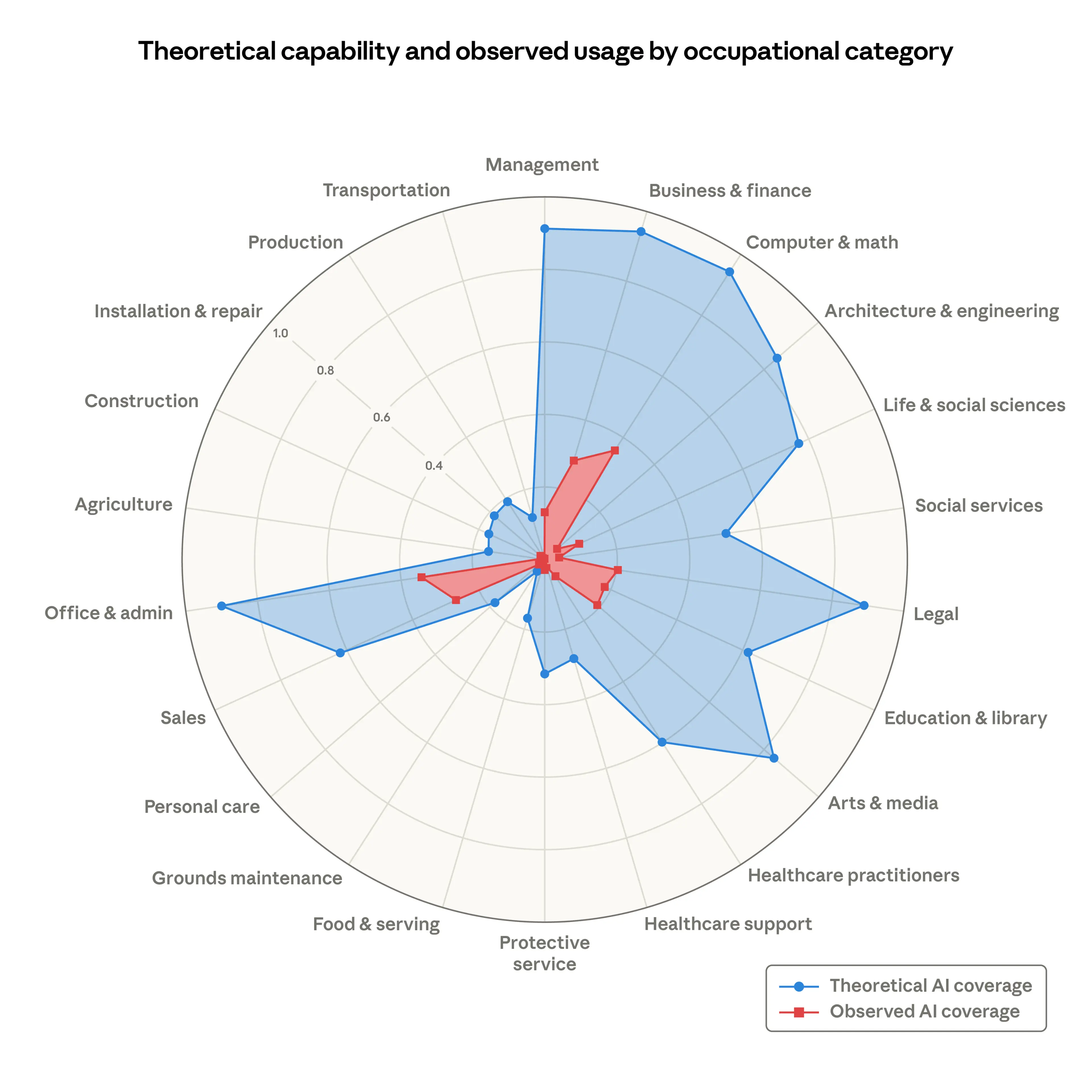
The study highlights that the theoretical automation rate for computer and mathematical occupations is as high as 94%, yet AI currently covers only 33% of these tasks. This gap suggests substantial room for further AI integration into these roles.
AI's Current Impact on Occupations
Economists Maxim Massenkoff and Peter McCrory developed a new metric, "Observed Exposure," to quantify the extent to which AI is currently replacing work tasks. Their methodology combines data from the O*NET occupational database, real-world usage statistics of Anthropic's Claude AI, and research on large language model capabilities. This approach allowed them to assess how many tasks within various occupations are being covered by AI.
The analysis revealed that programming is the occupation most susceptible to AI's influence, followed closely by customer service and data entry roles. These findings are attributed to AI's increasing use in programming tasks and its suitability for the process-oriented nature of white-collar jobs like customer service.

Split image showing digital tasks influenced by AI and physical tasks like cooking, contrasting automation susceptibility.
Conversely, about 30% of occupations remain largely unaffected by AI, including chefs, lifeguards, bartenders, and motorcycle mechanics. These roles often require physical interaction with the world, a domain where current AI technology has limitations.
Employment Trends and Youth Impact
Despite AI's growing capabilities, the report found that overall unemployment rates for occupations with high AI exposure have not significantly diverged from those with low exposure since 2016, even after the introduction of ChatGPT. However, a more concerning trend emerged: the entry rate for individuals aged 22-25 in high-exposure positions has decreased by 14%.
This suggests that while experienced workers may retain their positions, new graduates are finding it harder to enter fields increasingly impacted by AI. Tasks traditionally performed by junior staff, such as organizing meeting minutes, cleaning data, or writing basic code, are now frequently handled by AI.
Portrait of Dario Amodei, CEO of Anthropic, in a professional setting.
Anthropic CEO Dario Amodei previously warned that AI could eliminate 50% of entry-level white-collar jobs within one to five years, potentially raising overall unemployment to 10-20%. The report's findings align with the U.S. Bureau of Labor Statistics' prediction that occupations with higher AI exposure will experience slower employment growth over the next decade, with a 0.6 percentage point decrease in job growth for every 10% increase in AI-covered tasks.
Long-Term Outlook and Recommendations
The report characterizes AI's impact on the labor market as a "boiling frog" scenario, suggesting a gradual, long-term transformation rather than an immediate disruption. This contrasts with the view that AI is merely an efficiency tool, akin to past technological revolutions that ultimately created more jobs. Some researchers propose that AI's effect will be more like a "chronic earthquake," slowly reshaping industries over time, similar to the long-term impact of manufacturing shifts in the 2000s.

A ceramic frog figurine in a beaker of water with subtle bubbles, symbolizing the 'boiling frog' scenario of gradual AI impact.
As AI technology continues to advance and its applications expand within enterprises, more significant labor market changes are anticipated. The report encourages governments, businesses, and individuals to consider the implications of AI automating a substantial portion of daily tasks. Potential responses include exploring universal basic income (UBI), new models for lifelong learning, or even "human taxes."
For young professionals, the report offers three pieces of advice: avoid tasks that are "pure digital assembly line" work, embrace automated workflows by learning to leverage AI tools, and focus on "non-automatable" tasks that require physical interaction, complex problem-solving, or deep emotional intelligence. The report concludes that the window for human adaptation to these changes is narrowing as AI's capabilities expand.
Stay Ahead of the AI Curve
Join 50,000+ subscribers getting the latest AI tools, trends, and tutorials delivered to their inbox weekly.
No spam, unsubscribe at any time.