
Alibaba Cloud Launches Qwen3.6-Plus with Enhanced Coding Agent and Multimodal Capabilities

Alibaba Cloud has officially released Qwen3.6-Plus, an updated version of its large language model, now available for public API calls via Alibaba Cloud Bailian. The new iteration focuses on improving agent programming capabilities for developers, offering more stable task execution in areas such as front-end page generation, code repair, and terminal automation. The model also features native support for a 1-million context window and optimized multimodal perception and reasoning.

Developer's hands typing code on a keyboard, with a complex programming interface on screen.
Key Enhancements in Qwen3.6-Plus
Qwen3.6-Plus introduces several advancements, including improved end-to-end success rates for coding tasks, making it a leading domestic model in its size category for coding agent capabilities. The model provides more reliable code generation, repair, and tool invocation. Its 1-million context window aims to deliver more accurate information extraction from lengthy documents and multi-turn conversations. Additionally, enhanced multimodal capabilities offer more stable visual understanding and instruction following. Alibaba Cloud states that Qwen3.6-Plus provides high cost-effectiveness, being less than half the size of comparable models like K2.5/GLM5.

Abstract digital network symbolizing a 1-million context window for vast information processing.
Future releases in the Qwen3.6 series are expected to include more powerful performance versions and smaller, open-source models.
Focus on Agent Reliability and Multimodality
The development of Qwen3.6-Plus prioritized the stability of task completion for agent programming. In code agent applications, the model aligns with industry benchmarks for code repair and performs effectively in complex terminal operations and automated task execution. For general agents and tool usage, it has shown progress in long-range planning tasks and tool invocation benchmarks. The model also maintains strong general capabilities, achieving new performance levels in STEM reasoning, information extraction from ultra-long contexts, and multilingual adaptation.
Qwen3.6-Plus is presented as the first domestic model of its size to achieve comprehensive leadership in agent programming capabilities, aiming to provide a more stable coding experience at a lower inference cost.
The multimodal capabilities of Qwen3.6-Plus have been upgraded, focusing on enhanced reasoning, improved practicality of instruction modes, and expanded complex task execution. This includes stable improvements in complex document understanding, physical world visual understanding, video reasoning, and visual programming. The model aims to integrate cross-modal information more effectively for analysis and decision-making. In practical instruction modes, Qwen3.6-Plus has been optimized for real business scenarios, demonstrating stronger performance in instruction following, difficult text recognition, universal object recognition, fine-grained image perception, and real-world scene understanding.

Split screen showing a design draft transforming into a generated 3D model or webpage, illustrating visual agent applications.
API Access and Integration
Qwen3.6-Plus is accessible through Alibaba Cloud Bailian's official API. This API can be integrated with third-party coding assistants such as OpenClaw, Claude Code, Qwen Code, Kilo Code, Cline, and OpenCode.
A new API feature, preserve_thinking, has been introduced to improve performance for complex multi-step tasks by retaining all previous turns' thinking content. This feature is recommended for agent tasks to enhance decision consistency and potentially reduce token consumption. By default, preserve_thinking is set to false, meaning previous thinking content is discarded.
Alibaba Cloud Bailian supports industry-standard protocols, including chat completions and responses APIs compatible with OpenAI specifications, as well as Anthropic-compatible API interfaces.
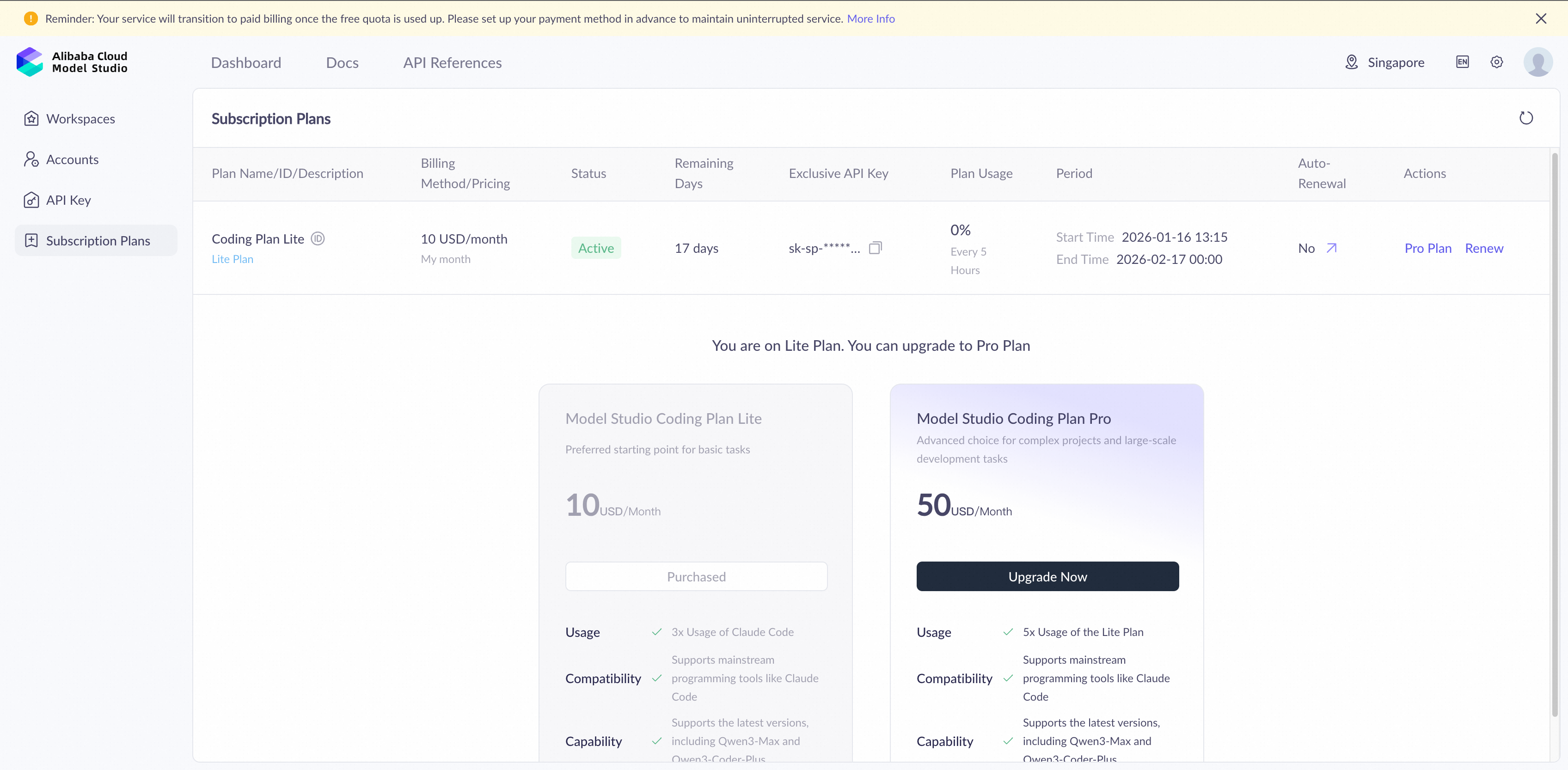
Alibaba Cloud Bailian API interface on a screen, showing integration with third-party coding assistants.
Coding and Visual Agent Applications
Qwen3.6-Plus offers capabilities for front-end development, including complex projects like 3D scenes and games. It can be integrated with OpenClaw, an open-source AI coding agent, for terminal-based agent coding. The model is also compatible with Qwen Code, an open-source AI agent optimized for the Qwen series, designed to assist with code understanding, automation, and delivery. Furthermore, the Qwen API supports the Anthropic API protocol, allowing integration with tools like Claude Code for coding experiences.
For visual agents, Qwen3.6-Plus aims to move from visual perception to multimodal reasoning and agent execution. This includes understanding, generating, and invoking tools based on visual content for tasks like front-end page generation, code completion, and interactive modifications from interface screenshots or design drafts. The model's visual reasoning capabilities have been enhanced for understanding, analyzing, and reasoning based on visual input, supporting tasks such as document understanding, chart parsing, interface understanding, and fine-grained localization.
The model also improves video understanding, processing temporal information, dynamic changes, and cross-frame associations for video analysis and processing scenarios. Visual agent applications, such as GUI Agents, enable models to understand interface states and execute operations based on planning. Combined with workflows involving multi-hop search, CI, and external tool invocation, the model is designed to evolve from single-turn Q&A to a task execution system.
The core of the Qwen3.6-Plus upgrade focuses on making coding agents more reliable and refining developer-centric scenarios for stability and user-friendliness. Future plans include open-sourcing lighter small models and addressing long-range tasks and repository-level complex problems.
Stay Ahead of the AI Curve
Join 50,000+ subscribers getting the latest AI tools, trends, and tutorials delivered to their inbox weekly.
No spam, unsubscribe at any time.