
Alibaba Cloud AI Powers "Smartest" Winter Olympics with Advanced 360-Degree Replay Technology

Chinese AI technology is set to enhance the Milan Winter Olympics in 2026, with Alibaba Cloud's 360-degree real-time replay technology generating cinematic replays within 15 seconds. This innovation aims to transform how audiences experience ice and snow sports by creating "spatiotemporal afterimages" of athlete movements.
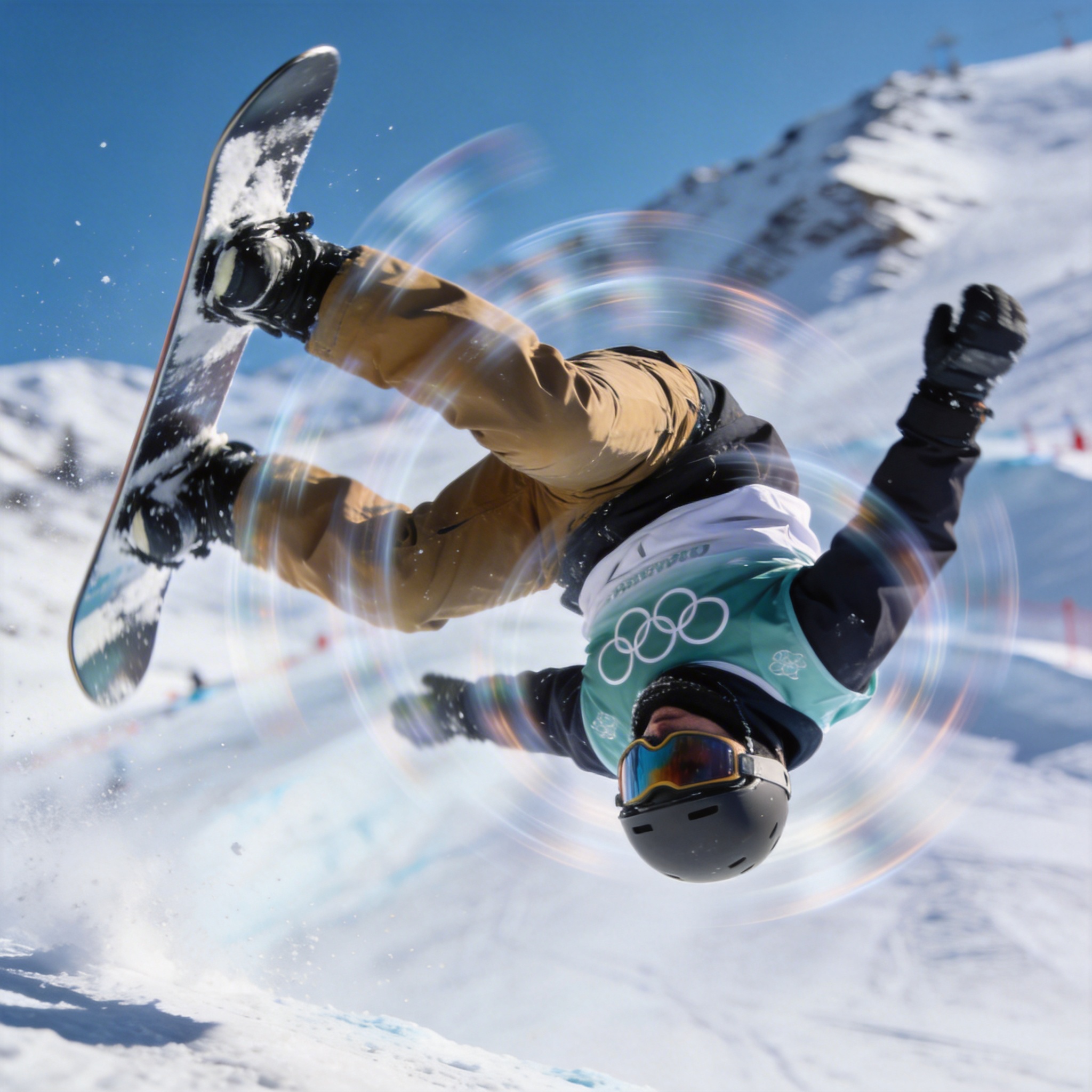
Snowboarder in mid-air with faint 'spatiotemporal afterimages' illustrating a 1980-degree rotation.
During a men's slopestyle final at the Milan Winter Olympics, a replay of a Chinese athlete's 1980-degree rotation showcased this technology. The footage not only provided a 360-degree view of the athlete's aerial posture but also visualized their movement trajectory as frozen "spatiotemporal afterimages" on screen. This effect is generated in real time during broadcasting, leveraging cloud computing to precisely transform complex dynamic moments into high-precision spatial slices and superimposed movement trajectories.
From Spatial Freeze to Temporal Deconstruction
Alibaba Cloud's "360-degree Real-time Replay Technology" represents an evolution from the "bullet time" effect seen at the 2024 Paris Olympics. While bullet time offered a 360-degree panoramic view of an action, the new technology in Milan aims for a deeper narrative dimension by deconstructing movement across time.
The previous 360-degree replay focused on a panoramic presentation within the spatial dimension. The updated technology breaks through temporal barriers, enabling a comprehensive analysis and reconstruction of complete spatiotemporal movement. This approach combines spatial freezing with temporal extension, constructing a composite narrative that first displays the movement path, then freezes a highlight moment, and finally reconstructs key moments from multiple angles.
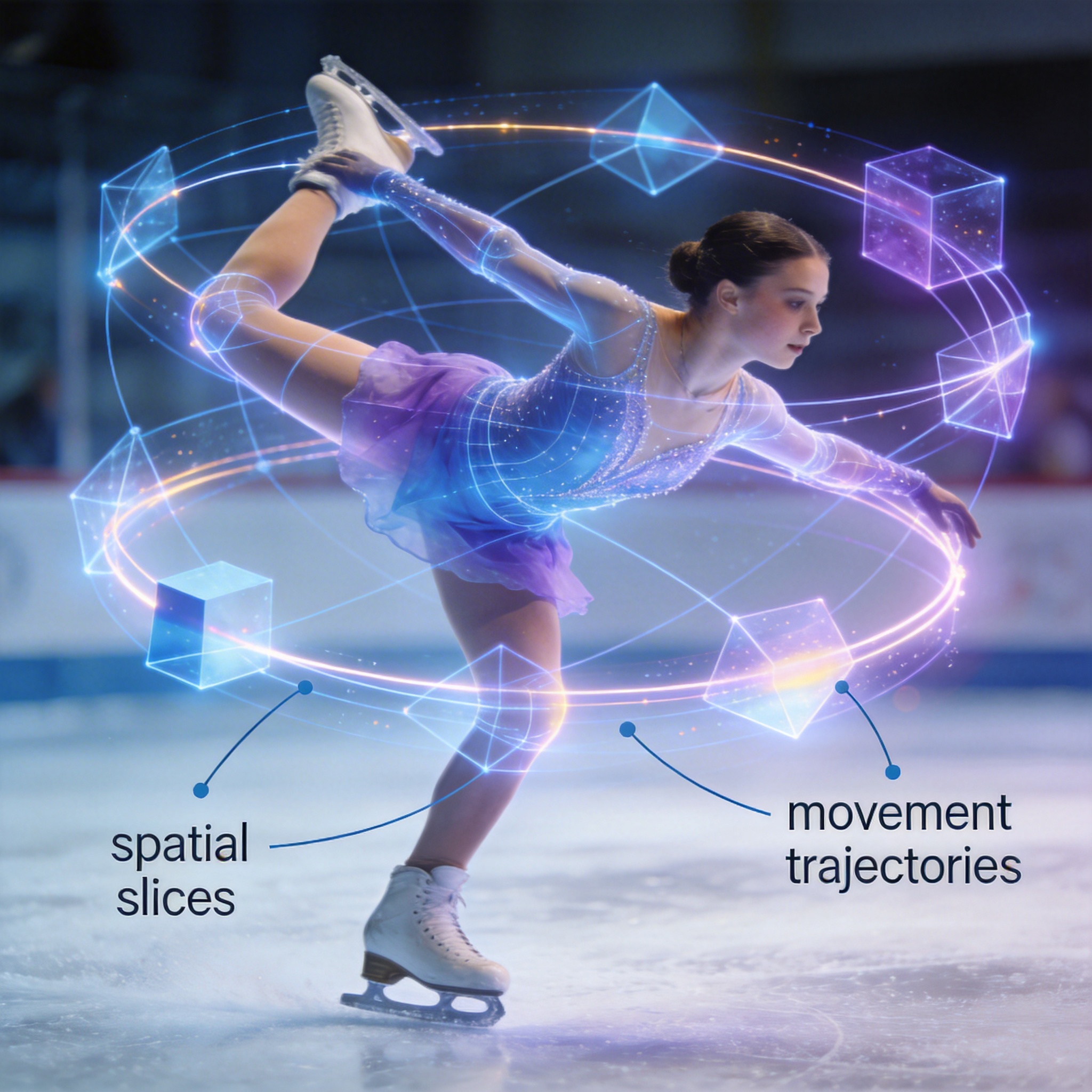
Figure skater with glowing lines and shapes representing spatial slices and movement trajectories.
Through precise slicing of movement trajectories, viewers can observe variable-speed virtual afterimages, dynamically superimposed movement trajectories, and freely switchable spatial perspectives. AI and Spacetime Slices trajectory recognition technology digitally analyze an athlete's entire process from takeoff to landing. This upgrade increases the information density of footage, transforming sports broadcasting from simple recording to deep deconstruction. For instance, in figure skating, time slices record and display an athlete's postures at different moments, visualizing trajectories and dissecting key nodes such as takeoff force, aerial rotation axis, and landing control. This provides an objective technical perspective on complex athletic techniques and mechanical details.
Technical Architecture: 15-Second Cinematic Production
The 360-degree real-time replay technology's core architecture involves four stages. The first stage is multi-camera synchronized acquisition, where arrays of 4K cameras capture key moments with frame synchronization. This AI-driven technology is deployed across 17 competition events in 10 core venues, performing 3D reconstruction within 15-20 seconds to meet live broadcast requirements and pushing content to the Olympic Broadcasting Services (OBS). AI capabilities significantly reduce the number of cameras needed compared to traditional solutions.
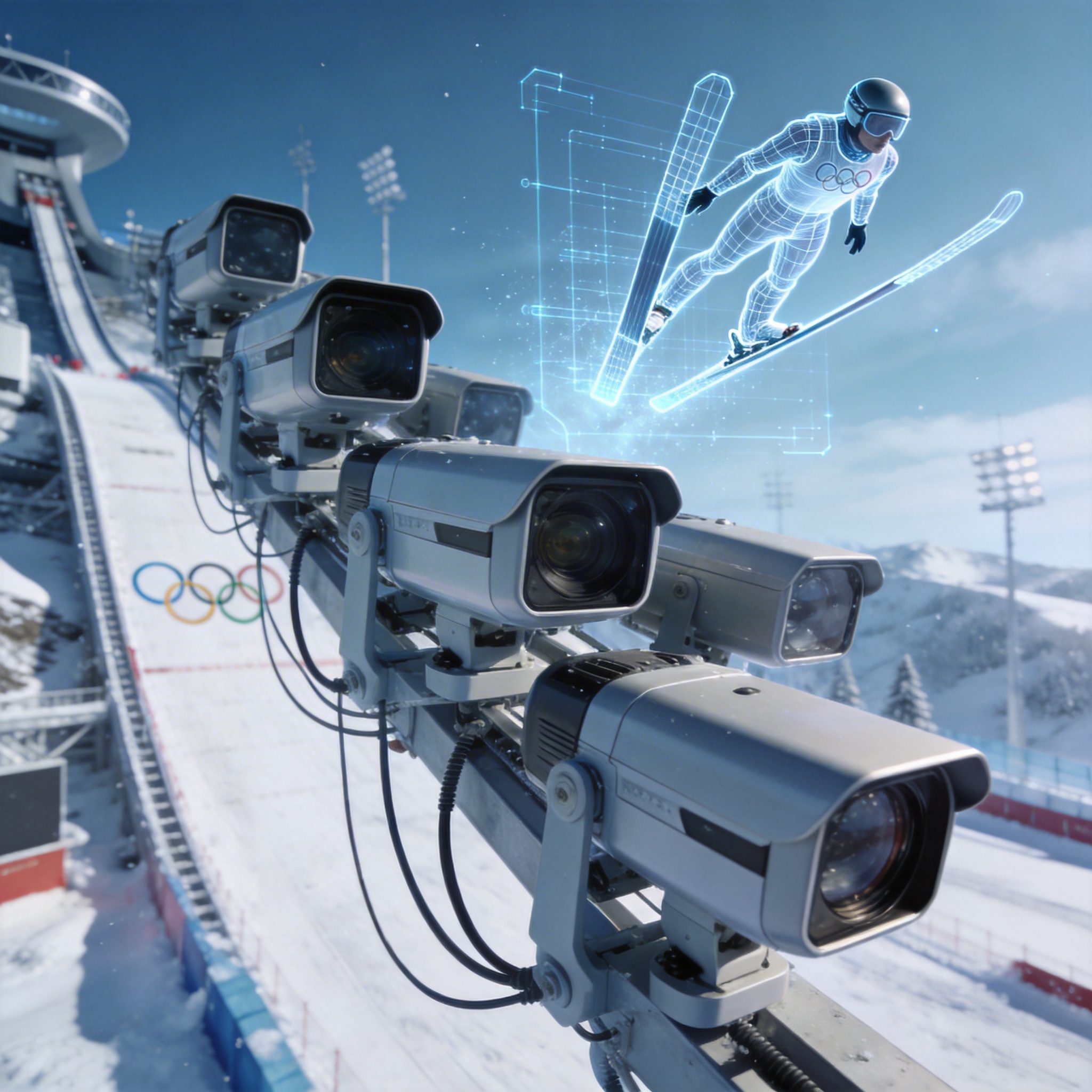
Multi-camera array capturing a ski jumper, with a subtle 3D wireframe overlay showing real-time reconstruction.
The second stage involves real-time cloud upload, where pre-processed footage is sent to the cloud. The third and most critical stage is AI 3D modeling, real-scene matting, data computation, and real-time rendering in the cloud. Cloud computing clusters collaborate to perform:
Real-scene matting: Algorithms separate athletes from complex backgrounds.
AI 3D modeling: Deep learning networks infer volume, curvature, and lighting from 2D images to construct 3D geometric topology.
Trajectory generation: The system calculates and outputs continuous movement trajectories based on the generated 3D digital twin.
Virtual viewpoint rendering: AI renders hundreds of virtual viewpoints in real time from actual footage with low latency.

Abstract cloud computing interface showing AI 3D modeling, matting, and rendering processes.
The final stage is low-latency distribution, where composite compression is applied and the output is pushed to the common signal stream for global broadcasters. This entire process, from material acquisition to final output, including two transmissions, is completed within 15-20 seconds, allowing effects that previously required days of post-production to be presented in real time.
Overcoming Ice and Snow Challenges
Applying 360-degree real-time replay technology to Winter Olympics venues presented unique challenges due to ice and snow. Unlike Summer Olympics venues with rich feature points like lawns and tracks, winter environments feature large areas of pure white and uniform textures, making 3D reconstruction difficult. Traditional visual algorithms, which rely on environmental textures for spatial positioning, struggle when athletes move at high speeds against such backgrounds.
Alibaba Cloud addressed this with a self-developed multi-model fusion algorithm. This AI large model, specifically designed for ice and snow environments, integrates rapid human posture capture, fuzzy prediction of movement trajectories, and spatial structure inference even with minimal feature values. Even against a stark white background, AI can establish a precise 3D coordinate system based on posture estimation and faint data. This multi-model fusion algorithm enabled stable modeling of ice and snow scenes. During the Milan Winter Olympics, this technology will be deployed in core venues, covering over two-thirds of events, including alpine skiing, ski jumping, ice hockey, and figure skating.
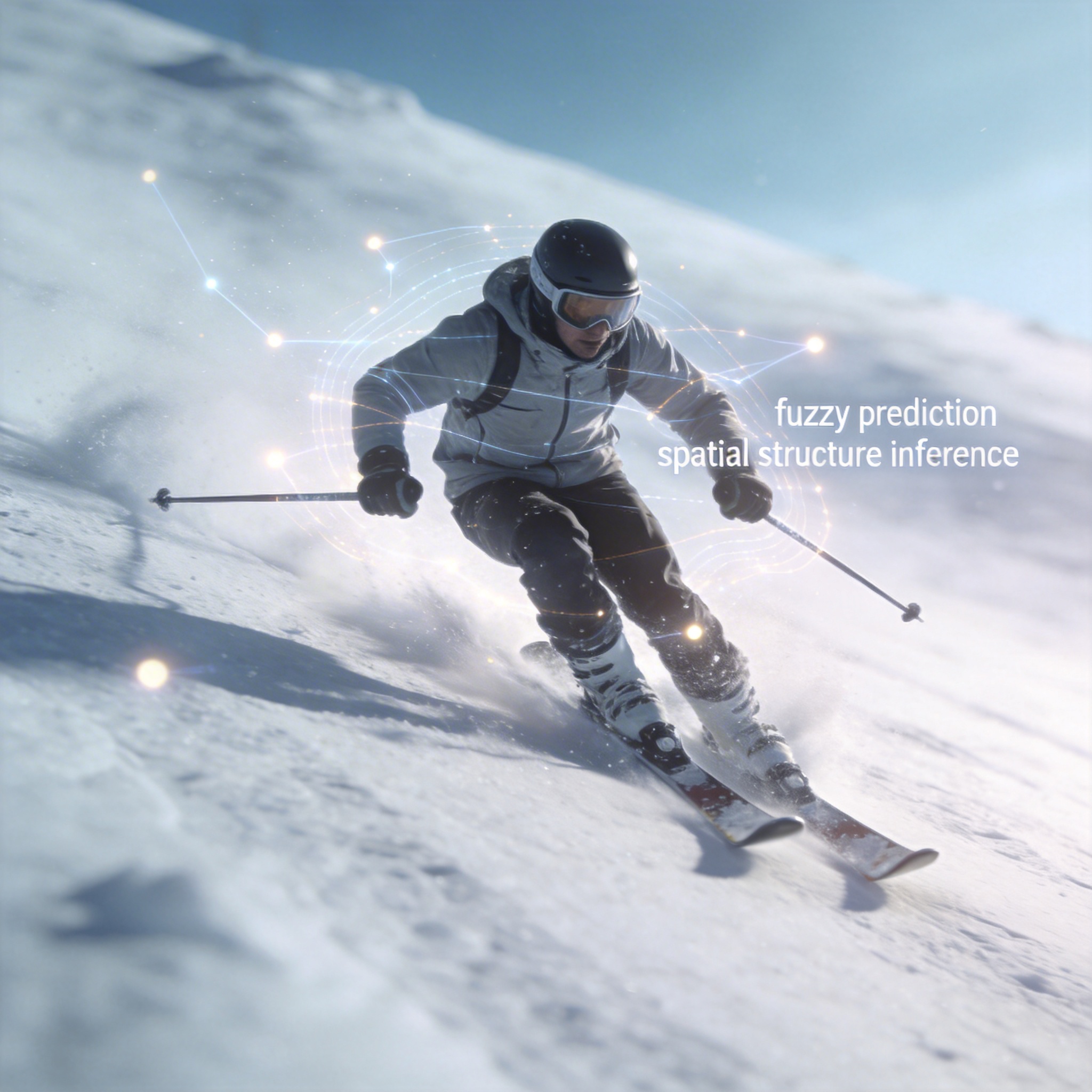
Alpine skier on a white slope, with glowing AI lines showing multi-model fusion algorithm at work.
Integrating Technology and Branding
Beyond broadcast applications, Alibaba Cloud collaborated with the International Olympic Committee on a venue display project. Despite strict "Clean Venues" requirements prohibiting commercial brand exposure, Alibaba Cloud's brand will be present at the Milan Winter Olympics through "Powered by Alibaba Cloud" messaging. Large screens in 13 venues across the four competition zones will daily broadcast highlight compilations produced using the 360-degree real-time replay technology, reviewing previous day's competitions for on-site audiences.
This approach not only upgrades the audience experience but also creates natural technical brand exposure by integrating technology directly into event content, rather than through traditional advertising. This native, technologically aesthetic presentation allows on-site audiences to engage with the events from an AI perspective. This signifies a shift for Chinese technology brands from traditional sponsors to technical definers of events.
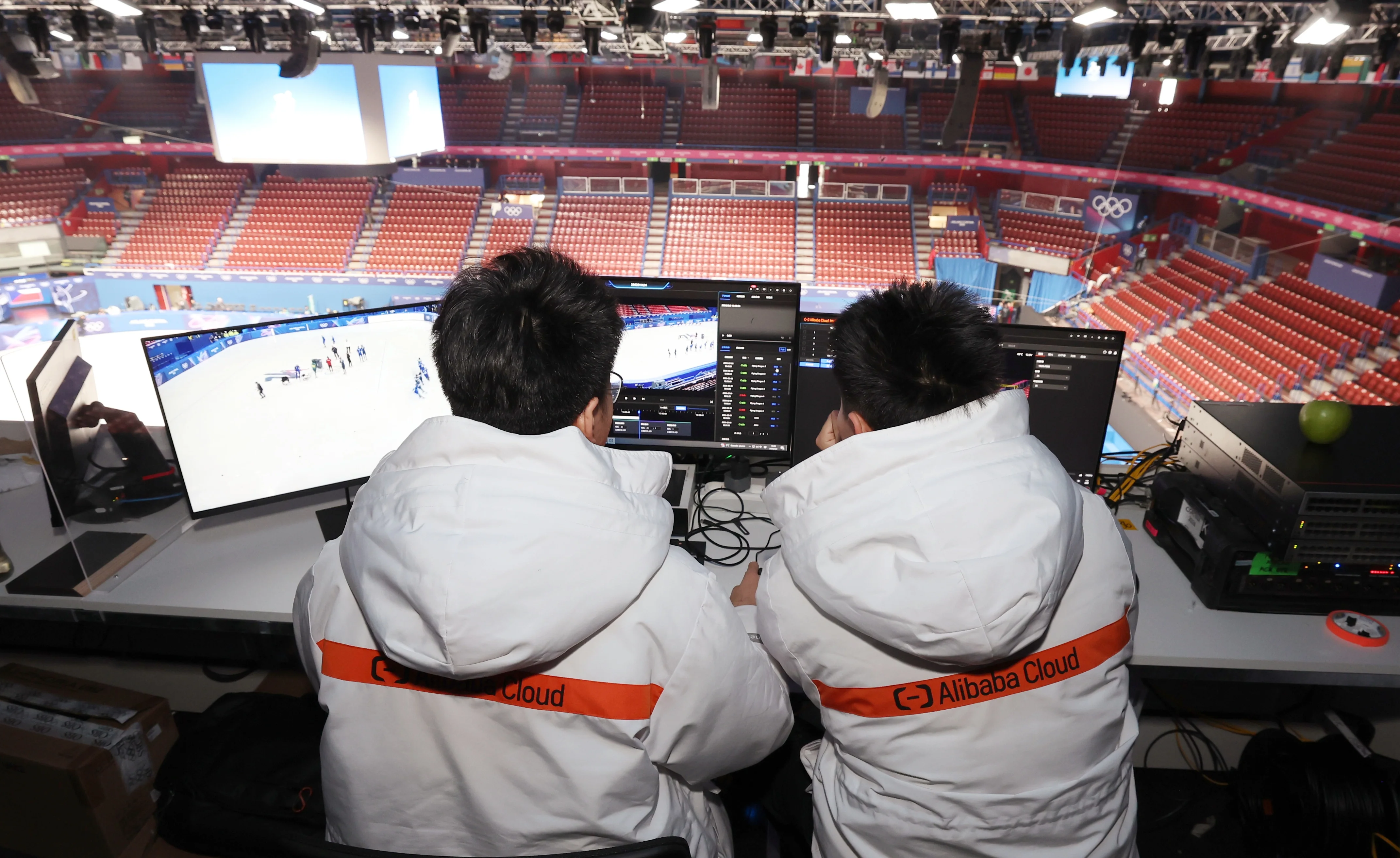
Large screen at Milan Winter Olympics venue displaying sports highlights powered by Alibaba Cloud.
AI Cloud: New Infrastructure for Sports
At the Milan Winter Olympics, technologies like 360-degree real-time replay have been adopted by Olympic Broadcasting Services (OBS) and multiple rights-holding media. An OBS executive noted that Alibaba Cloud has made the Milan Winter Olympics "transparent," reflecting the evolving landscape of event broadcasting. Cloud computing has become the underlying infrastructure for global sports events, with AI serving as the core productivity for broadcast production.
Kirsty Coventry, Chair of the International Olympic Committee, stated that the 2026 Milan Winter Olympics will be the "smartest" Olympic Games in history. Through cloud interfaces, technologies such as 360-degree real-time replay have helped sports broadcasting reduce reliance on heavy traditional hardware, lowering broadcasting thresholds for global media and establishing "full cloudification."
Abstract neural network with integrated sports imagery, symbolizing AI-native broadcasting.
With the maturation of underlying computing power, Alibaba Cloud's technological focus has shifted from basic cloud assurance and video cloud distribution to "AI-native broadcasting." The deep application of AI large models in broadcasting is transforming broadcasting technology from signal transmission to intelligent understanding and generation. Top sports events serve as testing grounds for validating AI large model capabilities. Leveraging multimodal data processing and real-time computing, complex event dynamics can be transformed into intuitive tactical analysis, automated editing, and multi-dimensional visual reconstruction. This set of reusable intelligent solutions makes AI large models a regular production tool in the sports industry, marking a generational upgrade in global event broadcasting technology.
Chinese cloud vendors are not only providing underlying computing power but are also leading in intelligent broadcasting applications based on AI large models, setting standards for serving top global events. The shift from cloud services to AI cloud confirms that underlying cloud computing power is an invisible cornerstone, while AI large models are becoming the "absolute core" and "new infrastructure" defining future sports broadcasting standards and reshaping the event experience. The Milan Winter Olympics represents a significant step for AI large models in reshaping global industries.
Stay Ahead of the AI Curve
Join 50,000+ subscribers getting the latest AI tools, trends, and tutorials delivered to their inbox weekly.
No spam, unsubscribe at any time.