
AI Shifts from Conversational to Task-Oriented Capabilities, Survey Finds


A recent crowdsourced survey on AI development indicates a significant shift in focus from conversational AI to systems capable of performing complex tasks. The survey, conducted on X, gathered insights from 95 individuals who responded to questions about critical technological breakthroughs, impactful products, and emerging trends in AI for 2025 and 2026.
The analysis of 127 comments revealed a consistent theme: terms like "reasoning," "agent," and specific product names such as "Claude Code" and "NotebookLM" appeared frequently, while "chatting" was rarely mentioned. The phrase "getting work done" emerged as a recurring motif, signaling a new direction in AI development.

Minimalist desk with a monitor displaying a task-oriented dashboard, symbolizing AI's shift from chatting to getting work done.
The Rise of Reasoning Capabilities
For 2025, a primary technological breakthrough is anticipated in the engineering implementation of reasoning capabilities. As described by Sanfeng (@3fenglife), this represents a move from "predicting the next word" to "predicting the next action." This evolution suggests AI will perform internal simulations, self-checking, and error correction, embodying what is technically known as System 2 Thinking or test-time scaling. Models like o1, o3, and DeepSeek R1 exemplify this approach.
Ray Zhai (@Cryptoxorz) noted that AI's ability to engage in "slow thinking" and comprehend real-world causality is crucial for its integration into the physical world. Uncle Lan (@LufzzLiz) and Xin (@Xin_Jin1018) highlighted Reinforcement Learning with Verifiable Rewards (RLVR) as a key technology. RLVR allows for automatic verification of answers in tasks like math and coding, reducing the need for manual data labeling and human review.
Another consensus pointed to a cost inflection point, with Rainman (@0xdeusyu) and Robinson (@python_xxt) mentioning the MoE sparse architecture. DeepSeek R1 demonstrated that advanced AI no longer requires prohibitive budgets, making inference costs more accessible. The systematic maturation of Agent systems was also frequently cited. SLiangD (@SLiangD) emphasized that the breakthrough lies in the seamless integration of tool calling, context engineering, and multi-step reasoning, enabling AI to handle complex task chains.

Close-up of a glowing circuit board, symbolizing the engineering implementation of AI reasoning capabilities and System 2 Thinking.
Product Innovations: From Dialog Boxes to Progress Bars
When asked about impressive products for 2025, Claude Code was mentioned over twenty times. G_Z (@GZhan57) described it as "the first general agent that actually works," while Ayi YiOS (@WangYiNotes) noted its collaborative feel, akin to working with a teammate rather than just a tool. Claude Code’s capabilities extend beyond code auto-completion to document retrieval, bug fixing, testing, and deployment.
NotebookLM secured the second spot, praised by Rocky (@Rockybnbtrade) for improving knowledge input efficiency and by Wang Shizilu (@atm13999) for transforming documents into natural podcast conversations. Its value lies in knowledge digestion rather than content generation.
Nano Banana Pro, Google Gemini's image generation feature, was a surprising third. Defyong (@defyong) found its combination of Gemini's perception and knowledge base made image generation less intuitive and more "alive." Steven Qi (@Jason_qeb) highlighted its Chinese language support, enabling text-to-image, image-to-video, and image-to-PPT functionalities.
Video generation tools like Sora, Keling, and Jimeng also received nominations, with cicada (@thebestsetup) singling out Veo/Sora as particularly stunning. JCat (@JackyisThinking) predicted significant maturation in video generation by 2026, impacting the film and television industry, particularly in low-cost special effects and animation.
Spatial intelligence was another frequently mentioned direction. JCat (@JackyisThinking) explained its necessity for robotics, requiring higher-level 3D spatial recognition, understanding, and reasoning. Ray Zhai (@Cryptoxorz) and suwakopro (@suwakopro) discussed "world models," emphasizing AI's need to comprehend real-world causality and physical rules beyond text and images. Xiaozhouzhou's AI Daily (@LZhou15365) observed rapid advancements in embodied AI, noting increasingly human-like gait and actions.
Sanfeng (@3fenglife) summarized the product shift, stating that the "dialog box" is being replaced by the "progress bar," indicating silent background task completion. Ray Zhai (@Cryptoxorz) termed this experience "perception disappears, efficiency doubles," marking a significant change in product form for 2025.
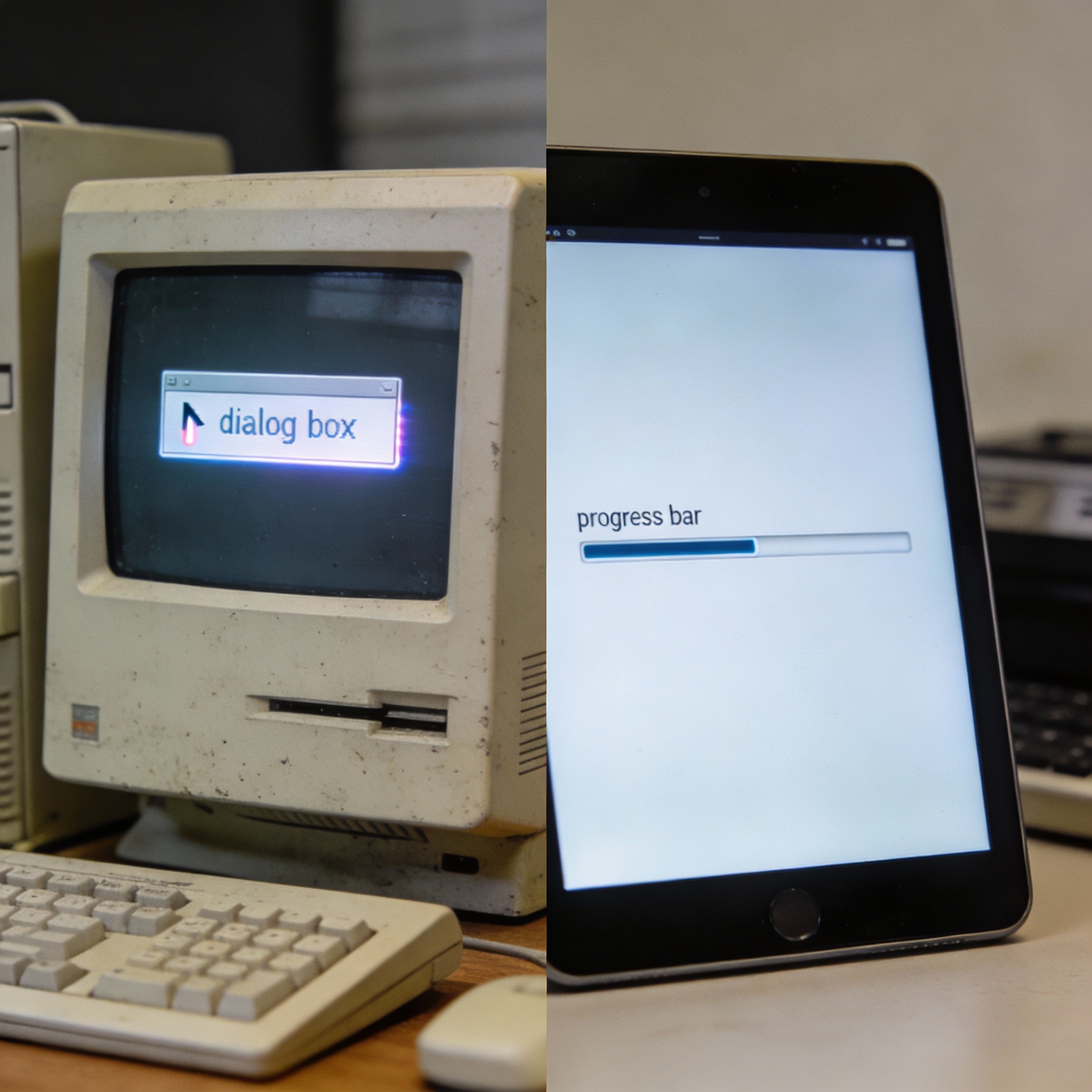
Split image showing a vintage dialog box on one screen and a modern progress bar on another, symbolizing AI product evolution.
2026 Roadmap: Defining Problems for AI
The consensus for 2026 trends centered on the large-scale adoption of Agents. Over a third of respondents foresee AI evolving beyond answering questions to decomposing tasks, calling tools, executing steps, and delivering results. Ray Zhai (@Cryptoxorz) envisioned users managing an "AI fleet" that autonomously divides labor, self-corrects, and stores data. This transition implies a shift from "teaching AI how to do it" to "telling AI what I want."
SLiangD (@SLiangD) used the Golden Circle framework to distinguish human and AI roles: "Why" (purpose) and "What" (objective) remain human domains, while "How" (execution) will be fully automated by machines. This suggests future competitiveness will hinge on problem definition rather than AI usage skills.
Embodied AI was the second consensus. Mashang Ying (@InnaLyceyum) predicted Agents integrated into smart hardware, from glasses to robots, gaining spatial perception and physical interaction. Ayi YiOS (@WangYiNotes) suggested that by 2026, AI will be embedded throughout operating systems and hardware.
The third consensus focused on AI's "personalization" and "memorization." Cunningham Card (@Card198454) highlighted breakthroughs in memory, enabling Agents to develop human-like social attributes and evolve into personalized digital assistants. Sanfeng (@3fenglife) predicted the demise of SaaS, replaced by "Service" subscriptions where users pay for results rather than software.
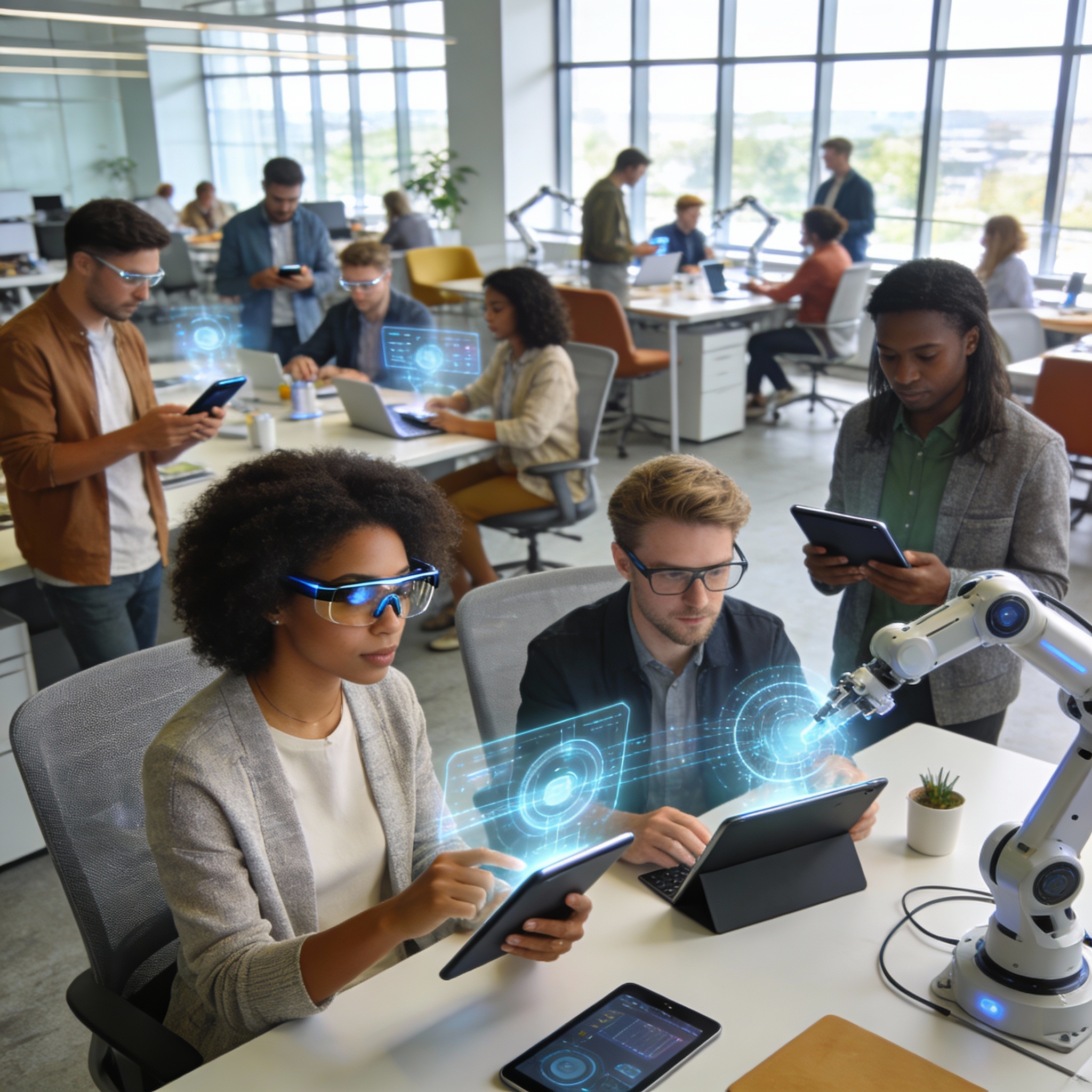
Diverse group of people interacting with various smart devices in a modern workspace, symbolizing the widespread adoption of embodied and personalized AI.
While optimism was prevalent, some dissenting voices emerged. Michael Guo (@Michaelzsguo) suggested 2025 saw performance improvements rather than critical technological breakthroughs. Tony Lee (@lee810860) predicted an acceleration of AI vendor bankruptcies, and Xiong Bulang (@Stephen4171127) noted the absence of an "inevitable path." These perspectives serve as a reminder that consensus does not equate to correctness.
Conclusion
AI's evolution has entered a new phase. The focus has shifted from model intelligence to task accomplishment. This paradigm change, from "being able to speak" to "being able to do," and from "outputting text" to "delivering results," marks a significant milestone. As Roland (@Roland_WayneOZ) and SLiangD (@SLiangD) concluded, 2025 is the year AI learns to get work done. The successful entities of 2026 will be those adept at defining problems, not merely using AI.
Stay Ahead of the AI Curve
Join 50,000+ subscribers getting the latest AI tools, trends, and tutorials delivered to their inbox weekly.
No spam, unsubscribe at any time.